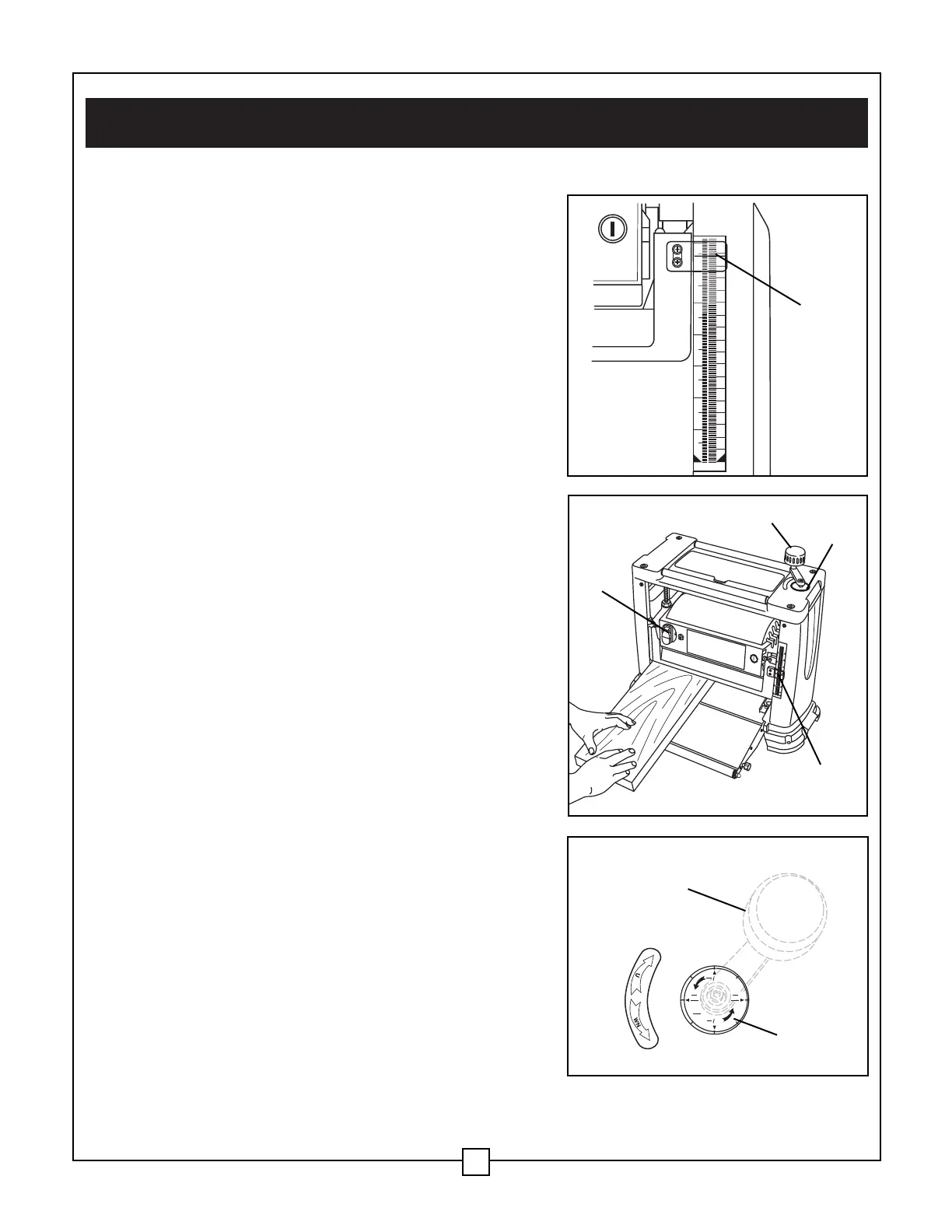
Setting the planing depth (Fig. 9 – 11)
Establish the starting point before attempting to plane
the surface. The depth of the cutter head contact with
the workpiece should only be enough to brush the
surface. DO NOT set the cutter head too deep.
Measure the workpiece at its thickest point. Use the
measurement scale (1) at the feed side of the planer to
approximate the starting point of the first pass. Your first
attempt at planing is intended to brush the surface.
It is good practice to measure the workpiece after every
planing operation.
1. Turn the power switch (2) to the ON position.
2. Slowly guide the workpiece along the workpiece
guides into the planer. If the cutter head makes
contact with the workpiece, back the workpiece out
and raise the cutter head using the cutter head
depth adjustment handle (3).
3. Repeat the step of slowly guiding the workpiece
along the guides into the planer, rotating the cutter
head adjustment handle in increments of 1/8 of a
turn or less in order to lower the cutter head until it
just brushes the surface of the workpiece. This will
establish the starting point for the next pass.
4. Use the cutter head depth adjustment scale (4) to
determine the desired amount to plane. The planer
will automatically feed the workpiece into and out of
the cutter head. Do not force the planer to work
faster than it is designed to work. Damage to the
workpiece and the planer can result.
Remember, planing should be done in steps in order to
achieve the final planing thickness. If the thickness is to
be reduced by 1/4" (6.4 mm), 1/8" (3.2 mm) should be
removed from each side. Measure the workpiece after
every planing operation.
VII. Operation (continued)
18


 To Next Page