WHERE SMOKE ALARMS SHOULD BE PUT
IN MOBILE HOMES
In mobile homes built after about 1978 that were designed and
insulated to be energy-efficient, smoke alarms should be installed as
described in the section above.
In older mobile homes that have little or no insulation compared to
today's standards, uninsulated metal outside walls and roofs can
transfer heat and cold from outdoors, making the air right next to
them hotter or colder than the rest of the inside air. These layers of
hotter or colder air can prevent smoke from reaching a smoke alarm.
Therefore, put smoke alarms in such units only on inside walls,
between 4 and 12 inches (10 and 30 cm) from the ceiling. If you are
not sure about the insulation level in your mobile home, or if you
notice that the walls or ceiling are unusually hot or cold, put the
smoke alarm on an inside wall.
Minimum protection requires one smoke alarm as close to the
sleeping area as possible. For better protection, put one smoke
alarm in each room, but first read the "Locations to Avoid."
LOCATIONS TO AVOID
Nuisance alarms are caused by placing smoke alarms where they
will not operate properly. To avoid nuisance alarms, do not place
smoke alarms:
• In or near areas where combustion particles are normally
present such as kitchens; in garages where there are particles
of combustion in vehicle exhausts; near furnaces, hot water
heaters, or gas space heaters. Install smoke alarms at least 20
feet (6 meters) away from kitchens and other areas where
combustion particles are normally present.
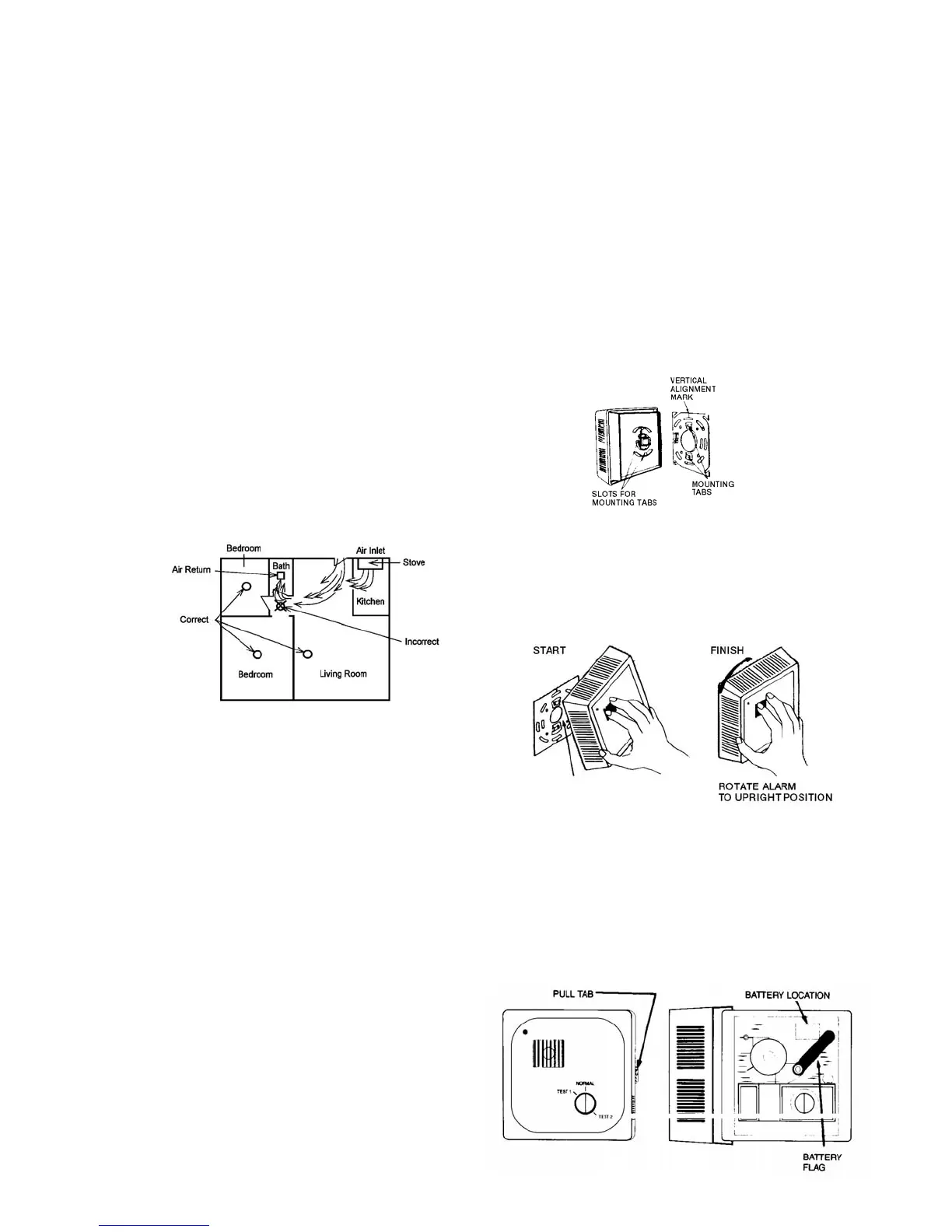
• In air streams passing by kitchens. Figure 7 shows how a
smoke alarm can be exposed to combustion particles in normal
air movement paths, and how to correct this situation.
WARNING: Never remove battery from the smoke alarm to silence a
nuisance alarm. Open a window or fan the air around the smoke
alarm to remove the smoke. The smoke alarm will automatically turn
off when the smoke in the air is completely gone. Do not stand close
to the smoke alarm. The sound produced by the smoke alarm is loud
because it is designed to awaken you in an emergency. Prolonged
exposure to the horn at a close distance may be harmful to your
hearing.
INSTALLATION 380 SERIES
CAUTION: New Construction: DO NOT attach smoke alarm head
until AFTER sanding, insulation, painting, and other dust creating
situations are finished and cleaned up.
MOUNTING: PLATE & SMOKE ALARM
1. Remove the mounting plate from the back of the smoke alarm
by rotating it counter-clockwise until plate unsnaps.
2. Mount plate to either the wall or ceiling, see "Mounting
Location" instructions. If smoke alarm is to be placed on the
wall, mount plate so the snap-in tabs are in a vertical position.
NOTE: PLATE IS MARKED "THIS SIDE OUT" FOR PROPER
MOUNTING.
Pg. 3-4
Figure 7
3. To use the supplied screw anchors, drill two 3/16" holes, insert
the screw anchors, and mount the plate to wall using the supplied
screws.
4. Place the smoke alarm up to the mounting plate, rotating it to
about 10:00 o'clock then rotate it clockwise to 12:00. It should
"snap-lock" firmly into place. Keep the smoke alarm parallel to
the mounting plate so upper and lower tabs on the plate seat into
the smoke alarm.
• In damp or very humid areas, or next to bathrooms with showers.
The moisture in humid air can enter the sensing chamber as water
vapor, then cool and condense into droplets that cause a nuisance
alarm. Install smoke alarms at least 10 feet (3 meters) away
from bathrooms.
• In very cold or very hot environments, or in unheated buildings
or outdoor rooms, where the temperature can go below or above
the operating range of the device. Temperature limits for proper
operation are 40° to 100°F (4.4° to 37.8°C).
• In very dusty or dirty areas. Dust and dirt can build up on the
smoke alarm's sensing chamber and can make it overly sensitive,
or block openings to the sensing chamber and keep the smoke
alarm from sensing smoke.
• Near fresh air inlets or returns or excessively drafty areas.
Air conditioners, heaters, fans, and fresh air intakes and returns
can divert smoke away from smoke alarms, making the devices
less effective.
• In dead air spaces at the top of a peaked roof or in the
corners between ceilings and walls. Dead air may prevent
smoke from reaching a smoke alarm. See Figures 5 and 6 for
recommended mounting locations.
• In insect-infested areas. If insects enter a smoke alarm's
sensing chamber, they may cause a nuisance alarm. Get rid of
the bugs before installing smoke alarms where bugs are a
problem.
• Near fluorescent light fixtures. Electrical "noise" from nearby
fluorescent light fixtures may cause a nuisance alarm. Install
smoke alarms and fluorescent lights on separate electrical
circuits.
BATTERY INSTALLATION
1. Once smoke alarm is mounted, the cover can be opened by using
the pull tab located on right side of cover.
2. Use a fresh 9 volt Duracell MN 1604 battery, connect it to
terminals located near upper right-hand corner inside the smoke
alarm after first resetting battery removal flag back to its stand-by
condition.
3. Re-close smoke alarm by snapping cover shut.
4. After battery has been installed or replaced, test smoke alarm. To
test smoke alarm, follow procedures under CHECKOUT &
TROUBLESHOOTING Section of this manual.



 To Next Page
 Loading...