4. Add 1/8 cup of Ivory dishwashing liquid to the first bucket of water
and allow it to mix thoroughly, then place one dirty smoke alarm
into the soap water mixture until it becomes completely covered or
submerged. NOTE: If the smoke alarms are exceptionally dirty,
you may wish to first wipe off any excess dirt before washing
smoke alarm so as not to dirty the wash water too quickly.
DO NOT open smoke alarm for cleaning. IF SMOKE ALARM IS
OPENED DURING CLEANING, PRODUCT WARRANTY BECOMES
VOID.
WARNING: ONLY IVORY DISHWASHING LIQUID IS TO BE USED.
OTHER BRANDS ARE NOT RECOMMENDED AND
MAY CAUSE YOUR SMOKE ALARM TO
MALFUNCTION.
5. Allow smoke alarm to soak for approximately 10 minutes (longer if
extremely dirty). Then agitate for 5 or 10 seconds to flush out
any remaining dirt left inside smoke alarm's housing.
6. Remove smoke alarm from wash water and transfer directly to
one of the first rinse buckets containing clear water. Again,
allowing smoke alarm to become completely submerged, agitate
once more for 5 or 10 seconds to remove soap residue.
7. Finally, transfer smoke alarm to your second and final rinse
bucket, repeating method found in Step 6, then remove smoke
alarm to a clean dry area for a period of 48 hours to allow it to
thoroughly dry.
8. Install battery into the smoke alarm, mount the unit and repeat
test procedure to verify proper operation.
WARNING: SMOKE ALARMS ARE TO BE AIR DRIED ONLY. DO
NOT PLACE SMOKE ALARM IN OVEN, MICROWAVE OR USE A
HOT AIR BLOWER TO ACCELERATE DRYING TIME. THIS
COULD RESULT IN DAMAGE TO YOUR SMOKE ALARM.
IMPORTANT: IT IS RECOMMENDED TO CHANGE WASH AND
RINSE WATER AFTER FIVE (5) SMOKE ALARMS. IF YOUR
UNITS ARE EXTREMELY DIRTY, WATER SHOULD BE CHANGED
MORE FREQUENTLY.
WARNING: If the smoke alarm does not work properly, do not try and
fix it yourself. This will void your warranty. See "To Return a Smoke
Alarm" for instructions to return smoke alarms that do not operate
properly. DO NOT TRY TO FIX IT YOURSELF.
WARNING: Smoke alarms are not to be used with detector
guards unless the combination has been evaluated and found
suitable for that purpose.
FAILURE TO REGULARLY CLEAN THIS SMOKE ALARM WILL
RESULT IN FALSE ALARMS. A BUILD UP OF DUST CREATES AN
OBSCURATION THAT SIMULATES SMOKE. THIS MEANS THE
UNIT WILL GO INTO ALARM WITHOUT A FIRE CONDITION.
TO RETURN A SMOKE ALARM
Should you experience problems with your smoke alarm, proceed
as follows:
1. Twist the smoke alarm counter-clockwise to remove it from its
mounting plate.
2. Remove the battery from the smoke alarm and snap the cover
back to the closed position.
3. Carefully pack (the manufacturer cannot be responsible for
consequential damage) and return to the manufacturer. Include
complete details as to exact nature of difficulties being
experienced and date of installation.
Return to: MasterGuard Corporation, 801 Hammond Street,
Suite 200, Coppell TX 75019
CHECKOUT & TROUBLESHOOTING
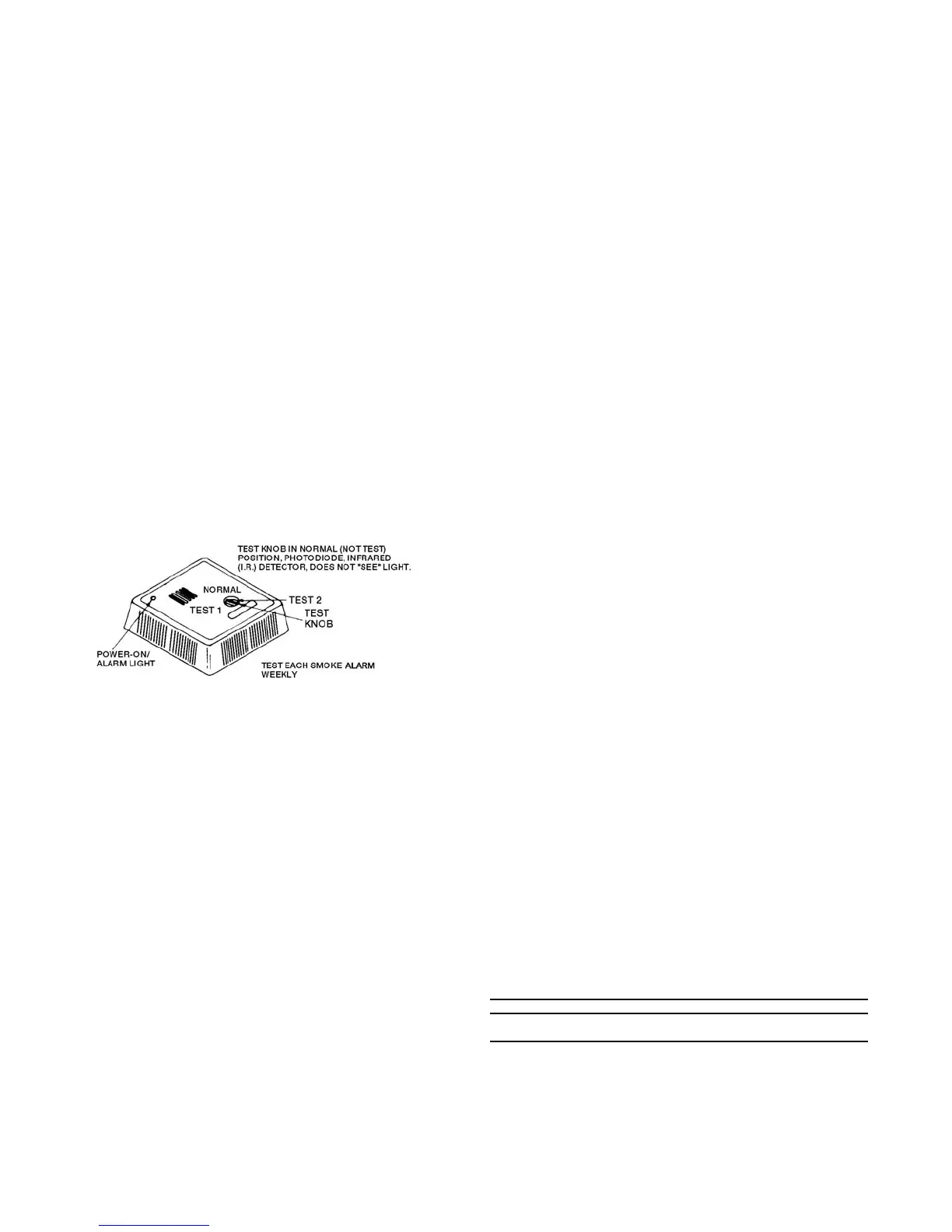
1. Testing with the Test Knob:
a. Rotate the test knob counter-clockwise to the TEST 1 position
and wait up to 20 seconds for the alarm to sound. If the smoke
alarm does not sound after 20 seconds, check the battery
connection. If the battery is good but the alarm does not sound,
return the smoke alarm to the manufacturer for service. See "To
Return a Smoke Alarm."
b. After successfully testing the smoke alarm, return the test knob
to NORMAL (non-test) position and wait 20 seconds for the
smoke alarm to stop sounding.
c. To test smoke alarm for high sensitivity, turn test knob clockwise
to TEST 2 position. Smoke alarm should remain silent. Make
sure to return test knob back to its normal position. If your
smoke alarm sounds during this test it means the smoke alarm's
sensitivity has become too high and may cause false alarms.
This could mean your smoke alarm is dirty and should be
cleaned as described in the maintenance procedure below. If
the smoke alarm continues to alarm for TEST 2 position
following cleaning return it to MasterGuard for service.
d. To check for proper smoke entry into your smoke alarm's
sensing chamber. MasterGuard recommends using the
Home Safeguard Smoke Spray or CHEKKIT® SMOKE Detector
Tester from SDI . This test should be performed once a year
and should be sprayed from a distance no closer than 12 inches
from smoke alarm.
IMPORTANT: The test knob is not an electrical switch, nor is it
connected in any way to the smoke alarm. Therefore, when you test
with the test knob, you are actually simulating a smoke
condition in the smoke alarm, as well as testing the sensitivity of the
photodiode and the circuit between the photodiode and the alarm.
e. Turn test knob to the NORMAL position. The red indicator light
should flash every 30 seconds, showing that the smoke alarm
has power.
f. If the red light is not flashing, check the battery connection. If
the battery is good but the red light does not flash, return the
smoke alarm for service.
MAINTENANCE
Your 380 Series smoke alarm is equipped with a weak battery
indication, which will sound a BEEP every 30 seconds, when the
battery needs replacing.
This trouble signal will last for a minimum of 7 days.
After your smoke alarm has been in operation for a period of time
or if it was installed prior to the completion of all building construction,
your smoke alarm may have become more sensitive due to dirt
build-up in the smoke alarm's optic sensing chamber which could
cause nuisance alarms or could cause activation from small amounts
of smoke build-up.
If this should occur, following this simple washing procedure will
restore your smoke alarm back to its original condition.
For further information, regarding frequency of cleaning and
testing, refer to NFPA 72, NFPA, Batterymarch Park, Quincy, MA
02269.
IMPORTANT: Failure to follow full cleaning instructions could
result in damage to this smoke alarm. DO NOT remove all
smoke alarms at the same time for cleaning.
1. Remove battery from the smoke alarm.
2. Twist the smoke alarm counter-clockwise to remove it from its
mounting plate.
3. Select three (3) standard size wash buckets and fill them each
with one gallon of normal tap water (distilled or de-ionized
treated water is recommended as a final rinse if water is
extremely hard in your area).
ELECTRICAL SPECIFICATIONS
MODELS 380 SERIES
OPERATING VOLTAGE 9 VDC
STANDBY CURRENT (AVG.) . . . .015 mA
ALARM CURRENT (MAX.) . . . . . 9 mA
THERMAL RATING (T OPTION) . . 135°F
OPERATION
TEMPERATURE . . . . . . . . . . . . . 40°F-100°F (4.4°C-37.8°C)
HUMIDITY . . . . . . . . . . . . . . . . . 10%-93%
BATTERY OPERATED MODELS SHOULD USE DURACELL MN
1604.
CAUTION: CONSTANT EXPOSURE TO HIGH OR LOW
TEMPERATURE OR HIGH HUMIDITY MAY REDUCE
BATTERY LIFE.
Pg. 3-5



 To Next Page
 Loading...