Need help?
Do you have a question about the Matrix COSEC PATH DCFE and is the answer not in the manual?
Lists precautions for installing the device safely.
Details warnings for installation and usage by qualified technicians.
Describes different variants of the COSEC PATH controller and reader.
Lists all components provided in the product package.
Lists necessary tools and software for installation and configuration.
Details the process for installing the device with concealed wiring.
Explains how to install the device with non-concealed wiring.
Explains the meaning of different LED status lights on the device.
The COSEC PATH is a compact door controller designed for access control and time-attendance applications. It functions as a versatile device that can operate either as a standalone door controller or as a reader connected to a central COSEC server or ARC controller. This flexibility allows it to be integrated into various security infrastructures, from single-door setups to large-scale multi-door systems.
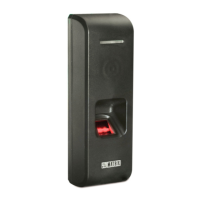
As a door controller, the COSEC PATH manages access to a single door, processing credentials, controlling the door lock, and logging events. It supports multiple credential types, including RF cards and fingerprints, offering a secure and convenient way for users to gain entry. The device features an LED indicator for status feedback, an RF card sensor for card-based authentication, and a fingerprint sensor for biometric verification. It can be connected to an external reader for two-way access control or used as a standalone unit for single-door entry. The COSEC PATH door controller variants, such as DCFE, DCFM, DCFI, DCCE, DCCM, and DCCI, indicate support for different card technologies like EM Prox, MIFARE®, and HID iCLASS.
When configured as a reader, the COSEC PATH works in conjunction with a COSEC Door Controller or a COSEC ARC Controller. In this setup, the reader captures credential data (card or fingerprint) and transmits it to the main controller for processing and decision-making. This distributed architecture is common in larger access control systems where multiple entry points are managed by a central unit. The reader variants, RDFE, RDFM, RDFI, RDCE, RDCM, and RDCI, also correspond to the supported card technologies.
The COSEC PATH offers two primary installation methods: concealed wiring and non-concealed wiring. Concealed wiring involves drilling holes in the wall for mounting and routing cables through a rectangular opening, providing a clean and integrated look. Non-concealed wiring utilizes a duct box base plate and top cover, allowing for easier cable management and installation on surfaces where concealed wiring is not feasible. Both methods ensure secure mounting of the device.
For usage, the COSEC PATH is designed for straightforward operation. Users present their RF card to the sensor or place their finger on the fingerprint sensor for authentication. The LED indicator provides visual feedback on the device's status, such as power on, online, offline, or degraded mode, helping users and administrators quickly understand its operational state.
Connecting the COSEC PATH to a COSEC server is essential for managing users, configuring access policies, and retrieving event logs. The device can be connected as a "Direct Door" via an Ethernet switch, where it communicates directly with the COSEC Application Server. Alternatively, in a "Panel Door" setup, multiple COSEC PATH devices can connect to a COSEC Panel via RS-485, and the panel then communicates with the COSEC Application Server via an Ethernet switch. This allows for scalable deployments, supporting up to 32 devices per panel and up to 255 panels in a larger system.
Assigning an IP address and configuring other network settings is done through a web browser interface. By entering the device's default IP address (http://192.168.50.1) into a browser, administrators can access the login page, where they enter default credentials (Username: Admin, Password: 1234). From there, they can navigate to the Network tab to configure settings such as the device's IP address and the server's IP address, ensuring proper communication within the network.
Maintenance features for the COSEC PATH primarily involve ensuring proper installation and environmental conditions. The device is designed for indoor use within specified operating temperatures and humidity ranges. It is crucial to install the device on a stable surface, away from ferromagnetic fields, noise, static electricity, volatile inflammable materials, and volatile/inflammable gases to prevent damage or malfunction. Installation and servicing should only be performed by qualified technicians, as there are no user-serviceable parts inside, and opening the device cover can expose users to electric shock or other hazards. The product is intended to be used only for its designed purpose.
The COSEC PATH also incorporates features like tamper detection, which can alert administrators to unauthorized attempts to open or remove the device, enhancing security. A built-in buzzer provides audible feedback for various events, and two tri-color LEDs offer detailed status indications. The device's robust design and adherence to safety instructions contribute to its reliable operation and longevity within an access control system. In terms of end-of-life, the product is covered by the WEEE directive, meaning it must be disposed of responsibly through recyclers, and Matrix offers assistance through its Return Material Authorization (RMA) department if users cannot dispose of products or locate e-waste recyclers.
 General
| Model | COSEC PATH DCFE |
|---|---|
| Type | Door Controller |
| Connectivity | Ethernet, RS-485 |
| Communication | TCP/IP, RS-485 |
| Power Supply | 12V DC, 1A |
| Tamper Detection | Yes |
| CPU | 32-bit RISC processor |
| Door Relay | 1 |
| Auxiliary Output | 2 |
| Operating Temperature | 0°C to 50°C |
| Supported Doors | 1 |
| Supported Events | Access Granted, Access Denied, Door Forced Open |

 To Next Page