Need help?
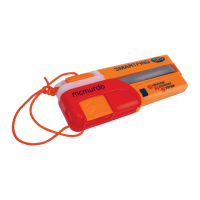
Do you have a question about the mcmurdo SMARTFIND E5 and is the answer not in the manual?
Explains the pre-programmed identity of an EPIRB and the importance of registration.
Details the process of completing and submitting registration forms for the EPIRB.
Information on completing the warranty form and obtaining a radio licence for the EPIRB.
Procedure for updating registration when the EPIRB is sold or transferred to a new vessel.
Specific registration requirements for EPIRBs in the Oceania region.
Details the manually activated EPIRB's bulkhead mounting bracket and its features.
Explains the automatically activated EPIRB's float-free enclosure and HRU mechanism.
Describes the manual activation switch, tear-off seal, and test button functions.
Explains how the sea switch activates the EPIRB automatically when immersed in water.
Explanation of Strobe, Red, and Green LED indicators for status and self-test results.
Details the audible feedback provided by the EPIRB's buzzer for alerts and tests.
How the EPIRB functions automatically and should be handled when a vessel sinks.
Procedure for releasing and deploying the EPIRB when abandoning a sinking vessel.
How the GPS receiver determines position and what affects its performance.
Instructions for detaching the EPIRB from its bulkhead bracket or float-free enclosure.
Steps for manually activating and deactivating the EPIRB in emergency or error situations.
Procedures for re-installing the EPIRB into its bulkhead bracket or float-free enclosure.
Procedure to notify authorities and prevent unnecessary rescue operations for false alerts.
Steps to correctly deactivate and secure the EPIRB after an unintended activation.
Methods to suppress signals from a faulty EPIRB that cannot be turned off.
Guidance on selecting an appropriate location for mounting the bulkhead bracket.
Steps for securely attaching the bulkhead bracket to a flat surface.
Instructions for positioning the safety instruction plate near the EPIRB.
Choosing an optimal location for the enclosure to ensure proper float-free deployment.
Steps for mounting the enclosure and ensuring correct fit for automatic release.
How to mark the expiry date of the Hydrostatic Release Unit (HRU) on the enclosure.
Procedure for marking the vessel name on the EPIRB and enclosure labels.
Performing monthly self-tests and visual inspections to ensure EPIRB readiness.
Step-by-step guide for running the basic EPIRB self-test routine.
Alert indicating unnecessary battery drain if the TEST button is held.
Testing the GPS receiver's performance and position acquisition capabilities.
Visual checks for damage to the EPIRB, lanyard, sea switches, and antenna.
Instructions for replacing the Hydrostatic Release Unit (HRU) before its expiry date.
Information on battery expiry, replacement by authorized agents, and safe disposal.
Where and how to get the EPIRB serviced by approved agents.
Information regarding the classification and shipping of EPIRB battery packs.
Details on regulatory inspections for vessels subject to GMDSS.
Detailed specifications for transmitters, GPS, strobe, battery, environment, and physical characteristics.
Statements confirming the EPIRB's compliance with relevant EU directives and standards.
 General
| Type | EPIRB |
|---|---|
| Frequency | 406 MHz |
| Secondary Frequency | 121.5 MHz |
| GNSS | Yes |
| Battery Life (Shelf) | 10 years |
| Waterproof | Yes |
| Floatation | Yes |
| Strobe Light | Yes |
| Operating Temperature | -20°C to +55°C |
| Activation | Automatic and Manual |
| Dimensions | 89 x 94 x 221 mm |

 To Next Page