
 Need help?
Do you have a question about the McQuay LMS and is the answer not in the manual?
Explains the designation for different design series of the units.
Details the numerical codes for unit capacities in BTUs.
Lists available coil options for unit configuration.
Specifies voltage codes for unit power supply.
Provides a key to model codes based on features and range.
Guidance on selecting and preparing the installation site for optimal performance and service.
Step-by-step guide for adjusting variable pitch motor sheaves for proper airflow.
Proper methods for installing condensate drain piping and traps.
Procedures and checks for successful unit operation in cooling mode.
Procedures and checks for successful unit operation in heating mode.
Troubleshooting common problems encountered during initial unit startup.
Specifies the acceptable ambient and water temperature ranges for operation.
Details water enthalpy values for different operating conditions.
Guidelines for power supply, wiring, and fusing.
Permissible voltage ranges for unit operation.
A detailed wiring diagram for a single compressor Mark IV/AC unit.
Wiring schematic for a single compressor MicroTech unit.
Details on connecting wires to the MicroTech controller terminals.
Wiring schematic for a dual compressor MicroTech unit.
Details on connecting the auxiliary module on MicroTech units.
Specific operational features and functions of Mark IV/AC control systems.
Detailed sequence of operations for Mark IV/AC units.
Description of the functions of each terminal on the Mark IV/AC board.
Details the meaning of LED colors and patterns for different modes.
Information on remote reset, fault retry, and general input usage.
Wiring diagrams for connecting a 7-day programmable thermostat.
Wiring diagrams for connecting a non-programmable thermostat.
Wiring for programmable thermostats on dual-circuit units.
Wiring for non-programmable thermostats on dual-circuit units.
Instructions for installing an optional remote temperature sensor.
Details the pump restart relay option and its wiring.
Illustrates the typical installation of a motorized valve assembly.
Explains how the BSK interacts with the Mark IV/AC board for duct heater control.
Shows various ways to connect the auxiliary relay for different functions.
Lists and explains the four types of output control signals available.
Information on the auxiliary module for additional output signals.
A visual guide to identify and resolve unit operational issues.
Recommendations for filter replacement and fan motor lubrication.
Procedures for checking and cleaning the condensate drain pan.
Importance of recording and comparing performance data.
Common causes for unit lockouts and protective shutdowns.
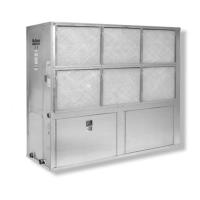
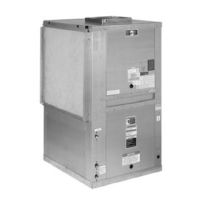
This document describes the installation and maintenance of Large Vertical Water Source Heat Pumps, ranging from 6 to 25 tons. These units are designed for indoor installation and are available in various models including LDD, LDE, LDL, LDS, LME, LMH, LML, and LMS.
The Large Vertical Water Source Heat Pumps are designed to provide heating and cooling for building spaces. Each unit incorporates a printed circuit board control system, with low voltage output from the terminal strip always at 24 volts DC. The control board also supplies 24 volts AC power to terminals C and R. These units are specifically designed to operate with a 24-volt mercury bulb type wall thermostat or a microelectronic wall thermostat selected by the manufacturer.
Single compressor units utilize a single Mark IV/AC circuit board, while dual compressor units feature two Mark IV/AC circuit boards. The refrigerant circuits in dual compressor units operate independently, allowing for total independent operation of each circuit. The Mark IV/AC circuit board includes several built-in features such as random start, compressor time delay, night setback, load shed, shutdown, condensate overflow protection, defrost cycle, brownout, and LED/fault outputs.
The low voltage terminal strip on each board is configured such that R-G energizes the fan, R-Y1 energizes the compressor for cooling, and R-W1 energizes the compressor and reversing valve for heating. The reversing valve is energized in the heating mode. A fan interlock circuit ensures the fan energizes whenever the compressor is on, even if the thermostat logic fails.
A lockout circuit on the Mark IV/AC control board stops compressor operation if any safety switches (high pressure, low pressure, or low temperature) open. If the low temperature switch opens, the unit enters cooling mode for 60 seconds to defrost the water-to-refrigerant heat exchanger before locking out the compressor. If the condensate sensor detects a filled drain pan, compressor operation is suspended only in cooling mode. The unit can be reset by opening and closing the disconnect switch on the main power supply. The Mark IV/AC control board also provides a fault output signal to an LED on a wall thermostat, indicating various fault conditions.
The system supports night setback operation, activated by a "grounded" signal to the "U" terminal on the low voltage terminal strip. This shuts off the fan and places the unit under control from the night setback terminal on the thermostat. For dual compressor units, W2 on single compressor and W3 on dual compressor units are used for day heating and cooling operation, with load shed and shutdown operations activated by a "grounded" signal to the "L" and "E" terminals, respectively.
The P and C terminals on the Mark IV/AC board are used for pump restart, passing a voltage signal when the unit's compressor is on. This signal can be detected by a Pump Restart Relay board to control heat pump loop circulation pumps, especially during unoccupied periods.
MicroTech 2000 units offer up to four configurable outputs for various control signals:


 To Next Page
 General