EasyManua.ls Logo

McQuay Enfinity CRH series - User Manual

McQuay Enfinity CRH series
28 pages
Print Icon
To Next Page IconTo Next Page
Loading...
Installation & Maintenance Data
McQuay
®
Enfinity
(R-410A) and Standard (R-22)
Horizontal Water Source Heat Pumps
Model CRH, CRW Unit Sizes 007 070 / R-22 Refrigerant
Model CCH, CCW Unit Sizes 007 060 / R-410A Refrigerant
Contents
Model Nomenclature . . . . . . . . . . . . . . . . . . . . . . . . . . . 2
Transportation & Storage
. . . . . . . . . . . . . . . . . . . . . . . . 2
Installation . . . . . . . . . . . . . . . . . . . . . . . . . . . . . . . . . .2-4
Electrical Data . . . . . . . . . . . . . . . . . . . . . . . . . . . . . . . . 5
Piping . . . . . . . . . . . . . . . . . . . . . . . . . . . . . . . . . . . . . . . 5
Cleaning & Flushing System . . . . . . . . . . . . . . . . . . . . .
6
Start-up. . . . . . . . . . . . . . . . . . . . . . . . . . . . . . . . . . . . . . 7
Operating Limits . . . . . . . . . . . . . . . . . . . . . . . . . . . . . . . 8
Typical Wiring Diagrams. . . . . . . . . . . . . . . . . . . . . . .9-11
Unit Operation . . . . . . . . . . . . . . . . . . . . . . . . . . . . .12-14
Thermostat Connections . . . . . . . . . . . . . . . . . . . . .16-17
Options for Mark IV/AC Units. . . . . . . . . . . . . . . . . .18-21
Field Installed Options on MicroTech Units . . . . . . . . . 22
Sequence of Operation . . . . . . . . . . . . . . . . . . . . . . . . 23
Troubleshooting WSHP . . . . . . . . . . . . . . . . . . . . . .24-25
Troubleshooting Refrigeration Circuit. . . . . . . . . . . . . . 25
Typical Refrigeration Cycles. . . . . . . . . . . . . . . . . . . . . 26
General Maintenance . . . . . . . . . . . . . . . . . . . . . . . . . . 27
Group: WSHP
Part Number: 106586605
Date: September 2007
IM 742-4
©2007 McQuay International

®

Questions and Answers

Summary

Model Nomenclature

Transportation & Storage

Installation Procedures

General Installation Steps

Step-by-step guide for installing the unit, covering initial setup and connection points.

Air Discharge Configuration

Instructions for changing the unit's air discharge direction from straight to end.

Ductwork and Attenuation

Guidelines for connecting ductwork, including transition pieces and acoustic insulation.

Ventilation Air Integration

Recommendations for introducing outside air into the return air system for ventilation.

Electrical Data and Wiring

General Electrical Information

Overview of electrical requirements, wiring compliance, and component connections.

230 Volt Operation Details

Specific instructions for setting up the unit for 230-volt power supply.

Fan Assembly Electrical Connections

Details on fan motor wiring, speed selection, and connections.

Piping Requirements

Cleaning and Flushing System

Start-up Procedure

Operating Limits and Voltages

Environmental & Air Limits

Specifies the acceptable ambient and air temperature ranges for unit operation.

Water Limits for Operation

Defines the acceptable entering water temperature ranges for cooling and heating modes.

Initial Start-up Conditions

Details on specific conditions and settings recommended for initial unit start-up.

Voltage Range Specifications

Lists the minimum and maximum acceptable operating voltages for the unit.

Typical Wiring Diagrams

Mark IV;AC Wiring Diagram

Illustrates the internal wiring for units equipped with the Mark IV/AC control system.

MicroTech 2000 WSHP Wiring Diagram

Shows the wiring schematic for units using the MicroTech 2000 controller.

BACnet WSHP Wiring Diagram

Presents the wiring schematic for units controlled by the BACnet WSHP controller.

Unit Operation Modes

Mark IV;AC Control System

Explains the features and operation of the Mark IV/AC control board.

MicroTech 2000 Controller Operation

Describes the functionality and operation of the MicroTech 2000 control system.

BACnet WSHP Controller Operation

Details the features and operational modes of the BACnet WSHP control system.

Thermostat and Sensor Connections

Programmable Thermostat Wiring

Wiring diagrams and instructions for connecting 7-day programmable thermostats.

Non-Programmable Thermostat Wiring

Wiring diagrams and instructions for connecting non-programmable thermostats.

Remote Sensor Installation

Guidance on installing and wiring an optional remote sensor for temperature monitoring.

Optional Unit Controls and Features

Auxiliary Relay Functionality

Information on using the auxiliary relay for fault signals or unit operation indicators.

Multiple Unit Control (3 Units)

Details on controlling up to three units from a single thermostat using a control board.

Multiple Unit Control (2 Units)

Details on controlling up to two units from a single thermostat using a control board.

Motorized Valve & Relay Kit

Instructions for installing and wiring a motorized valve and associated relay.

Boilerless System Kit (BSK)

Information on the Boilerless System Kit for controlling remote duct heaters.

Pump Restart Relay Kit

Details on installing and wiring the pump restart relay kit for system pump control.

MicroTech Field Installed Options

Scheduled Output Configuration

How to configure output signals for scheduled operation on MicroTech 2000 units.

Auxiliary Heat (Skin Heat) Control

How to use the auxiliary heat output for remote electric heaters.

Fresh Air Damper Control

How to use outputs to control a remote fresh air damper.

Motorized Water Valve Control

How to use outputs to control a motorized water valve.

Sequence of Operation Logic

Terminal Strip Functionality

Explanation of the functions of each pin on the 14-position terminal strip.

LED Status and Fault Indicators

Description of the LED indicators and their meaning for unit status and faults.

General Usage Guidelines

General information and tips for using the Mark IV/AC control system.

WSHP Troubleshooting Guide

Troubleshooting Flowchart Overview

A visual guide to diagnosing common WSHP problems and their solutions.

Refrigeration Circuit Troubleshooting

R-410 A Refrigerant Information

Details about R-410A refrigerant, its properties, and handling precautions.

Refrigeration Circuit Symptom Analysis

A table correlating symptoms with refrigerant circuit conditions.

Typical Refrigeration Cycles Explained

Cooling Mode Refrigeration Cycle

Diagram and explanation of the refrigerant flow during cooling operation.

Heating Mode Refrigeration Cycle

Diagram and explanation of the refrigerant flow during heating operation.

General Maintenance Recommendations

Overview

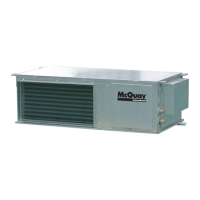
The McQuay Enfinity™ (R-410A) and Standard (R-22) Horizontal Water Source Heat Pumps (Models CRH, CRW Unit Sizes 007 – 070 / R-22 Refrigerant and Models CCH, CCW Unit Sizes 007 – 060 / R-410A Refrigerant) are designed for indoor installation and provide heating and cooling for commercial applications. This document outlines the installation, operation, and maintenance procedures for these units.

Function Description:

These units are water source heat pumps designed to provide efficient heating and cooling. They operate by transferring heat to or from a water loop, utilizing a refrigeration cycle. The units are available in two refrigerant types: R-22 for CRH/CRW models and R-410A for CCH/CCW models. The R-410A models offer higher operating pressure and refrigeration capacity compared to R-22. The units are designed to be suspended from the ceiling, with options for straight or end discharge airflow.

Control Systems:

The heat pumps can be equipped with either a Mark IV/AC control unit or a MicroTech 2000 Water Source Heat Pump Unit Controller.

  • Mark IV/AC Control Units: These are microprocessor-based systems with built-in features such as random start, compressor time delay, night setback, load shed, shutdown, condensate overflow protection, defrost cycle, brownout, and LED/fault outputs for diagnostics. They are designed for operation with 24-volt mercury bulb or microelectronic wall thermostats. The control board manages fan, compressor, and reversing valve operation based on thermostat signals. It includes a lockout circuit to stop compressor operation if safety switches (high pressure, low pressure, low temperature) open or if the condensate sensor detects a filled drain pan. The Mark IV/AC system also supports remote reset of lockouts and a fault retry feature to minimize nuisance trips. Load shed and shutdown operations can be initiated via "grounded" signals to specific terminals. Pump restart functionality is provided, passing a voltage signal to a pump restart relay board when the compressor is on, allowing for loop circulation pump control.

  • MicroTech 2000 WSHP Unit Controller: This is a microprocessor-based controller designed to communicate over a LONWORKS® (LonTalk® or LonMark® 3.3) communications network, integrating with centralized building automation systems. It monitors and controls unit operation, water and air temperatures, and communicates fault conditions. Features include unit-mounted return air, discharge air, and leaving water temperature sensors, with options for wall-mounted room sensors, tenant setpoint adjustment, and override buttons. The controller provides an on-board status LED for diagnostics, indicating operating mode (Occupied, Occupied Load Shed, Unoccupied, Tenant Override, Override Load Shed) and alarm conditions (flashing).

  • BACnet® WSHP Unit Controller: This is a specialized Alerton BACnet unit controller that communicates over a BACnet MS/TP communications network to an Alerton BACtalk building automation system (BAS). Each controller has a unique MAC address set via DIP switches. It controls the compressor, fan, and reversing valve to maintain space temperature within setpoints. Operational data, commands, equipment status, water and air temperatures, and fault conditions are available on the BACtalk network. Features include start-up checks, customizable fan operation (continuous or cycling), proportional-integral control for cooling and heating run-time, short cycle protection (180-second start delay, 2-minute on, 5-minute off times), random start, occupied/unoccupied modes with configurable setpoints, after-hours override (half-hour increments up to 9.5 hours), reversing valve delay (60 seconds after heating, 10 seconds before compressor start), load shed, and brownout protection (suspends operation if voltage drops below 82% for 10 seconds, resets above 90%).

Important Technical Specifications:

  • Refrigerant Types: R-22 (CRH, CRW models) and R-410A (CCH, CCW models).
  • Capacities: Nominal capacities range from 7,000 to 70,000 BTU/hr (007 to 070 unit sizes).
  • Voltage Options: Multiple voltage options including 115/60/1, 208-230/60/1, 208-230/60/3, 277-265/60/1, 460/60/3, 575/60/3, and 50 Hz options (230/50/1, 380/50/3 for CCH&CCW only).
  • Operating Voltage Range: Specified minimum and maximum voltages for each option (e.g., 115/60/1: 104-127V; 460/60/3: 414-506V). Three-phase system unbalance should not exceed 2%.
  • Refrigerant 410A: Requires polyolester (POE) oil. Must be charged as a liquid. Requires recovery equipment designed for R-410A (up to 800 PSIG high side, 250 PSIG low side, 400 PSIG recovery cylinders).
  • Fan Motors: Multi-speed, PSC type with integral mounting brackets and thermal overload protection. Fan speed can be changed by interchanging wires on the motor body or terminal strip.
  • Piping: Two-pipe reverse return configuration recommended for self-balancing. Supply and return runouts should use short lengths of high-pressure flexible hose for sound attenuation. Shutoff valves are required at each conditioner. Condensate piping must be trapped and pitched at least 1/4" per foot.
  • Air Discharge: Units can be configured for straight or end discharge. Conversion involves rotating the fan discharge panel and motor.
  • Ductwork: Should conform to ASHRAE standards. Flexible connectors, transition pieces, and internally lined branch ducts are recommended. Return air ductwork can connect to a standard filter rack for side or bottom filter removal.
  • Operating Limits (Standard Range Units):
    • Ambient Air: Cooling: 50-100°F (10-38°C); Heating: 50-85°F (10-29°C).
    • Entering Air (dw/wb): Cooling: 80/67°F (27/19°C); Heating: 70°F (21°C).
    • Entering Water: Cooling: 55-110°F (13-43°C); Heating: 55-90°F (13-32°C).
  • Operating Limits (Geothermal Range Units):
    • Ambient Air: Cooling: 40-100°F (5-38°C); Heating: 40-85°F (5-29°C).
    • Entering Air (dw/wb): Cooling: 80/67°F (27/19°C); Heating: 70°F (21°C).
    • Entering Water: Cooling: 30-110°F (-1-43°C); Heating: 20-90°F (-6-32°C).
  • Start-up Conditions (Standard Range): Ambient 50°F (10°C), entering air 50°F (10°C), entering water 70°F (21°C).
  • Start-up Conditions (Geothermal Range): Ambient 40°F (5°C), entering air 40°F (5°C), entering water 25°F (-4°C).

Usage Features:

  • Installation: Units are suspended from the ceiling using four threaded rods attached to hanger brackets with rubber isolators to minimize vibration. Minimum 18" clearance around the heat pump is required for maintenance. Filter access is designed for side removal, with options for bottom removal using a sheet metal duct filter retainer.
  • Airflow Direction: Airflow direction can be changed from straight to end discharge (or vice versa) before unit installation.
  • System Cleaning: Prior to initial operation, the water circulating system must be cleaned and flushed of construction dirt and debris. Trisodium phosphate was formerly recommended, but current practice suggests flushing longer with warm 80°F (27°C) water.
  • Start-up Procedure: Involves opening all valves, turning on power, setting the thermostat to "Fan Only" to check air delivery, then to "Cool" and "Heat" to verify proper operation, temperature differences, and water flow rates. Condensate line elevation and cleanliness should be checked.
  • Troubleshooting: Flowcharts are provided for diagnosing issues related to fan/compressor operation, insufficient cooling/heating, and refrigeration circuit problems.
  • Optional Accessories:
    • Auxiliary Relay: Interfaces external equipment with the Mark IV/AC board, providing fault signals, unit operation signals, or remote control.
    • Multiple Unit Control Board: Allows control of up to 3 (VDC relays) or 2 (VAC relays) units from a single thermostat.
    • Motorized Valve & Relay: Opens on a call for compressor operation, available in 1/2" and 3/4" power-open spring-return types.
    • Boilerless System Kit (BSK): Controls a remote duct heater, using electric heat instead of heat pump heat when water temperature drops below a setpoint. Includes a water temperature sensor and an auxiliary relay.
    • Pump Restart Relay Kit: Alerts the loop water controller that water flow is required, allowing the system pump to start.

Maintenance Features:

  • Filter Changes: Required at regular intervals, depending on project requirements and lint accumulation. Filters should be changed if light cannot be seen through them.
  • Condensate Drain Pan: Should be checked annually and cleaned/flushed as required.
  • Motor Lubrication: Fan motors are permanently lubricated and do not require oiling.
  • Performance Monitoring: Recording volts, amps, and water temperature differences (heating and cooling) is recommended to track equipment condition.
  • Troubleshooting Lockouts: Periodic lockouts are typically caused by air or water problems (dirty filter, water system dirt, incorrect flow rates, extreme temperatures).
  • Training and Development: McQuay offers training information on all HVAC products via their website and a dedicated Training Department.
  • Warranty: All McQuay equipment is sold with a Limited Product Warranty.

McQuay Enfinity CRH series Specifications

General IconGeneral
BrandMcQuay
ModelEnfinity CRH series
CategoryHeat Pump
LanguageEnglish

Related product manuals