10
When sailing upwind or
downwind, your boat’s
performance will depend
upon the angle of your sail,
also known as your sail trim.
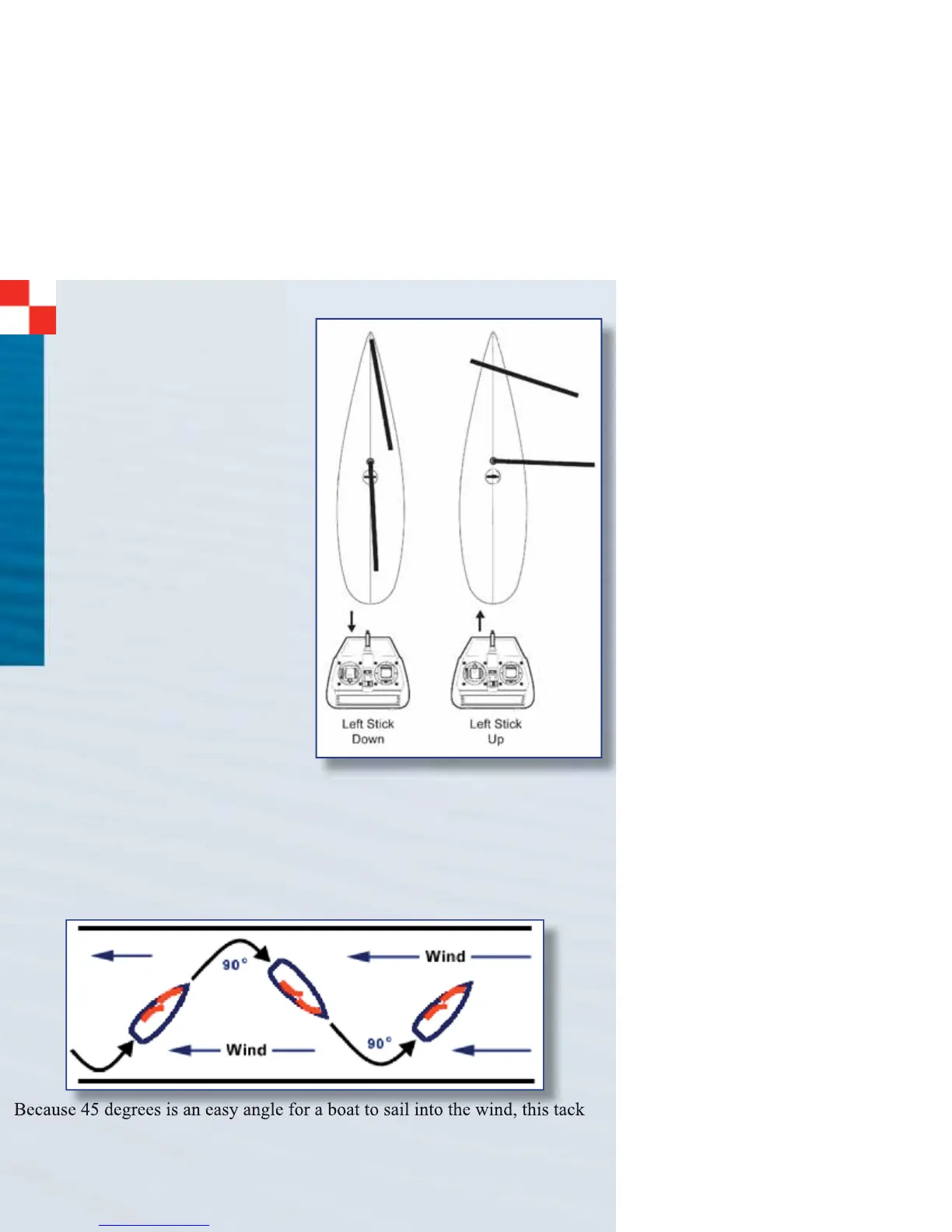
To pull the sails in, move the
sail stick down. To ease the
sails out, move the sail stick
up. A good way to fi nd the
right trim is to ease the sails
out until they begin to luff
(fl ap like a fl ag in the breeze).
Then simply trim back in just
enough to stop the luffi ng.
Sailing with the wind is easy.
You just let the sails trim all
the way out (as in the
illustration to the far right)
and let the wind push you
along. This is called “running.”
It’s when you want to go in a different
direction than the wind that things get
tricky. Sailboats cannot sail directly into the wind. If a boat is pointed directly
into the wind, the sail will luff. So, how does the boat move to a point directly
upwind? It zigzags, or tacks its way into the direction of the wind. Sailboats
can only sail at angles to the wind. The closest angle is approximately 30
degrees, although 45 degrees is recommended. To tack, you must change the
boat’s direction so that the bow comes through the eye of the wind (point
directly into the wind).
requires a turn of 90 degrees. As the boat turns and the bow comes through
the eye of the wind, the sails will move across to the opposite side of the boat.
Your main sail will then refi ll on this side, you can straighten your rudder, and
the boat will assume the new heading.
Tacking


 To Next Page