Page 7
3. PREPARING TO USE THE UNIT
RISK OF CONTACT WITH BATTERY ACID.
BATTERY ACID IS A HIGHLY CORROSIVE SULFURIC ACID.
3.1
Make sure the area around the battery is well ventilated
while the unit is in use.
3.2
Clean the battery terminals before using the jump starter.
During cleaning, keep airborne corrosion from coming into
contact with your eyes, nose and mouth. Use baking soda
and water to neutralize the battery acid and help eliminate
airborne corrosion. Do not touch your eyes, nose or mouth.
3.3
Determine the voltage of the battery by referring to the vehicle
owner’s manual and make sure that the output voltage is 12V.
3.4
Make sure that the unit’s cable clamps make tight connections.
4. FOLLOW THESE STEPS WHEN CONNECTING TO A BATTERY
A SPARK NEAR THE BATTERY MAY CAUSE
A BATTERY EXPLOSION. TO REDUCE THE RISK OF A SPARK
NEAR THE BATTERY:
4.1
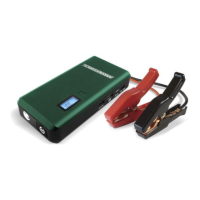
Plug the clamps into the unit, and then attach the output
cables to the battery and chassis as indicated below. Never
allow the output clamps to touch each other.
4.2
Position the DC cables to reduce the risk of damage by the
hood, door and moving or hot engine parts. NOTE: If it is nec-
essary to close the hood during the jump starting process,
ensure that the hood does not touch the metal part of the
battery clips or cut the insulation of the cables.
4.3
Stay clear of fan blades, belts, pulleys and other parts that can
cause injury.
4.4
Check the polarity of the battery posts. The POSITIVE (POS,
P, +) battery post usually has a larger diameter than the NEG-
ATIVE (NEG, N, -) post.
4.5
Determine which post of the battery is grounded (connected)
to the chassis. If the negative post is grounded to the chas-
sis (as in most vehicles), see step 4.6. If the positive post is
grounded to the chassis, see step 4.7.
4.6
For a negative-grounded vehicle, connect the POSITIVE
(RED) clamp from the jump starter to the POSITIVE (POS,
P, +) ungrounded post of the battery. Connect the NEGA-
TIVE (BLACK) clamp to the vehicle chassis or engine block
away from the battery. Do not connect the clamp to the
carburetor, fuel lines or sheet-metal body parts. Connect
to a heavy gauge metal part of the frame or engine block.


 To Next Page