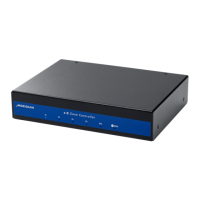
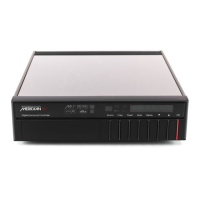
The Meridian 861V4 Surround Controller is a sophisticated audio processing unit designed for high-fidelity home cinema and stereo applications. It serves as the central hub for managing various audio and video signals, offering advanced digital signal processing (DSP) capabilities to deliver an immersive listening experience.
Function Description:
The 861V4 acts as a versatile preamplifier and surround sound processor, capable of handling a wide array of audio and video inputs and outputs. Its primary function is to decode and process multi-channel audio formats, such as Dolby Digital and DTS, as well as high-resolution stereo signals. The unit employs Meridian's proprietary DSP technologies, including Trifield, to create a natural and enveloping soundstage from various source materials. It routes audio signals through a modular architecture, allowing for customization with different input and output cards to suit specific system requirements. Video signals are also managed, with various video input and output options available through dedicated cards. The controller features a display board for user interaction and a switch board for control functions, all integrated into a robust chassis.
Important Technical Specifications:
The 861V4 utilizes a modular design, with a motherboard (PA10583) serving as the central backplane for various sub-assemblies. Key components include:
- PSU (PA10140): The power supply unit, available in older and newer types, provides stable power to all internal components. Output voltage adjustment is possible, typically set to 5.2V.
- Display Board (PA10579): Provides visual feedback and menu navigation for the user.
- Switch Board (PA10580): Handles user input for control functions.
- Cap Board (PA10532): A capacitor board that works in conjunction with the PSU, available in floor-mounted and side-mounted configurations.
- Com Board (PA10563): Manages communication within the unit.
- Input Cards:
- IE42 PCB (SU2612): Digital input card (coax, optical).
- IA00 PCB (SU1672): Analogue input card (unbalanced).
- IA10 PCB (SU1652): Analogue input card (balanced XLR).
- IA20 PCB (SU1680): Analogue input card (unbalanced).
- IA30 PCB (SU1688): Audio from MC cartridge.
- IA35 PCB (SU1684): Audio from MM cartridge.
- IA40 PCB (SU2136): Analogue input card (multichannel).
- IA45 PCB (SU2622): Analogue input card (multichannel).
- ID20 PCB (SU1664): Digital input card (optical).
- ID25 PCB (SU2920): Digital input card (optical).
- ID30 PCB (SU1668): Digital input card (AES/EBU, AT&T optical).
- TP00 PCB (SU1660): Analogue input card (unbalanced).
- Output Cards:
- OA03 PCB (SU2756): Analogue output card.
- OA13 PCB (SU2763): Analogue output card.
- OE12 PCB (SU0039): Digital output card.
- DSP Cards:
- CD20 PCB (SU2602): DSP card.
- EF20 PCB (SU3197): DSP card.
- Video Cards:
- VS00 PCB (SU1676): Video inputs (composite and S).
- VS10 PCB (SU2143): Video outputs (composite and S-video).
- VS20 PCB (SU1692): Video input (component).
- VS40 PCB (SU2150): Video inputs (composite).
- VS50 PCB (SU2930): Video output (component).
- Other Cards:
- SL00 PCB (SU1656): Comms patch.
- RF00 PCB (SU1975): Radio frequency board.
- TM00 Terminator Board (SU2713): Used for signal termination on the motherboard.
The unit supports various configurations of input and output cards, with specific recommendations for terminator card placement depending on the installed cards, especially for the IA45 multichannel analogue input board.
Usage Features:
The 861V4 is designed for integration into high-end audio systems. Its modularity allows users to tailor the unit's capabilities to their specific needs, whether for a dedicated stereo setup, a multi-channel home cinema, or a combination of both. The display and switch board provide intuitive control over source selection, volume, DSP modes (like Trifield), and other settings. The ability to adjust the PSU's output voltage ensures optimal performance. The system's flexibility extends to its terminator card requirements, which are detailed to ensure proper signal integrity and prevent unwanted audio problems, particularly with complex multi-channel configurations.
Maintenance Features:
Maintenance of the 861V4 primarily involves the substitution of sub-assemblies, such as complete circuit boards. This approach simplifies repairs and minimizes downtime. The service guide provides detailed instructions for disassembling the product, including:
- Removing the Outer Cover Assembly: Involves unscrewing four screws on each side and sliding the cover backward.
- Removing the Fascia Assembly: Requires removing four screws (two on each side) and disconnecting a loom from the display board.
- Removing the Display Board and Switch Board: Involves disconnecting looms and removing screws.
- Removing the Inner Lid: Requires removing four black self-tapping screws and one or two screws with nylon washers.
- Removing Boards from the Back-Panel: Involves removing Torx-headed screws and disconnecting internal looms, such as the 12-way ribbon loom for the Com board.
- Removing the Motherboard: Requires disconnecting looms from the Cap board and removing six screws.
- Removing and Replacing the PSU and Cap Board: Detailed instructions are provided for both floor-mounted and side-mounted Cap boards, as well as older and newer PSU types. This may involve drilling new holes in the chassis for newer Cap board types and detaching loading resistors.
- Modifying the Switch PCB (for older-style PSUs): This involves removing a capacitor, scraping a solder-resist layer, and fitting a three-pin "watchdog" IC (Meridian part-number D81813) to prevent front-panel keys from locking up after a power cycle. Post-modification, display brightness and contrast may need adjustment.
- Adjusting the Output Voltage of the PSU: A trimmer on the PSU allows for adjustment to 5.2V.
- Fitting Terminator Cards: Guidelines are provided on how many and where to fit terminator cards based on the installed input/output cards, with troubleshooting steps for audio problems.
- Reassembling the Unit: Instructions emphasize aligning the motherboard correctly and securing all earth connections.
Meridian provides spare parts for these sub-assemblies. While circuit-component level repairs are not covered in the standard service guide, circuit diagrams are available from Meridian under a non-disclosure agreement (NDA) for more in-depth servicing.

 Need help?
 General

 To Next Page