The MFJ-401D Econo Keyer II is a microprocessor-controlled keyer designed to facilitate Morse code sending with features like iambic key operation and dot-and-dash memory. This device aims to make sending perfect code easier for amateur radio operators.
Function Description:
The core function of the MFJ-401D is to generate Morse code. It supports both iambic Type "A" and Type "B" keying, allowing users to choose their preferred method. The keyer provides tuneable code speed, code weight, and sidetone frequency, offering flexibility in operation. It also features both direct and grid-block keying outputs, making it compatible with various transmitters.
Important Technical Specifications:
- Power: The unit can be powered by a 9-volt battery (not included) or an external 12 VDC power supply. The external power supply requires a 2.1 mm coaxial plug with a positive center and a negative sleeve. The battery is automatically disconnected when external power is used.
- Code Speed: The speed range is configurable via an internal jumper (JMP9). It can be set for either 5 to 65 WPM or 10 to 40 WPM. The factory default is 5 to 65 WPM.
- Code Weight: The weight control adjusts the dot and dash lengths from approximately 25% to 75%, with the standard dot defined as 50% weight (1:3:1 dot-dash-space ratio at mid-range). This control is internal and accessible through a small hole on the left side of the front panel.
- Sidetone Frequency: The tone control allows adjustment of the sidetone pitch from approximately 300 to 1200 Hz. This control is also internal and accessible through a small hole on the left side of the front panel.
- Keying Output: The MFJ-401D supports both direct keying (for solid-state transmitters) and grid-block keying. This is an internal jumper-selected option (JMP1 and JMP2). The factory default is direct keying. The keying output connection is made with an RCA phono plug.
- Iambic Mode: The iambic Type A/B mode is selected via an internal jumper (JMP3). The factory default is Type "A" Iambic.
- Key Input: The device accepts a squeeze key or a single lever key via a 1/4-inch stereo phono plug. A straight key can also be used, converting the unit into a manual keyer.
Usage Features:
- Power Control: A push-button switch turns the unit ON (locked "in" position) and OFF ("out" position).
- Semi-Auto/Auto Mode: A button allows selection between semi-automatic "bug" operation (dots generated automatically, dashes manually) and fully manual operation (for straight keys). Semi-Auto is active when the switch is "in," and Auto when "out."
- Speed Control: An external knob adjusts the code speed. Turning it clockwise increases speed, counter-clockwise decreases it.
- Volume Control: An external knob adjusts the sidetone level of the internal speaker.
- Dot and Dash Memories: This feature simplifies sending by allowing users to key a dot before a dash completes, and vice versa. It also supports dot and dash insertion.
- Iambic Operation: When using a squeeze key, the unit generates alternate dots and dashes, with the first paddle contacted determining the initial element.
- Internal Adjustments: Code weight and sidetone pitch are adjusted via internal trimpots, accessible through small holes on the left side of the front panel using a small, flat-headed screwdriver.
- Jumper Settings: Several operational parameters are configured using internal jumpers. These include:
- Keying Mode (JMP1, JMP2): "D D" for Direct Keying (factory default), "G G" for Grid Block Keying. Other combinations are invalid.
- Iambic Mode (JMP3): "A" for Iambic Mode A (factory default), "B" for Iambic Mode B.
- Speed Range (JMP9): "L" for 5 – 66 WPM (factory default), "H" for 10 – 40 WPM.
Maintenance Features:
- Cover Removal: To access internal jumpers for configuration changes or battery installation, the cover must be removed by unscrewing two screws (one on each side).
- Power-Off Requirement: All internal jumper settings (speed range, keying mode, iambic mode) require the power to be off before making changes to prevent potential damage or incorrect configuration.
- Battery Installation: A battery holder is provided inside the enclosure for installing a 9-volt battery.
- Troubleshooting: The manual advises users to consult the relevant sections for problem-solving. If issues persist, technical assistance is available via phone, fax, or email. Users are encouraged to have their unit, manual, and station information ready when contacting support.

 Need help?
 General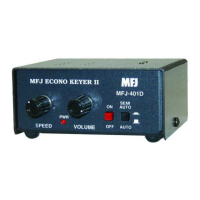

 To Next Page