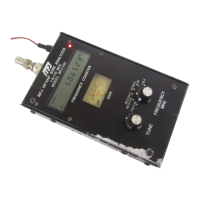
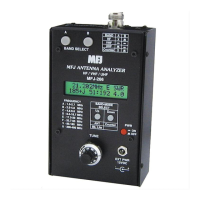
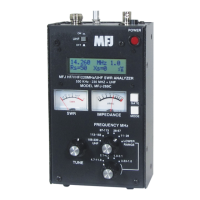
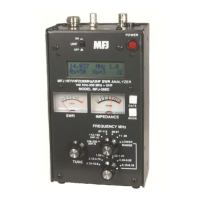
MFJ-259C Instruction Manual HF/VHF SWR Analyzer
24
inductance through lead length or internal structure. For best accuracy with a variable load,
disconnect and check its value with a digital ohmmeter at the conclusion of the experiment.
However, never check load resistance with an ohmmeter with the analyzer connected -- the
results will be inaccurate and the meter's DC voltage could damage the detector diodes!
[ ] Connect the DUT cable to the analyzer and terminate the far end with your first trial load.
[ ] Tune the
VFO up and down over a wide frequency span. Note the Impedance changes.
[ ] Try different terminations until the Impedance remains constant over the tuning range.
[ ] The resistance holding
Impedance most constant is the line's characteristic impedance.
Important Warning: Never check the resistance of an adjustable load using an
ohmmeter if the analyzer is connected at the opposite end of the line!
7.5 Pre-adjusting Antenna Tuners
Using the MFJ-259C to pre-adjust the impedance match through your station's tuner (ATU)
avoids exposing the transmitter PA to high-SWR loads and eliminates needless over-the-air
interference. The analyzer may be temporarily patched to the tuner's input using a short cable,
but many operators prefer to install a manual RF switch to facilitate rapid changeover. If you
choose to switch the analyzer, confirm:
• Your switch has more than 50 dB of port Isolation
• The wiper (or common) switch port is connected to the Input Jack of the tuner
• There's no possible way for the analyzer to become connected to a transmitter.
To pre-adjust the tuner:
[ ] Patch or switch in the analyzer.
[ ] Tune the
VFO to your target frequency and leave it there
[ ] Select the default
R&X mode in the Basic menu.
[ ] Adjust the tuner controls until
SWR indicators show 1.0 (or as close to 1:1 as possible).
[ ] Turn off and disconnect the MFJ-259C
[ ] Reconnect the transmitter to the tuner.
7.6 Testing RF Transformers: You can evaluate any RF transformer that has a termination
port between 25 and 100 Ohms available on one of its windings. Use only non-inductive
resistances for loads:
[ ] Connect the test port to the analyzer with a
very short 50-ohm pigtail (<1° phase shift).
[ ] Terminate all other port(s) with loads of the specified impedance.
[ ] Set the analyzer to the default
R&X function in the Basic menu.
[ ] Sweep the
VFO across the transformer's intended operating range.
Use
SWR, Resistance (R) Reactance (X) and Impedance Magnitude (Z) to evaluate the
transformer's impedance and useable bandwidth. To measure efficiency, compare the source


 To Next Page
 Loading...