8
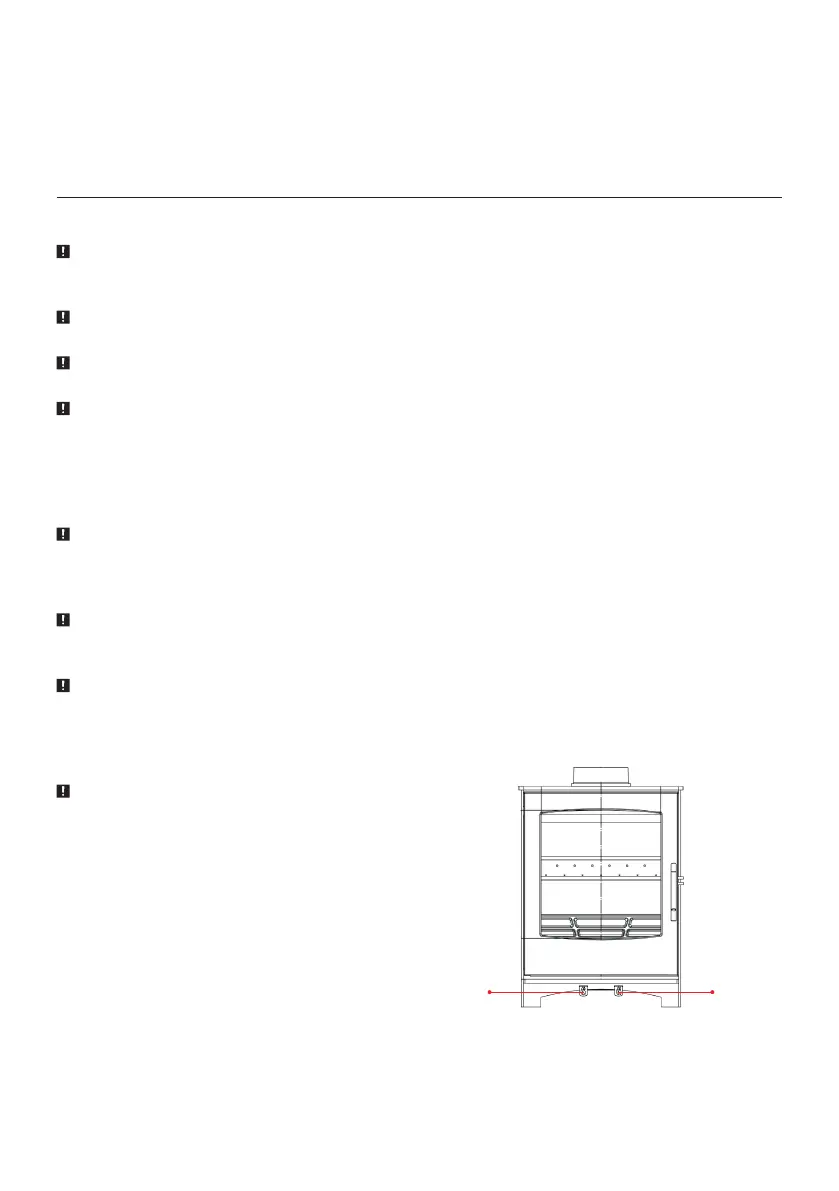
Check all the levers are operating fully and freely.
CO Alarm: Building Regulations require that
whenever a new or replacement fixed solid fuel or
wood/biomass appliance is installed in a dwelling
a carbon monoxide alarm must be fitted in the
same room as the appliance.
Further guidance is available in BS EN50292:2002
and from the alarm manufacturer’s instructions.
Provision of an alarm must not be considered a
substitute for either
3. LIGHTING AND USING THE STOVE
3.1 IMPORTANT SAFETY INFORMATION
The stove will become warm during use and
therefore it should be treated with all necessary
caution.
Never keep easily combustible fluids such as
petrol in the vicinity of the wood burning stove.
Never use easily combustible fluids to light the
fire in the wood burning stove.
Never empty the ashes when the wood
burning stove is warm. Embers may still be
found in the ash for up to 24 hours after the
fire has gone out. Please wait to empty the ash
until you are sure that there are no embers in
the ash.
The door should be kept closed while the
wood burning stove is in use. While lighting
the fire, the door can stand ajar for the first few
minutes.
In the event of a chimney fire: Close all the
dampers on the wood burning stove and call
the fire-fighting service.
Your installer should have fitted a CO alarm in
the same room as the appliance. If the alarm
sounds unexpectedly, Leave the premises
immediately and contact installer. Let the fire
go out.
The control and handles will get warm when
the wood burning stove is in use. Please use
the glove provided when you operate the
wood burning stove.
3.2 THE FIRST TIME A FIRE IS LIT
The first few times the stove is used, there may
be some smoke and unpleasant odours from the
wood burning stove, which is fairly normal. This
is caused by the heat-resistant paint hardening.
Make sure there is sufficient ventilation during
this stage.
It is also important not to let the fire burn too
fiercely the first 2-3 times, so that the wood
burning stove has time to expand slowly.
You should also be aware that the stove may
make some clicking sounds as it heats up and
cools down – like pouring boiling water into a
sink. These are caused by the great differences
in temperature to which the materials are being
exposed.
During the first firing, which should be carried
out using approximately 1 kg of wood, the
stoking door must be left slightly open and
must not be closed until the stove is cold. This
is to prevent the sealing rope sticking to the
stove.
3.3 THE STOVE AIR CONTROLS
The amount of heat emitted by the stove is
regulated using the air controls built into the front
of the stove.
When using Wood after the stove has reached
operating temperature the stove is controlled by
closing the primary air and adjusting the output
and flame effect with the secondary air control.
With small adjustment made to the tertiary air
when needed.
When using manufactured mineral fuels after
the stove has reached operating temperature the
stove is controlled by reducing the secondary air
control and adjusting the primary air control to
gain the required heat output and flame effect.
3.4 HOW SHOULD I USE MY STOVE WHEN
WOOD BURNING?
The wood burning stove is intended for
intermittent combustion. This means that each
PRIMARY
AIR
CONTROL
AIR WASH
CONTROL
(SECONDARY
AIR CONTROL)


 To Next Page