26 MHX-920 Operating Manual: Chapter 4 Configuration
Master Slave
Master
Repeater
Slave
Master
Repeater1
Repeater2 Slave
Slaves and Masters do not
use Secondary Hopping
Patterns
Remember to assign a
unique Unit Address (1 to
65535) to each unit in the
system
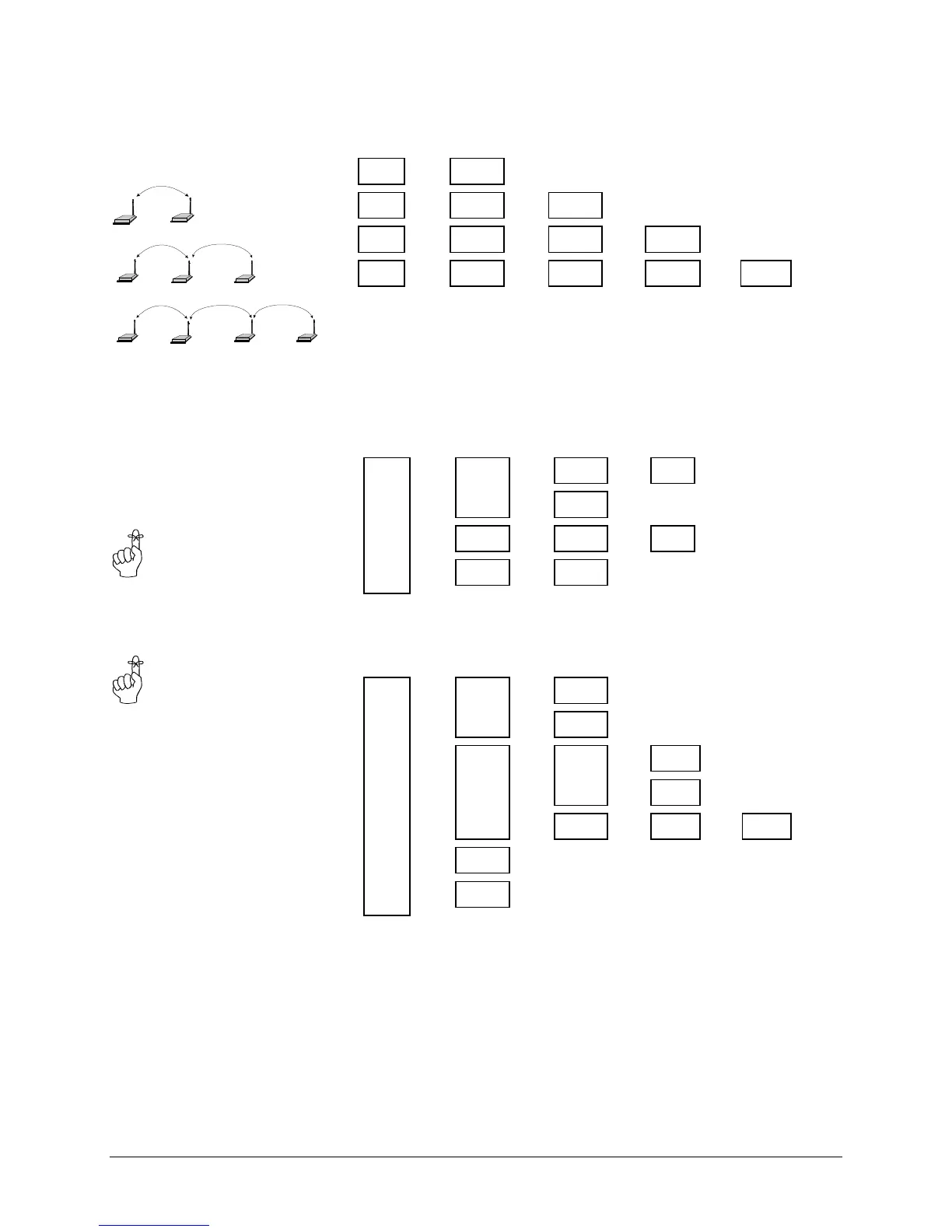
the following diagrams illustrate the methodology for deploying simple to
complicated networks:
M[1]
←→
S1[1]
M[1]
←→
R1[1,2]
←→
S2[2]
M[1]
←→
R1[1,2]
←→
R2[2,3]
←→
S3[3]
M[1]
←→
R1[1,2]
←→
R2[2,3]
←→
R3[3,4]
←→
S4[4]
It is reasonable to consider a Repeater as being both a Slave and a Master,
alternating between Primary and Secondary Hopping Patterns as the unit
changes channel. Consider R1 in the illustration below. When
communicating with the Master, R1 is acting like a Slave on Primary
Hopping Pattern 1. When communicating with R2 and S4, R1 is acting like
a Master on Secondary Hopping Pattern 2. If multiple Repeaters are used,
they should have different Secondary Hopping Patterns:
←→
R1[1,2]
←→
R2[2,5]
←→
S3[5]
M[1]
←→
S4[2]
←→
R5[1,3]
←→
R6[3,6]
←→
S7[6]
←→
R8[1,4]
←→
S9[4]
Note that all units have a unique Unit Address.
Networks of any complexity can be created by linking multiple Repeaters
and Slaves:
←→
R1[1,2]
←→
S2[2]
←→
S3[2]
←→ ←→
R5[3,6]
←→
S6[6]
M[1] R4[1,3]
←→
S7[6]
←→
R8[3,7]
←→
R9[7,8]
←→
S10[8]
←→
S11[1]
←→
S12[1]
With a limitation of 64 hopping patterns, one might suspect that there is a
limitation to the number of repeaters in a system. However, if the units are
far enough away from one another, hopping patterns may be reused in
different sections of the network, without causing interference.



 To Next Page