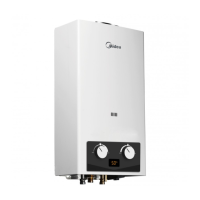
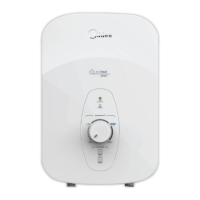
This document serves as an instruction manual for a Midea Gas Water Heater, specifically models JSD12-6DH4 and JSD20-10DH4. It provides comprehensive guidelines for installation, operation, and maintenance, emphasizing safety and professional handling.
Function Description
The Midea Gas Water Heater is designed for domestic water heating, utilizing an atmospheric gas burner. It operates by automatically igniting the heat when the water faucet is turned on, providing hot water on demand. The device is equipped with an exhaust security thermostat that activates if the exhaust outlet is not completely open, closing the gas valve for safety. Once the heater has cooled off, it can be ignited again. The heater is designed to be installed on a vertical wall within a room that has good ventilation.
Usage Features
The water heater offers several user-friendly features for controlling its operation and ensuring safety.
Ignition and Operation:
The heater ignites automatically when the hot water faucet is opened. If no flame is generated after ignition, users are instructed to close the faucet and reopen it after 10 minutes. A minimum safety distance of 300mm from the flame indicator window should be maintained during ignition. If the heater has been inactive for a long period, air may enter the gas system, requiring the ignition procedure to be repeated several times.
Power and Temperature Adjustment:
The gas regulation knob allows users to adjust the volume of gas circulation, which in turn controls the hot water temperature. Turning the regulator clockwise increases the hot water temperature, while turning it counter-clockwise reduces it. It is crucial to keep the sealing valve at the cold water inlet completely open and not to reduce water circulation by closing this valve.
Anti-Freezing Measures and Putting Out of Service:
For periods of long non-use, especially in cold conditions, specific measures are recommended to conserve the heater and prevent freezing. These include closing the gas switch, extracting batteries from the compartment, closing the sealing valve at the cold water inlet, adjusting the temperature regulator to the lowest setting, turning on the hot water switch, and opening the empty valve to drain water from the system.
Flame Failure During Operation:
If the flame extinguishes during operation, the heater's security thermostat will automatically cut off the gas supply. The heater will only reignite after it has cooled down. In such an event, users should ensure adequate ventilation of the exhaust outlet, allow the heater to cool, and then turn off and on the water faucet again. If the issue persists, users are directed to consult the troubleshooting guide or contact an installer.
Anti-Blockage Function:
The water heater incorporates an anti-blockage function within its exhaust system. Should the exhaust duct become blocked, a thermostat on the fume collector will shut off the gas supply to ensure safety. If this occurs, users should check and clear any blockage in the exhaust duct. The heater can be reused once the exhaust is clear. This safety feature should not be removed or short-circuited.
Maintenance Features
The manual strongly emphasizes professional maintenance and adherence to specific guidelines to ensure the heater's longevity and safe operation.
Regular Maintenance:
Repair and maintenance for the heater should be performed at least once a year, ideally after a heating period. All maintenance and repair tasks must be carried out by authorized professionals. Records of maintenance and repair should be kept.
Pre-Maintenance Steps:
Before any cleaning or maintenance, the batteries must be removed from the water heater, and the gas switch should be turned down. Only original spare parts provided by the manufacturer should be used for maintenance. The use of non-original parts voids the quality guarantee. All connecting pieces used during maintenance must be new.
Casing Access for Maintenance:
To perform maintenance or repair, the casing must be opened. This involves unscrewing two bolts at the lower part/back of the casing, removing the operation button, and gently detaching the slipcover at the lower part of the casing by pressing it upwards and then taking it off forwards.
Maintenance Procedures:
Maintenance tasks include:
- Checking the exhaust system for perfect operation.
- Dismounting and cleaning the burner and gas nozzle with a brush and vacuum cleaner, especially if the water heater is not operating.
- Cleaning the heat exchanger with a brush and vacuum cleaner.
- Remounting the burner.
- Inspecting the ignition electrode and controller for integrity; replacing them if damaged.
- Verifying the distance between the ignition electrode and the fuel surface, which should be between 3mm and 5mm.
- Confirming the perfect state of ignition, operation, and disconnection of the heater.
- Checking the gas connection and nozzle pressure under rated load.
- Ensuring the tightness of water and gas connections.
- Verifying the normal operation of all security devices and overall performance.
- Checking for gas leakage at gas joints using a soapy solution.
- Remounting and cleaning the casing with a wet rag and soapy water.
Butane Facility Maintenance:
If a hosepipe is used for gas connection, it should be replaced once a year.
Troubleshooting:
The manual includes a troubleshooting section to address common issues such as no flame, low water temperature, or flame extinguishing during operation. Solutions range from checking gas supply and battery polarity to ensuring exhaust system fluency and water pressure. In case of persistent failures, users are advised to contact the technical service department or an installer.
Cleaning:
The heater should be cleaned with a clean, wet cloth. Dissolvent products are not allowed for cleaning. The exhaust pipe should only be cleaned when cold.



 To Next Page
 General