EasyManua.ls Logo

Miele WCA 020 - User Manual

Miele WCA 020
12 pages
Print Icon
To Next Page IconTo Next Page
Loading...
11637110-01
Installation
*INSTALLATION*
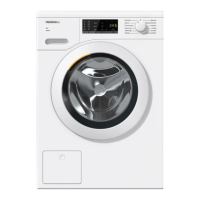
Front view
a
Inlet hose (tested to withstand
pressures up to 7000kPa)
b
Electrical connection
c
Flexible drain hose (with detachable
swivel elbow)
d
Control panel
e
Detergent dispenser drawer
f
Door
g
Access to filter, pump and
emergency release
h
Four height-adjustable feet
Question and Answer IconNeed help?

Do you have a question about the Miele WCA 020 and is the answer not in the manual?

Summary

Installation

Front View Overview

Overview of the washing machine's front components and connections.

Rear View Components

Visual guide to the washing machine's rear components and connections.

Installation Surface Requirements

Guidance on selecting a suitable floor surface for stable installation.

Transporting the Washing Machine

Instructions and safety warnings for safely transporting the appliance.

Removing Transit Bars

Step-by-step instructions for removing the washing machine's transit bars.

Covering Transit Bar Holes

Procedure to cover holes left after transit bar removal for safety.

Securing Transit Bars for Storage

Guidelines for securely storing transit bars for future transport needs.

Fitting Transit Bars

Instructions on how to refit the transit bars for safe transportation.

Levelling the Washing Machine

Explanation of why levelling is crucial for safe and proper operation.

Adjusting Machine Feet

Detailed steps for adjusting the machine's feet to achieve a level position.

Installing Under Worktop

Guidance on installing the machine beneath a continuous worktop.

Washer and Dryer Stacking

Information on stacking a tumble dryer on top of the washing machine.

Miele Water Protection System

Overview of the Miele water protection system and its components.

Water Supply Connection

Instructions and requirements for connecting the machine to the water supply.

Hose Maintenance and Extension

Advice on using genuine hoses, maintaining filters, and optional extensions.

Drainage System Setup

Information on the drainage system and hose length limitations.

Drain Hose Connection Options

Various methods for connecting the drain hose to waste pipes or troughs.

Electrical Connection Safety

Instructions and safety warnings for the electrical connection of the appliance.

Summary

Installation

Front View Overview

Overview of the washing machine's front components and connections.

Rear View Components

Visual guide to the washing machine's rear components and connections.

Installation Surface Requirements

Guidance on selecting a suitable floor surface for stable installation.

Transporting the Washing Machine

Instructions and safety warnings for safely transporting the appliance.

Removing Transit Bars

Step-by-step instructions for removing the washing machine's transit bars.

Covering Transit Bar Holes

Procedure to cover holes left after transit bar removal for safety.

Securing Transit Bars for Storage

Guidelines for securely storing transit bars for future transport needs.

Fitting Transit Bars

Instructions on how to refit the transit bars for safe transportation.

Levelling the Washing Machine

Explanation of why levelling is crucial for safe and proper operation.

Adjusting Machine Feet

Detailed steps for adjusting the machine's feet to achieve a level position.

Installing Under Worktop

Guidance on installing the machine beneath a continuous worktop.

Washer and Dryer Stacking

Information on stacking a tumble dryer on top of the washing machine.

Miele Water Protection System

Overview of the Miele water protection system and its components.

Water Supply Connection

Instructions and requirements for connecting the machine to the water supply.

Hose Maintenance and Extension

Advice on using genuine hoses, maintaining filters, and optional extensions.

Drainage System Setup

Information on the drainage system and hose length limitations.

Drain Hose Connection Options

Various methods for connecting the drain hose to waste pipes or troughs.

Electrical Connection Safety

Instructions and safety warnings for the electrical connection of the appliance.

Overview

This document provides installation, usage, and maintenance information for a washing machine.

Function Description:

This is a washing machine designed for domestic use, capable of cleaning clothes. It features a front-loading design with a door for accessing the drum and a detergent dispenser drawer for adding washing agents. The machine is equipped with various connections for water supply and drainage, as well as an electrical connection. It incorporates a comprehensive water protection system to prevent water damage.
Important Technical Specifications:

  • Water Inlet Hose: Tested to withstand pressures up to 7000 kPa (70 bar). The water connection pressure needs to be between 100 kPa (1 bar) and 1000 kPa (10 bar). If the pressure exceeds 1000 kPa, a pressure reducing valve must be installed. A 3/4 inch threaded union is required for connection. Only genuine Miele hoses should be used for replacement, as they are tested to the same pressure specifications. Longer hoses (2.5 m or 4.0 m) are available as optional accessories. Filters are located at the open end of the inlet hose and at the intake point to protect the inlet valve; these must remain in place and be replaced after cleaning. The washing machine is not suitable for connection to a hot water supply.
  • Drain Hose: Flexible, with a detachable swivel elbow. The suds are drained through a drain pump with a 1 m delivery head. The hose can be extended up to 5 m. For a delivery head of more than 1 m (up to a maximum of 1.8 m), a replacement drain pump will be needed. For a delivery head of 1.8 m, the hose can be extended up to 2.5 m. Necessary parts for extensions can be purchased from Miele. The drain hose is protected by a ventilation system to prevent complete emptying of the machine.
  • Electrical Connection: Supplied with a mains cable with a moulded plug for connection to a switched socket. The socket must be easily accessible after installation. If not, an additional means of disconnection for all poles must be provided. The data plate indicates nominal power consumption and fuse rating. All electrical work must comply with national and local safety regulations. Installation of a residual current device (RCD) with a trip current of 30 mA is advisable for extra safety. Power must not be supplied until installation is complete. If the connection cable is damaged, it must be replaced with a specific Miele-supplied cable by a qualified technician. The appliance must be earthed. Do not connect to multi-socket adapters, extension leads, stand-alone inverters (e.g., solar power), or energy-saving devices, as these can cause overheating or damage to the electronics.
  • Dimensions (for stacking): When stacked with a Miele tumble dryer using a "WTV" stacking kit, the total height is 172 cm (without drawer) or 181 cm (with drawer). The depth (c) is 64 cm. A minimum clearance of 2 cm (a) is required above the stacked units.
  • Installation Surface: A concrete floor is recommended as it is less prone to vibration during the spin cycle. If installing on a wooden joist floor, a plywood base (at least 59 x 52 x 3 cm) spanning several joists and bolted to them (not just floorboards) is required. The machine must be level and securely positioned. Installation in a corner is often the most stable.

Usage Features:

  • Control Panel: Located on the front of the machine for operation.
  • Door: Front-loading design for loading and unloading laundry.
  • Detergent Dispenser Drawer: For adding detergent and other washing agents.
  • Filter, Pump, and Emergency Release Access: An access point is provided for maintenance of the filter and pump, and for the emergency release mechanism.
  • Height-Adjustable Feet: Four feet allow for levelling the machine. These are screwed in upon delivery and can be adjusted using a supplied spanner. Counter nuts secure the feet against the housing to prevent movement.
  • Transit Bars: These are essential for securing the drum during transport to prevent damage. They must be removed before first use and re-installed if the machine is moved again. Removal involves pushing a flap outwards, turning the bar 90° with a spanner, and pulling it out. The holes must then be covered with the flaps. The transit bars can be secured to the back of the machine for storage.
  • Water Protection System: The Miele water protection system includes the inlet hose, electronic unit with drainage and overflow protection, and the drain hose.
    • Sump: Collects any leaking water in the base, with a float that switches off inlet valves and pumps away water from the suds container.
    • Overflow Protection: Prevents the machine from taking in too much water; if the water level exceeds a certain point, the drain pump activates to remove excess water.

Maintenance Features:

  • Levelling: The four height-adjustable feet allow for precise levelling of the machine, which is crucial for safe and proper operation, and to prevent increased electricity/water consumption or machine movement. A spirit level should be used to ensure the machine is level. Counter nuts must be tightened firmly against the housing to secure the feet.
  • Transit Bar Management: Transit bars are removed for operation and re-fitted for transport. They can be stored on the back of the machine.
  • Filter Cleaning: Filters in the inlet hose and at the intake point of the inlet valve must be cleaned and replaced as needed.
  • Drain Hose Connection: The drain hose should be installed free of kinks. It can be directed into a laundry trough/tub, connected securely to a trapped waste pipe, or to a floor drain (gully). When connecting to a sink drain outlet, an adapter, nut, and hose clip are used, with the clip tightened with a screwdriver. Ensure water can drain freely to avoid overflow or back-siphoning.
  • Under-Worktop Installation: A special "building under conversion kit" is required if the machine lid needs to be removed to fit under a worktop, replacing the lid with a cover plate for electrical safety. If there is enough space to push the machine under a worktop without removing the lid, the conversion kit is not necessary. Connections for electricity, water, and drainage should remain accessible.
  • Washer and Dryer Stacking: A Miele tumble dryer can be stacked on top of the washing machine using an appropriate "WTV" stacking kit, available from Miele.

Miele WCA 020 Specifications

General IconGeneral
BrandMiele
ModelWCA 020
CategoryWasher
LanguageEnglish

Related product manuals