17
VII
CS60
Rated input
No-load speed
Saw blade dia. x hole dia
Cutting depth max. at 90°/45°/56°
Weight without cable
Noise/vibration information
Measured values determined according to EN 60 745.
Typically, the A-weighted noise levels of the tool are:
Sound power level (K = 3 dB(A))
Sound pressure level (K = 3 dB(A))
Wear ear protectors!
Total vibration values (vector sum in the three axes) determined according to EN 60745.
Vibration emission value ah
Uncertainty K
1600 W
5800 min
-1
184x30 mm
61/49/35 mm
4,8 kg
92,5 dB(A)
103,5 dB(A)
2,3 m/s
2
1,5 m/s
2
GB
English
WARNING
The vibration emission level given in this information sheet has been measured in accordance with a standardised test given in EN 60745 and
may be used to compare one tool with another. It may be used for a preliminary assessment of exposure. The declared vibration emission level
represents the main applications of the tool. However if the tool is used for dierent applications, with dierent accessories or poorly maintained,
the vibration emission may dier. This may signicantly increase the exposure level over the total working period.
An estimation of the level of exposure to vibration should also take into account the times when the tool is switched o or when it is running but
not actually doing the job. This may signicantly reduce the exposure level over the total working period. Identify additional safety measures
to protect the operator from the eects of vibration such as: maintain the tool and the accessories, keep the hands warm, organisation of work
patterns.
hardware of the saw will run eccentrically, causing loss of control.
Never use damaged or incorrect blade washers or bolt. The
blade washers and bolt were specially designed
for your saw, for
o
ptimum performance and safety of operation.
Causes and operator prevention of kickback:
kickback is a sudden reaction to a pinched, bound or misaligned saw
blade, causing an uncontrolled saw to lift up and out of the workpiece
toward the operator;
- when the blade is pinched or bound tightly by the kerf closing down,
the blade stalls and the motor reaction drives the unit rapidly back
toward the operator;
- if the blade becomes twisted or misaligned in the cut, the teeth at the
back edge of the blade can dig into the top surface of the wood causing
the blade to climb out of the kerf and jump back toward the operator.
Kickback is the result of saw misuse and/or incorrect operating
procedures or conditio
ns and can be avoided by taking proper
precautions as given below.
Maintain a rm grip with both hands on the saw and position
your arms to resist kickback forces. Position your body to either
side of the blade,
but not in line with the blade. Kickback could cause
the saw to jump backwards, but kickback forces can be controlled by
the operator, if proper precautions are taken.
When blade is binding, or when interrupting a cut for any
reason, release the trigger and hold the saw motionless in the
material until the blade comes to a complete stop. Never attempt
to remove the saw from the work or pull the saw backward while
the blade is in motion or kickback may occur.
Investigate and take
corrective actions to eliminate the cause of blade binding.
When restarting a saw in the workpiece, centre the saw blade
WARNING! R
eadallsafetywarningsandallinstructions,
includingthosegivenintheaccompanyingbrochure. Failure
to follow the warnings and instructions may result in electric shock,
re and/or serious injury.
Saveallwarningsandinstructionsfor
futurereference.
SAFETY INSTRUCTIONS
Cutting procedures
DANGER: Keep hands away from cutting area and the
blade. Keep your second hand on auxiliary handle, or motor housing.
If both hands are holding the saw, they cannot be cut by the blade.
Do not reach underneath the workpiece. The guard cannot protect
you from the blade below the workpiece.
Adjust the cutting depth to the thickness of the workpiece.
Less than a full tooth of the blade teeth should be visible below the
workpiece.
Never hold piece being cut in your hands or across your leg.
Secure the workpiece to a stable platform. It is important to
support the work properly to minimize body exposure, blade binding,
or loss of control.
Hold power tool by insulated gripping surfaces, when
performing an operation where the cutting accessory may
contact hidden wiring.
Cutting accessory contacting a „live“ wire
may make exposed metal parts of the power tool „live“ and shock the
operator.
When ripping always use a rip fence or straight edge guide. This
improves the accuracy of cut and reduces the chance of blade binding.
Always use blades with correct size and shape (diamond versus
round) of arbour holes. Blades that do not match the mounting
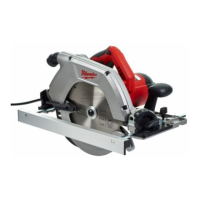
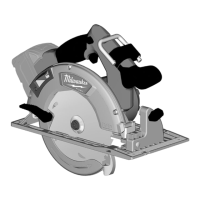
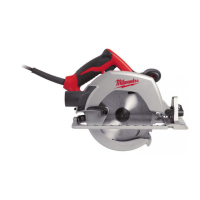
TECHNICAL DATA Circular saw



 To Next Page