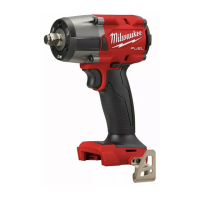
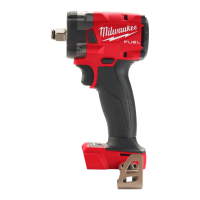
The Milwaukee M18 FUEL™ 3/8" Compact Impact Wrench (Cat. No. 2854-20) and 1/2" Compact Impact Wrenches (Cat. No. 2855-20, 2855P-20) are cordless power tools designed for fastening and loosening nuts, bolts, and screws. These tools are part of the M18™ battery platform, utilizing 18 DC Volt M18™ battery packs.
Function Description:
These impact wrenches are designed to deliver high torque for various fastening applications. They operate by impacting rotational force, which allows them to drive or remove fasteners more effectively than standard drills or drivers, especially in situations requiring significant torque. The tools feature a control switch for selecting forward, reverse, and lock positions, and a variable speed trigger for precise control over driving speed. An LED light illuminates the work area when the trigger is pulled.
Important Technical Specifications:
- Model Numbers: 2854-20 (3/8" Compact Impact Wrench), 2855-20 (1/2" Compact Impact Wrench), 2855P-20 (1/2" Compact Impact Wrench with Pin Detent).
- RPM (No Load Revolutions per Minute): 0-2400 min⁻¹
- IPM (Impacts per Minute Under Load): 0-3500 min⁻¹
- Volts: 18 DC
- Battery Type: M18™
- Charger Type: M18™
- Recommended Ambient Operating Temperature: 0°F to 125°F
- Anvil Types:
- 2854-20: 3/8" Square drive anvil
- 2855-20: 1/2" Square drive anvil
- 2855P-20: 1/2" Square drive anvil with pin detent
Speed Control Settings (Cat. No. 2854-20):
- Mode 1: 0-800 RPM, 0-1000 IPM, Up to 65 ft-lbs Fastening Torque, Up to 65 ft-lbs Nut-Busting Torque
- Mode 2: 0-1650 RPM, 0-2400 IPM, Up to 150 ft-lbs Fastening Torque, Up to 150 ft-lbs Nut-Busting Torque
- Mode 3: 0-2400 RPM, 0-3500 IPM, Up to 250 ft-lbs Fastening Torque, Up to 250 ft-lbs Nut-Busting Torque
- Mode 4 (Auto Shut-off): 0-2400 RPM, 0-3500 IPM, Up to 20 ft-lbs Fastening Torque (Auto Shut-off mode), Up to 250 ft-lbs Nut-Busting Torque
Speed Control Settings (Cat. No. 2855-20 & 2855P-20):
- Mode 1: 0-900 RPM, 0-1000 IPM, Up to 65 ft-lbs Fastening Torque, Up to 65 ft-lbs Nut-Busting Torque
- Mode 2: 0-1650 RPM, 0-2400 IPM, Up to 150 ft-lbs Fastening Torque, Up to 150 ft-lbs Nut-Busting Torque
- Mode 3: 0-2400 RPM, 0-3500 IPM, Up to 250 ft-lbs Fastening Torque, Up to 250 ft-lbs Nut-Busting Torque
- Mode 4 (Auto Shut-off): 0-2400 RPM, 0-3500 IPM, Up to 20 ft-lbs Fastening Torque (Auto Shut-off mode), Up to 250 ft-lbs Nut-Busting Torque
Note: Torque values are approximate and depend on factors like battery discharge, battery size, impacting time, and bolt size. A torque wrench should always be used to confirm desired torque.
Usage Features:
- Battery System: Uses Milwaukee M18™ battery packs. Batteries are inserted by sliding them into the tool body until they latch securely and removed by pushing release buttons.
- Control Switch: A three-position switch allows selection of forward (clockwise) rotation, reverse (counter-clockwise) rotation, and a locked-off position. The switch can only be adjusted when the ON/OFF trigger is not pressed.
- Variable Speed Trigger: The tool's speed is controlled by the amount of pressure applied to the trigger. Releasing the trigger activates an electric brake, stopping the tool instantly.
- Speed Control Button: A dedicated button allows users to cycle through different speed modes (1, 2, 3, and 4/Auto Shut-off mode). The tool should come to a complete stop before changing speeds.
- Auto Shut-Off Mode (Mode 4):
- Forward: The tool runs at a reduced RPM and then shuts off once the desired torque is achieved, preventing over-tightening.
- Reverse (Bolt Removal): The tool runs at full RPM and IPM until the nut breaks free from the joint, then slows to a reduced RPM for better control during removal.
- Accessory Attachment:
- Square Drive Anvil (2854-20, 2855-20): Sockets are attached by aligning them with the anvil and pushing them firmly over the retaining ring. Removal involves pulling the socket off the anvil.
- Square Drive Anvil with Pin Detent (2855P-20): Sockets are attached by aligning the hole in the accessory with the detent pin, holding the detent pin in while pushing the socket onto the anvil until it snaps into place. Removal requires inserting a thin object (like a nail) into the accessory's hole to press in the detent pin, then pulling the socket off.
- Impacting Techniques: The manual advises against excessive impacting to prevent damage to fasteners or workpieces, especially with smaller fasteners. It recommends practicing to determine optimal impacting times and verifying tightness with a hand-torque wrench. Factors like oil, dirt, or rust on threads can affect tightness.
Maintenance Features:
- Regular Maintenance Program: Users are encouraged to adopt a regular maintenance program for the tool, battery pack, and charger.
- Inspection: Periodically inspect the tool for issues such as undue noise, misalignment or binding of moving parts, breakage of parts, or any other condition that may affect operation.
- Cleaning: Keep the tool's vents clear of dust and debris. Handles should be kept clean, dry, and free of oil and grease. Use only mild soap and a damp cloth for cleaning; avoid harsh cleaning agents, solvents (gasoline, turpentine, lacquer thinner, paint thinner, chlorinated cleaning solvents, ammonia, household detergents containing ammonia), and flammable or combustible solvents, as they can damage plastic and insulated parts. Never immerse the tool, battery pack, or charger in liquid.
- Battery Contact Cleaning: If the tool does not start or operate at full power with a fully charged battery pack, clean the contacts on the battery pack.
- Professional Service: For all repairs, or if the tool still does not work properly after cleaning contacts, return the tool, battery pack, and charger to a MILWAUKEE service facility. The manual recommends returning the tool, battery pack, and charger for inspection after six months to one year of use, depending on usage frequency. Never disassemble the tool, battery pack, or charger.
- Safety Precaution: Always unplug the charger and remove the battery pack from the charger or tool before performing any maintenance.

 Need help?
 General



 To Next Page