57
7. SELECTION
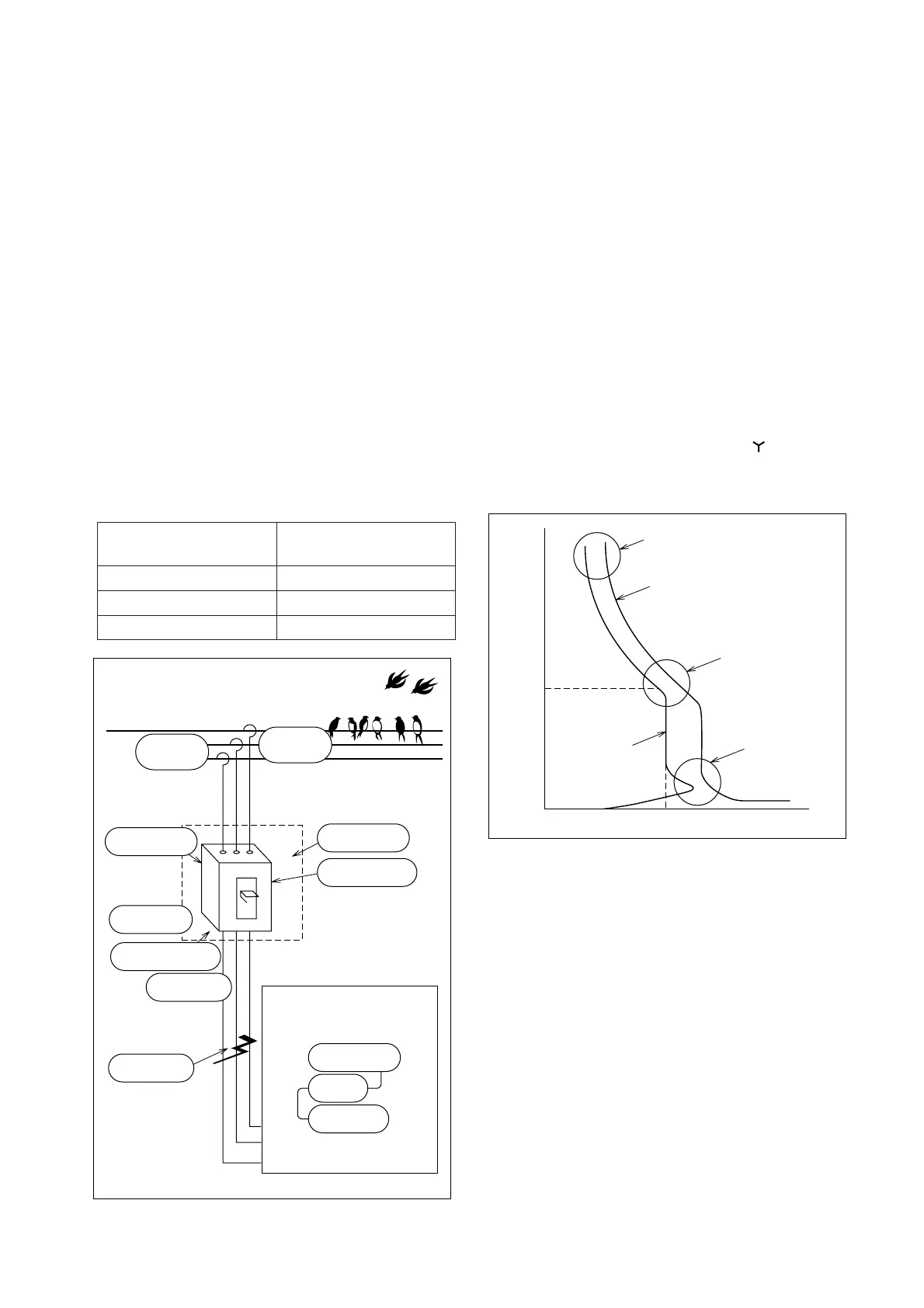
In selecting MCCBs for a particular application, in
addition to purely electrical aspects of load and distri-
bution conductor systems, physical factors such as
panelboard configuration, installation environment,
ambient-temperature variations, vibration, etc. must
also be considered.
MCCBs are rated for an ambient of 40°C, and
where panelboard internal temperatures may exceed
this, the MCCBs installed should be derated in accor-
dance with Table 7.1.
1. Actual load currents may exceed the nominal-val-
ues.
2. Load currents may increase with time, due to dete-
rioration of load devices (i.e., friction in motors).
3. Source voltage and frequency may vary.
7.1 Motor Branch Circuits
The following discussion assumes single motors and
cold-start operation.
7.1.1 General Considerations
The starting current (I
MS
) and time (T
MS
) for the mo-
tor, and its full-load current, dictate the rated current,
long-delay trip and instantaneous-trip curves for the
MCCB as shown in Fig. 7.2. A safety-margin of up to
50% should be considered for the starting time, to
allow for voltage variations and increase in load fric-
tion.
The instantaneous-trip curve should be at least 1.4
x normal starting current to allow for the effect of the
DC component attendant to the low power factor
(about 0.3) of the starting current. For -delta start-
ing the unphased-switching allowance increases the
1.4 margin to 1.9. For running restarting the unphased-
switching allowance increases the factor to 2.4.
Rated currents
MCCB trip curve
Starting current
and long-delay trip
Inrush and
inst. trip
Motor
starting
current
T
MS
I
MS
Current
Time
Fig. 7.2 MCCB and Motor Starting
7.1.2 Motor Breaker
Where starting times are relatively short and currents
are small, the Mitsubishi M Line motor breakers can
be used without the need for a motor starter.
7.2 For Lighting and Heating Branch Cir-
cuits
In such circuits, switching-surge magnitudes and times
are normally not sufficient to cause spurious tripping
problems; however, in some cases, such as mercury-
arc lamps or other large starting-current equipment,
the methods presented in §7.1 above should be con-
sidered.
In general, branch MCCBs should be selected so
that the total of ratings of the connected loads is not
more than 80% of the MCCB rating.
Fig. 7.1 MCCB Selection Consideration
Table 7.1 MCCB Deratings Due to Installation
Factors
Panelboard max.
internal temp. (°C)
50
55
60
Load allowable, due to
panelboard temp. (%)
90
80
70
Supply
system
Ambient
temperature
Main,submain
or branch use
Ambient
conditions
Wire
connection
Load
current
Operation
conditions
Load
Short circuit
Installation and
connection style
Service
purpose
Regulations
?



 To Next Page
 Loading...