EasyManua.ls Logo

Mitutoyo 129 Series - User Manual

Mitutoyo 129 Series
2 pages
Print Icon
To Next Page IconTo Next Page
Loading...
1
Date of publication: May 1, 2023
Printed in Japan
Mitutoyo Corporation 20-1, Sakado 1-Chome, Takatsu-ku, Kawasaki-shi, Kanagawa
213-8533, Japan
■
129Series
DMC
①
Spindle
Base
Sleeve
Thimble
Ratchet stop
Spindle clamp
Key wrench
Rod
Thimble cap
Hex wrench
Wrench
2. PrecautionsforUse
Parallax
Because of the structure of the product, the reference line surface on
the sleeve and the graduation line surface on the thimble are not on
the same plane, so the point where the two lines meet will deviate
depending on the position of your eyes. When reading measured
values, do so with reference to the gure at right, perpendicular from
the point where the reference line on the sleeve is aligned with the
graduation line on the thimble.
If looking from a different direction (as in the gure at right), there will
be a parallax of approximately 2 μm.
MeasuringForce
Use the ratchet stop to ensure consistent measuring force.
The appropriate measuring force is about three to ve turns of the ratchet
stop with ngers after the measuring surface lightly contacts the
workpiece. Note that excessive measuring force may cause measurement
error.
PrecautionsandCleaningafterUse
After use, check each part for damage and clean the entire spindle, rod, and base with a soft lint-free cloth.
When oil, cutting uid, or liquid itself is adhered, or when very dirty, clean with a soft lint-free cloth impregnated with a
volatile solvent (cleaning alcohol, etc.).
After use, apply anti-rust treatment to the spindle, rod, and base using Micrometer Oil (Part No. 207000).
If using in places exposed to water-based cutting uid, always apply anti-rust treatment after cleaning.
If Micrometer Oil is unavailable and the only option is a commercial product, we recommend low-viscosity anti-rust oil
of ISO VG10 or so.
3. ReferencePointSetting
Important
Be sure to follow the procedure below to conrm and adjust the reference point prior to measuring.
Reference point setting for this product should be performed on a at surface such as a precision surface plate.
When setting the reference point for this product, make sure to use a calibrated gage (gauge block, etc.).
Remove any dirt or oil from the measuring surfaces of the gages and product prior to setting the reference point.
Use the same orientation and conditions when measuring and setting the reference point.
When setting the reference point, press the base rmly against the reference surface as shown in the gure below.
ReferencePointConrmation
1
Remove any dirt or dust from the measuring surfaces of the gages and the product.
2
Rotate the thimble and bring the measuring surface gently into contact with the precision surface plate.
3
Apply the prescribed measuring force by turning the ratchet stop three to ve times.
4
Read the scale, and if the reading does not match the zero point or the gage dimensions, adjust the reference point
in accordance with the following procedure.
ReferencePointAdjustment
128Series
If the reference point difference is ±0.01 mm or less
1
With the reference point conrmed, x the spindle with the spindle clamp.
2
Insert the supplied key wrench into the hole on the rear of the reference line on the sleeve, and then rotate the
sleeve until the reference line is aligned with the zero graduation line on the thimble.
If the reference point difference is approximately ±0.01 mm or more
1
With the reference point conrmed, x the spindle with the spindle
clamp.
2
While holding the thimble in place with your ngers to prevent it
from turning, insert the supplied key wrench into the hole on the
side of the ratchet stop and loosen the ratchet stop.
3
Rotate the thimble while pushing it toward the ratchet stop and
align the thimble's gradations with the sleeve's reference line.
4
Tighten the ratchet stop with the key wrench while gently pushing
the thimble in the direction of the sleeve, being careful not to allow
the thimble to rotate.
5
Loosen the spindle clamp.
SafetyPrecautions
To ensure operator safety, use this product according to the directions, functions and specications given in this
User's Manual. Use under other conditions may compromise safety.
Always handle the sharp parts of this product such as measuring faces with care to avoid injury.
Do not use this product for purposes other than measurement.
Do not disassemble or modify. Doing so will void the warranty.
Do not use or store the product in a place with sudden temperature changes. Adapt the product to
ambient temperature before use.
Do not store the product in a place with high humidity or a lot of dust.
Do not use the product in a place where it may contact water, etc.
Apply anti-rust treatment after use if the product is used in a place where it is directly exposed to
splashes of coolant, etc. Rust may cause malfunction.
Do not apply excessive force or subject to sudden impacts such as dropping.
Remove dust, cutting chips, etc. and apply anti-rust oil after use.
Remove any dirt on the product by wiping gently with a soft non-linty cloth. Do not use organic solvents
such as cleaning agents or thinner.
Do not write numbers, etc. with an electric pen.
DepthMicrometer
User's Manual
No.99MAA024A
Contents
1. Names of Components ........................................................................................... Page 1
2. Precautions for Use................................................................................................. Page 1
3. Reference Point Setting .......................................................................................... Page 1
4. Changing the Measurement Range ........................................................................ Page 2
5. How to Read Graduations ....................................................................................... Page 2
6. Specications .......................................................................................................... Page 2
7. Paid Maintenance ................................................................................................... Page 2
1. NamesofComponents
■
128Series
DMS
NG
OK
NG
Reference line
Sleeve
Thimble
For 0 to 25 mm measurement range
For measurement range greater than 25 mm
2
Thimble
Ratchet stop
Key wrench
Rotate about three to ve times
Base
Reference surface
Precision surface plate
en

Question and Answer IconNeed help?

Do you have a question about the Mitutoyo 129 Series and is the answer not in the manual?

Summary

Precautions for Use

Parallax

Explains how eye position affects reading due to different planes of reference and graduation lines.

Measuring Force

Details the use of the ratchet stop for consistent measuring force and the appropriate force application.

Reference Point Setting

Reference Point Confirmation

Procedure to confirm the reference point by contacting a precision surface plate and checking the scale.

Reference Point Adjustment

Guides on adjusting the reference point for differences of ±0.01 mm or more using a key wrench.

Paid Maintenance

Changing the Measurement Range

How to Read Graduations

Specifications

Overview

This document describes the Mitutoyo 129 Series Depth Micrometer (DMC), a precision measuring instrument designed for accurate depth measurements.

Function Description

The Depth Micrometer is used to measure the depth of holes, steps, and other features on a workpiece. It operates by extending a rod from a base, with the measurement read from a sleeve and thimble scale. The instrument provides a direct reading of the depth, ensuring high precision for various applications.

Important Technical Specifications

  • Maximum Permissible Measurement Error: ±3 µm (±0.00015 in) for 128 Series models.
  • Graduation: 0.01 mm (0.001 in). This indicates the smallest division that can be read directly from the scale.
  • Operating Temperature: 5 °C to 40 °C. This is the recommended temperature range for accurate operation.
  • Storage Temperature: -10 °C to 60 °C. This range specifies the safe storage conditions for the instrument.
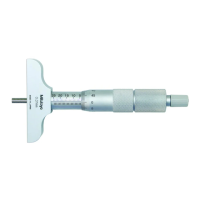
  • Components: The micrometer consists of a spindle, base, sleeve, thimble, ratchet stop, spindle clamp, key wrench, rod, thimble cap, hex wrench, and wrench. These components work in conjunction to facilitate measurement and adjustment.

Usage Features

Reference Point Setting: Before any measurement, it is crucial to confirm and adjust the reference point. This process involves:

  1. Preparation: Removing dirt or dust from the measuring surfaces of both the gages (e.g., precision surface plate) and the product.
  2. Contact: Rotating the thimble to bring the measuring surface gently into contact with a precision surface plate.
  3. Measuring Force: Applying the prescribed measuring force by turning the ratchet stop three to five times.
  4. Reading: Reading the scale. If the reading does not match the zero point or the gage dimensions, adjustment is necessary.

Reference Point Adjustment (128 Series):

  • For differences of ±0.01 mm or less:
    1. Fix the spindle with the spindle clamp.
    2. Insert the supplied key wrench into the hole on the rear of the reference line on the sleeve.
    3. Rotate the sleeve until the reference line aligns with the zero graduation line on the thimble.
  • For differences of approximately ±0.01 mm or more:
    1. Fix the spindle with the spindle clamp.
    2. While holding the thimble in place, insert the key wrench into the hole on the side of the ratchet stop and loosen it.
    3. Rotate the thimble while pushing it toward the ratchet stop to align its gradations with the sleeve's reference line.
    4. Tighten the ratchet stop with the key wrench, being careful not to rotate the thimble.
    5. Loosen the spindle clamp.

Measuring Force: The ratchet stop is used to ensure consistent measuring force. The appropriate force is achieved by turning the ratchet stop three to five times after the measuring surface lightly contacts the workpiece. Applying excessive force can lead to measurement error.

Parallax: Due to the product's structure, the reference line on the sleeve and the graduation line on the thimble are not on the same plane. This can cause a deviation in the perceived meeting point of the lines depending on eye position. To avoid parallax (approximately 2 µm), readings should be taken with the eye perpendicular to the point where the reference line on the sleeve aligns with the graduation line on the thimble.

Changing the Measurement Range (129 Series): The 129 Series allows for changing the measurement range by replacing the rod.

  1. Hold the thimble steady and remove the thimble cap.
  2. Pull out the mounted rod and insert the appropriate rod.
  3. Hold the thimble steady and mount the thimble cap securely. Important: Always set the rod into the body slowly and carefully to prevent damage.

How to Read Graduations: Measurements are read from the sleeve (outer sleeve) and the thimble. For example, a sleeve reading of 17.5 mm and a thimble reading of 0.37 mm combine for a total measurement of 17.87 mm. The thimble is read at the location where the sleeve reference line matches the graduation line on the thimble. While typically read down to 0.01 mm, it can be visually estimated down to 0.001 mm.

Maintenance Features

Precautions and Cleaning after Use:

  • Inspection: After use, check each part for damage.
  • Cleaning: Clean the entire spindle, rod, and base with a soft, lint-free cloth. If oil, cutting fluid, or liquid is adhered, or if very dirty, clean with a soft, lint-free cloth impregnated with a volatile solvent (e.g., cleaning alcohol).
  • Anti-rust Treatment: After use, apply anti-rust treatment to the spindle, rod, and base using Micrometer Oil (Part No. 207000). If Micrometer Oil is unavailable, low-viscosity anti-rust oil of ISO VG10 or similar is recommended. Always apply anti-rust treatment after cleaning, especially if used in environments exposed to water-based cutting fluid.

Safety Precautions:

  • Use the product only for measurement purposes.
  • Do not disassemble or modify the product, as this will void the warranty.
  • Avoid sudden temperature changes; allow the product to adapt to ambient temperature before use.
  • Do not store the product in high humidity or dusty environments.
  • Prevent contact with water or coolant splashes, as rust may cause malfunction.
  • Avoid excessive force or sudden impacts.
  • Remove dust and cutting chips after use.
  • Do not use organic solvents like cleaning agents or thinner for cleaning.
  • Do not write numbers with an electric pen.
  • Handle sharp parts (e.g., measuring faces) with care to avoid injury.

Paid Maintenance: Periodic inspections are recommended to maintain the product's accuracy. In case of inconsistent measured values or damage (e.g., burrs or nicks on measurement surfaces affecting repeatability), contact the agent where the product was purchased or a Mitutoyo sales office.

Mitutoyo 129 Series Specifications

General IconGeneral
BrandMitutoyo
Model129 Series
CategoryMeasuring Instruments
LanguageEnglish

Related product manuals