Page Number - 4 Form 824255
eign matter that may have fallen into the cylinders during
preparation for test.
10.Selecttheappropriateadaptertting(14mm,18mmshort
reachor14mm,18mmlong-reach),andthreadadapter
into spark plug hole of cylinder head.
11. Connect the appropriate test hose or adapter to the
gauge assembly.
12.Cranktheengineatleastvecompressionstrokesor
until the pressure reading stops increasing on gauge.
13. Read the pressure level on the gauge and record the
reading along with the cylinder number being tested.
Example: #1-150 psi, #2-145 psi, etc.
14. Repeat this test on each cylinder. If any of the cylinder
readingsarefoundtobeloworuneven,performwet
compression test.
15.Whencompressiontestiscomplete,returnthespark
plugs to their respective cylinders and the throttle and
ignition components to their normal positions.
Wet Compression Test Procedure
CAUTION: DO NOT perform the wet compression test
on any diesel engine. The higher compression in a
diesel engine may cause engine damage or injury to
the technician.
Thewetcompressionisawaytoremovetheinuenceof
thepistonrings,pistonsandcylindersfromthecompres-
siontest.Aftercompletingthedrycompressiontest,squirt
approximately one teaspoon of engine oil into the spark
plug holes and crank the engine several times to seal the
piston rings. Repeat the dry compression test outlined
above. NOTE: If the readings during the wet compression
testaregreater,thenairisleakingaroundwornordam-
aged piston rings. If the reading is approximately the same
forbothwetanddryteststhenthevalves,valveliftersor
the camshaft lobes are worn. Any low reading of cylinder
compression indicates worn or damaged parts.
Small Engine Compression Testing
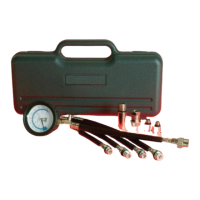
The Mityvac Professional Compression Test Kit has two
(2)adapters,10mmand12mm,thatallowittobeusedon
smallenginesfoundinlawnmowers,chainsawsandline
trimmers.Tousetheseadapters:
1. Disconnectthesparkplugwireandremovethespark
plug.
2. Thread the appropriate size adapter onto the compres-
sion tester main hose end until the o-ring seats (do not
use a wrench to tighten).
3. Thread the assembly into the cylinder spark plug hole
untiltheo-ringontheadapterseatsrmly(donotusea
wrench to tighten).
4. Ensure the spark plug is grounded to the cylinder head
or is insulated in a way that will prevent an electric
shock hazard.
5. Crank the engine over using the pull cord (or starter if
electric) a minimum of 5 revolutions. This will allow the
cylindertobuildsufcientcompressiontobemeasured.
6. Refer to the manufacturer’s data to determine the cor-
rect reading
Using the Pressure Hold Adapter
The Mityvac Professional Compression Tester comes with
a pressure hold adapter. This adapter is used to perform
valve seal replacement on an engine without removing the
cylinderhead(s).Tousetheadapter:
1. Remove the spark plug from the desired cylinder.
2. Selecttheappropriateextensionhosethatwilltthe
spark plug hole.
3. Usingthevalvecoretool(fromtheeldservicekitin-
cluded),removethevalvecorefromtheendofthehose
and lay it aside.
4. Thread the extension hose into the spark plug hole
until the o-ring seats; do not use pliers or a wrench to
tighten.
5. Attach the Air Hold Adapter to the extension hose.
6. AttachashopairhosetotheAirHoldAdapter,thiswill
maintain air pressure in the cylinder to hold the valves
closed while performing repairs. (It may be necessary
to rotate the engine until all valve are closed and air is
holding in the cylinder)
Note: Air Hold quick connector does not come with a
compressed air line tting to adapt to your air source.
This will have to be purchased separately to t your
system.
Contacting Lincoln Industrial Corp.
LincolnIndustrialCorporation,
OneLincolnWay,
St.Louis,MO63120
Phone:(314)679-4200Ext.4410
Fax:(800)424-5359
E-mail:custserv@lincolnindustrial.com
Fortechnicalquestions,pleasecontactourTechnicalSer-
viceDepartment:
Phone:(314)679-4200Ext4782
Fax:(314)679-HELP(4357)
E-mail:techserv@lincolnindustrial.com
VisitourWebSiteat:www.mityvac.com
TO AVOID PERSONAL INJURY AND/OR VEHICLE DAM-
AGE:
Whilesomeprecautionsarespeciedinthismanual,
and should be noted to avoid personal injury or vehicle


 To Next Page
 Loading...