Need help?
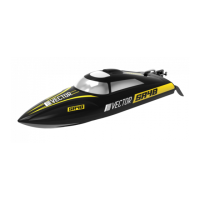
Do you have a question about the MODSTER Vector SR65 and is the answer not in the manual?
RC boats are not toys and require responsible use and adherence to safety guidelines.
Users are solely responsible for the safe operation and any damage caused by the product.
Lithium batteries are more volatile than other types and require careful handling to prevent fire.
Essential safety checks and precautions must be followed before charging or using the battery.
Never leave the lithium battery unattended while charging and always monitor it.
Allow the battery to cool to room temperature before recharging after use.
Use only the supplied or compatible charger for lithium batteries to prevent fire and damage.
Stop charging immediately if a battery swells and place it in a safe area away from combustibles.
Store batteries at room temperature (20-25°C) or 4-37°C for transport, avoiding hot locations.
Do not leave the LiPo battery connected to the ESC when not in use to prevent over-discharge.
Store lithium batteries partially charged for better security and longevity.
Never store the battery inside the model; store it in a fire-proof place.
Lists all components included in the product package for assembly and use.
Step-by-step guide for installing the battery into the boat hull.
Procedures to verify correct radio system operation, including transmitter/ESC on/off sequence.
Correct sequence for powering the transmitter and ESC on and off to prevent damage.
Steps for preparing the boat and transmitter for the first use and initial testing.
Guidelines for conducting the initial test drive of the boat in water safely.
How to adjust the steering trim and rudder for straight boat navigation.
Advice on safe driving practices, avoiding hazards, and adapting to conditions.
Recommendations for optimal driving conditions and managing speed based on environment.
Warning about potential propeller damage when operating in turbulent water at full throttle.
Do not remove the boat from water during extreme temperatures or turbulence without supervision.
Tips to prevent motor overheating and excessive wear for longer motor life.
Steps to follow after driving, including powering down and battery removal.
Importance of replacing damaged or worn drive shafts to prevent further damage.
Recommended lubrication of drive shafts and moving parts every 2-3 hours for protection.
Detailed steps for removing, cleaning, and lubricating the drive shaft.
Warning that operating in salt water voids the warranty and requires thorough cleaning.
Step-by-step instructions for installing the rudder and associated components.
Essential checks and preparations before operating the boat, including connections and settings.
Procedures after driving, including disconnecting power, drying the boat, and repairs.
Use only compatible chargers for lithium batteries to prevent damage or fire.
Ensure correct polarization when connecting the battery and charger to avoid damage.
Steps to connect the balance charger and power supply correctly for charging.
Connect the battery to the charger, noting polarity to prevent damage.
Understanding LED indicators for charging status (red for charging, green for charged).
Estimated time for recharging a battery, typically 1.5-2.5 hours.
Avoid storing lithium batteries fully charged; partial charge is recommended for longevity.
Troubleshooting common issues like noise, reduced runtime, and binding problems.
Solutions for boat diving or taking on water, including center of gravity and trim tabs.
Resolving issues with rudder movement, reversed controls, and unresponsive steering.
Diagnosing and fixing problems related to motor or ESC overheating.
Solutions for boats failing to bind or respond to throttle commands.
Model not for children under 14; keep body parts and clothing away from propeller.
Operate only in safe areas, avoiding third parties, crowds, and hazardous conditions.
Test range, battery status, and check all connections and screws for security.
Avoid salt water, poor visibility, high-voltage lines, radio masts, and storms.
Always disconnect and remove the battery after driving; store outside the model.
Warranty is voided by salt water use or damage from leaking batteries.
Product complies with Radio Equipment Directive (RED) 2014/53/EU and harmonised standards.


 To Next Page
 General