®
Maintenance Procedures
Not under documentation control if printed. May be revised without notice. ©05-2014
Electronic version is available at www.moldmasters.com
Hot Runner User Manual Revision 18
11-9
Checking Nozzle Tip Height
1. Correct nozzle tip height and nozzle reference
point is found on the gate detail of the general as-
sembly drawing.
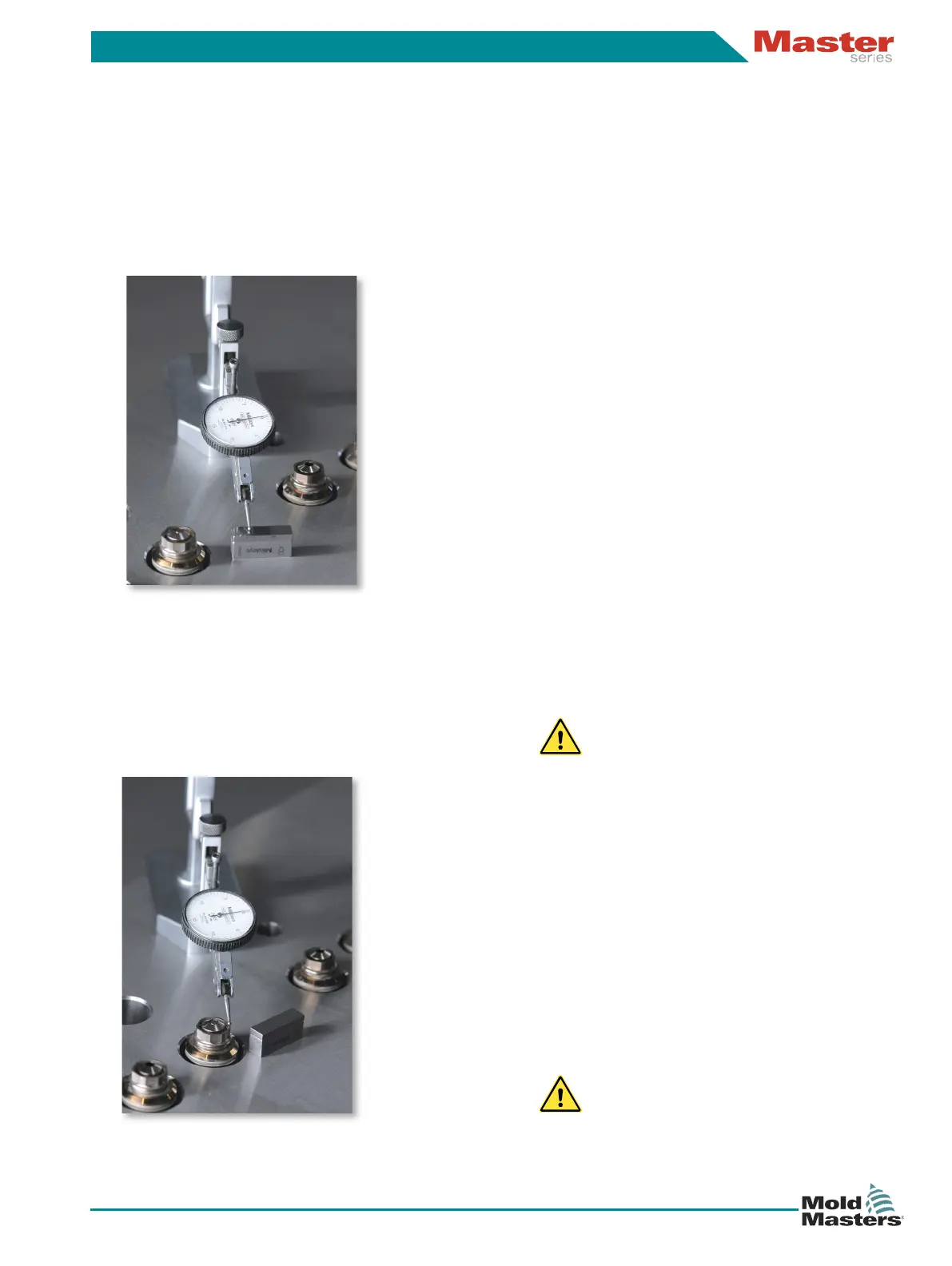
2. Assemble spacer blocks to same value as correct
nozzle tip height.
3. Zero indicator to spacer blocks.
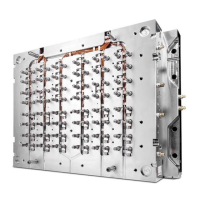
Figure 11-28 Checking Nozzle Tip Height
Figure 11-27
4. Move indicator to correct reference point on nozzle
tip (per drawing).
5. Check that nozzle height is within drawing speci-
cation.
6. Repeat for each nozzle.
Latching
Introduction
There are two reasons latches are used in a mold:
• To tie the mold halves together for transportation
and handling.
• To gain access between two mold plates which are
screwed together during normal mold operation.
Latches are always used in pairs mounted on diago-
nally opposite sides of the mold to provide equal pull
on the plates.
The latches are located on:
• The operator’s side.
• Non-operator’s side of the mold.
• Top and bottom of the mold.
Under no circumstances are plates to be pulled or
handled with only one latch attached.
Latch locations are shown on the assembly drawings.
During mold operation the latches must be removed
from the mold and stored elsewhere.
Latching the Cavity Plate to the Core
Half (Cold Half)
Use this procedure for reference purposes only. For
latch locations, refer to the assembly drawings.
For additional instructions on latching in the machine
refer to the machine manufacturers manual.
WARNING
Make sure the machine has been locked
out and tagged out in accordance to the
machines documented procedures. Failure
to do so may lead to serious injury or
death.
1. Open the mold.
2. Ensure that the machine and hot runner controller
has been locked out and tagged out.
3. Apply lock out / tag out to the machine power
source and hot runner controller. Refer to the con-
troller and machine manufacturers documentation
for procedures.
4. Allow the mold to cool to room temperature.
Continue to circulate the mold cooling water in all
plates to cool the mold more quickly.
WARNING
Make sure the lifting eyebolt, lifting chain
and crane are rated to adequately support
the weight of the plate(s). Failure to do so
could cause serious injury.


 To Next Page