Need help?
Do you have a question about the molex 2002180370 and is the answer not in the manual?
Instructions for terminal locator replacement, including removal and installation.
Recommended steps for cleaning, lubrication, and storage to ensure tool longevity.
Guidance on how to safely resolve tool jams without forcing.
Details on using the modular crimp head with various power tools and adapters.
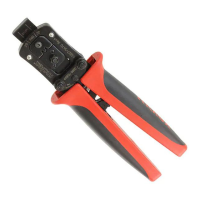
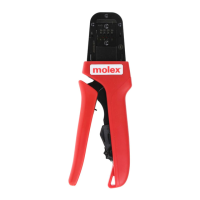
This document describes a hand crimp tool designed for 1.25mm (.049") pitch wire-to-board crimp terminals, specifically for 26-30 AWG, UL1061 wire. The tool is a manually powered device intended for low-volume or field repair, and its repetitive use for production is discouraged. It features a full-cycle ratcheting mechanism that ensures complete crimps by not releasing until the crimp is fully closed. The tool is equipped with ergonomically designed soft handles for comfortable use and precisely designed crimping profiles that simplify contact positioning. Its design also offers an outstanding force ratio, making it easy to handle.
The core of this tool is a modular crimp head, which is removable and versatile. This modular head (Order No. 2002180370) can be used not only with the hand crimp tool frame but also with other powered tools. For instance, it can be integrated into an Air Powered Tool (Order No. 63816-0100) when accompanied by an Air Powered Crimp Adapter (Order No. 63816-0700). Alternatively, it can be used with Battery Powered Tools (Order No. 63816-0200 for 110 V or 63816-0250 for 220 V), requiring a Battery Powered Crimp Adapter (Order No. 63816-0600). This modularity enhances the tool's flexibility and application range across different power sources.
Operating the hand crimp tool involves several steps to ensure a proper crimp. First, the tool must be opened by squeezing the handles together until the ratchet mechanism releases, allowing the tool to spring open. With the tool open, the terminal locator is pivoted outward by pulling up on its knob, and the wire stop blade is lifted. The terminal is then inserted into the correct profile slot until it is fully seated and stops, ensuring the wire stop blade is fully seated on the terminal behind the conductor grip section. The locator is then gently pivoted closed, and the wire stop blade is brought down. Next, the pre-stripped wire is slid into the terminal, aiming the wire brush towards the tip point on the wire stop blade. The wire must be aligned parallel to and seated in the terminal, maintaining light and constant pressure on the wire and terminal until fully crimped. The tool is then closed until the ratchet releases. Finally, the wire stop blade is lifted, and the crimped terminal is carefully removed. It is crucial to follow these instructions to maintain good brush control and a consistent bell mouth. The tamper-proof ratchet action ensures the tool will not release until it has been fully closed.
The tool's design emphasizes proper crimp formation, including specific requirements for bell mouth, conductor brush, bend up/down, twist roll, and seam integrity. The seam, for example, must not be open, and no wire should protrude from the crimping area. Pull force is a critical criterion for an acceptable crimp and should be measured without influence from the insulation crimp. For accurate pull force measurements, the insulation should be stripped long (1/2 inch) to prevent the insulation grips from interfering with the wire insulation or conductor.
Maintenance of the hand crimp tool is essential for its longevity and trouble-free operation. Operators are responsible for regularly removing dust, moisture, and other contaminants using a clean brush or lint-free cloth. Abrasive materials should not be used, as they can damage the tool. All pins, pivot points, and bearing surfaces require a thin coat of high-quality machine oil. Excessive oiling should be avoided. Applying light oil (such as 30-weight automotive oil) at the oil points every 5,000 crimps or every three months will significantly extend the tool's life. Excess oil should be wiped from the hand tool, especially from the crimping area, as oil transfer to terminations can affect electrical characteristics. When not in use, the handles should be kept closed to prevent objects from lodging in the crimping dies, and the tool should be stored in a clean, dry area.
In case of miscrimping or jamming, the tool should not be forced open or closed. Instead, the ratchet release lever should be lifted to open the tool easily. The tool is warranted against manufacturing defects for 30 days, with repairs or exchanges provided free of charge. However, this warranty is voided if the tool is altered, misused, damaged, or used for purposes other than hand crimping electrical terminals, such as clamping, fixturing, or using handle extensions. Molex does not repair hand tools, and replacement parts are limited to those listed in the manual. If the handles or crimp tooling are damaged or worn, a new tool must be purchased. Molex does not certify crimp hand tools.
Safety precautions include wearing eye protection at all times and keeping fingers away from the crimping area to prevent severe injury. The insulated rubber handles are not designed to protect against electrical shock. When using the modular crimp head with powered tools, it is critical to never operate, service, install, or adjust the head without proper instruction and without first reading and understanding the relevant manual or specification sheet. Additionally, tooling should never be installed or serviced while the tool is connected to any power source; the power must be disconnected by unplugging or turning off the actuator. Only Molex terminals specified for crimping with this tool should be used, as Molex crimp specifications are valid only with Molex terminals and tooling.
 General
| Manufacturer Part Number | 2002180370 |
|---|---|
| Manufacturer | Molex |
| Tool Type | Hand Tool |
| Minimum Wire Size (AWG) | 30 |
| Terminal Type | Crimp Terminals |
| Product Name | Crimp Tool |
| Application | Crimp |


 To Next Page