EN EN
2 3
INTENDED USE
The Aerobika
®
Oscillating Positive Expiratory Pressure Therapy System is intended for use as a Positive Expiratory
Pressure (PEP) device. The Aerobika
®
Oscillating PEP device may also be used simultaneously with nebulized aerosol
drug delivery. The device is intended to be used by patients capable of generating exhalation flow of 10 lpm for 3–4
seconds.
CAUTIONS
• Donotleavethedeviceunattendedwithchildren.Itisnotatoy.
• Donotpressattachmenttabswhenthecaseisdisassembled.Doingsocouldbreakthetabsandpreventproper
assembly of the device.
• Ensurecontraindicationsareobserved.
• Federal(USA)lawrestrictsthesaleofthisdeviceonorbytheorderofaphysician.
CONTRAINDICATIONS
UseoftheAerobika
®
Oscillating PEP device is not recommended for the following conditions
• Patientsunabletotoleratetheincreasedworkofbreathing
• Intracranialpressure(ICP)>20mmHg
• Hemodynamicinstability(bloodpressureinstability)
• Recentfacial,oral,orskullsurgeryortrauma
• Acutesinusitis
• Epistaxis(bleedingnose)
• Esophagealsurgery
• Nausea
• Activehemoptysis(bleedingfromlungs)
• Untreatedpneumothorax(untreatedcollapsedlung)
• Knownorsuspectedtympanicmembraneruptureorothermiddleearpathology
WARNING
Useofthisdeviceatexcessivepressuresmayhaveadverseeffects.Expiratorypressuresabove20cmH
²
O in patients
sensitive to increased transpulmonary pressure may develop one or more of the adverse side effects listed below. Expert
clinicaljudgmentshouldbeexercisedintheselectionoftheappropriatesettingforeachindividualpatient.Failureto
match the appropriate resistance setting on the Adjustment Indicator with the patient’s expiratory flow may result in
failure to achieve therapeutic objectives of oscillatory PEP therapy or one or more adverse side effects listed below.
Adverse reactions may include
• Increasedworkofbreathingthatmayleadtohypoventilationandhypercarbia
• Increasedcranialpressure
• Cardiovascularcompromise
• Myocardialischemia
• Decreasedvenousreturn
• Airswallowingwithincreasedlikelihoodofvomitingandaspiration
• Claustrophobia
• Pulmonarybarotraumas
SETTING UP THE AEROBIKA
®
OSCILLATING PEP
FordevicedescriptionsseeFigure1.
Beforeuse,ensuretheseinstructionshavebeenreadandarekeptavailableatalltimes.Ifyouhavequestionsaboutthe
performanceorusabilityofthisproduct,pleasecontactyourhealthcareprofessionalpriortouse.
FIGURE 2
DETERMINING PROPER RESISTANCE SETTING
The Aerobika
®
Oscillating PEP device should be set up by a healthcare professional using the following steps:
1. StartwiththeResistanceIndicatoratthelowestsetting.(Fig.2)
2. With the patient in a comfortable seated position, have them
inhalethroughthedevicetakingadeeperbreaththannormal,
but not to total lung capacity, then exhale briskly but not
forcefully through the device.
3. Resistance should be set so exhalation lasts for 3–4 times
longer than inhalation. Resistance can be increased by moving
theindicatortotheleft.Toreduceresistance,movetheindicator
backtotheright.
NOTE: Selection of the proper resistance setting will produce
thedesiredinspiratory:expiratoryflowratioof1:3or1:4for10–20minuteswithoutexcessfatigue.
4. Patientsshouldbereevaluatedperiodicallyorwithanychangeinstatus.Asairwaysbecomelesscongested,more
resistance will be needed to maintain inspiratory:expiratory ratios.
CAUTION: The resistance setting should be adjusted as recommended by your healthcare professional.
PROPER TECHNIQUE FOR USING YOUR AEROBIKA
®
OSCILLATING PEP
Treatments should be conducted twice daily or as directed by your healthcare professional.
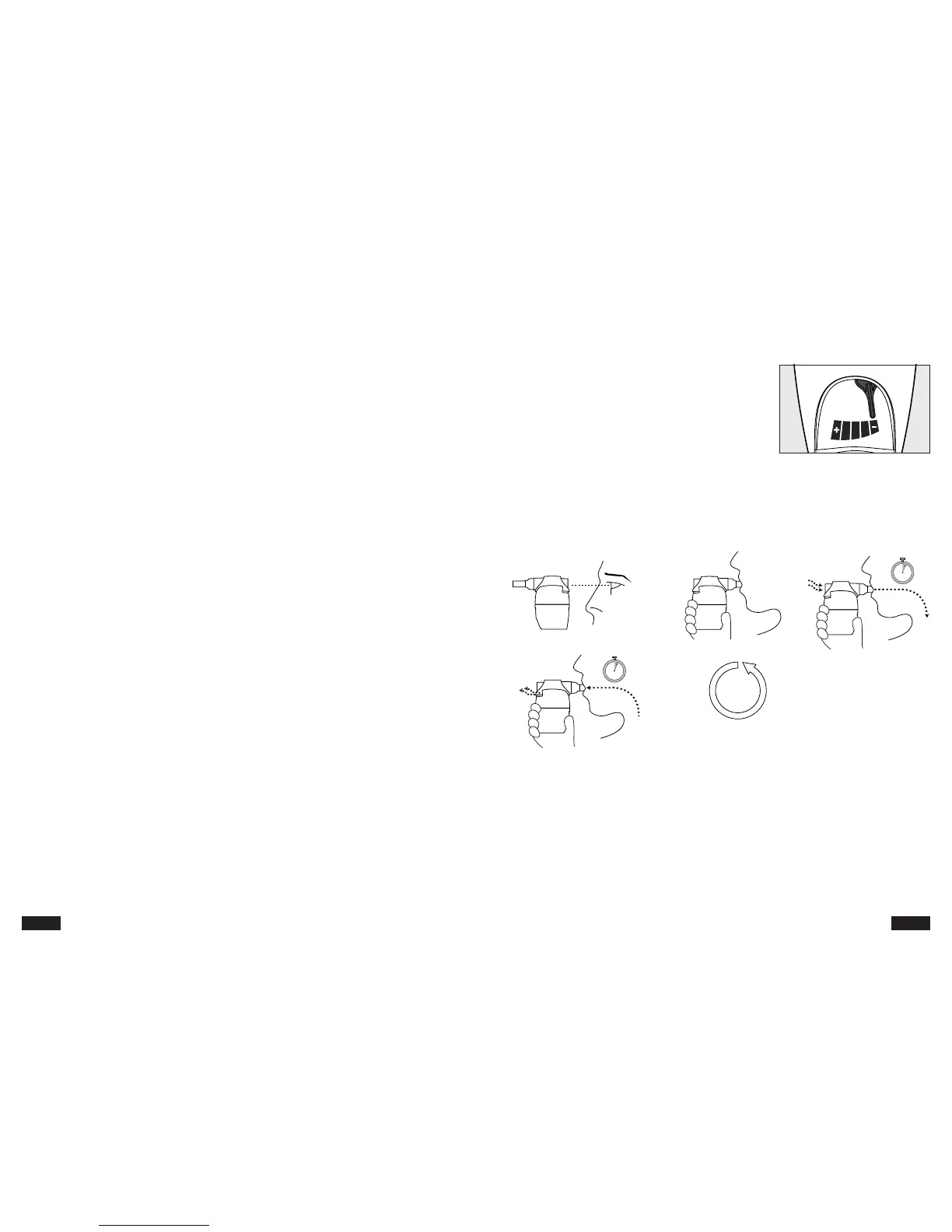
1 23
4
56
7
1. Before use carefully examine the device. Replace immediately if any defect is noticed. Always ensure the Resistance
Indicatorispositionedasprescribedbyyourhealthcareprofessional.Gentlypressthetwohalvestogethertomake
sure the Attachment Tabs are engaged.
2. TheAerobika
®
Oscillating PEP can be used in any orientation. It is recommended that treatments be done in a
comfortably seated position.
3. Putthemouthpieceinmouthandcloselipsaroundittoensureaneffectiveseal.Makesureyourhanddoesnot
blocktheexhalationpathonthebackofthedevice.
4. Inhalethroughthedevicetakingadeeperbreaththannormal,butdonottotallyfillyourlungs.Holdyourbreathfor
2–3secondsbeforeexhaling.
5. Exhale actively, but not forcefully, through the device. Ideally, exhalation should last 3–4 times longer than
inhalation.Keepyourcheeksflatandfirmtomaximizetreatmenteffectiveness.Ensureyoumaintainagoodsealon
the mouthpiece for the duration of your treatment.
Repeat
Steps
3–6



 To Next Page
 Loading...