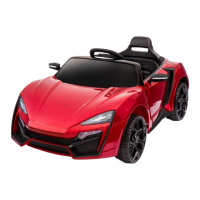
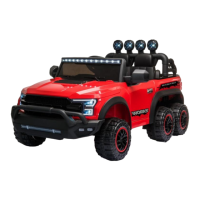
This document is a user manual for a children's battery-operated car with 2.4G remote control, model Florida, item number KL-5088-1. It provides instructions in both Bulgarian and English.
Function Description
The Florida battery-operated car is designed for children over 36 months of age, with a maximum weight capacity of 20 kg. It is intended for play and home use by one child who can stand steadily on their feet and move on their own. The car can be operated by the child using a foot pedal and steering wheel, or by an adult using the 2.4G remote control. The remote control allows an adult to override the child's control for safety. The car features a music player and lights.
Important Technical Specifications
- Appropriate Age: Over 3 years of age
- Speed: 3 – 5 km/h
- Maximum Weight Capacity: < 20 kg
- Size of the Product: 96 x 63 x 41 cm
- Size of the Package: 98 x 53.5 x 29.5 cm
- Charger: Input current: 100-220V 50-60Hz, Output current: DC12V 1000mA
- Battery: 1*12V4.5Ah (rechargeable lead-acid battery)
- Charging Time: 10 – 12 hours (first charge 8-12 hours, no more than 15 hours)
- Expected Life of the Battery: Around 300 charges
- Working Frequency of the Remote Control: 2.4GHz
- Range of the Remote Control: Maximum up to 10 meters
The product is designed and produced in compliance with the requirements of the European Toy Safety Directive, implemented at national level with the Regulation on the essential requirements and conformity assessment of toys. It complies with harmonized standards including EN 71-1:2014+A1:2018, EN 71-2:2020, EN 71-3:2019, EN IEC 62115:2020+A11:2020, EN 62368-1:2014+A11:2017, EN 62479:2:2010, EN 61000-3-2:2014, EN 61000-3-3:2013, ETSI EN 301 489-1 V2.2.3 (2019-11), ETSI EN 301 489-17 V3.2.2 (2019-07), and ETSI EN 300328 V2.2.2 (2019-07).
Usage Features
Assembly:
Adult assembly is required. The car contains small parts, so children under 3 years of age should not be present during assembly. Protective material and poly bags should be removed and disposed of before assembly.
- Front and Rear Wheels Installation: Turn the car body upside down. Attach side brackets to the left and right sides of the car body using screws and a screwdriver. For both front and rear wheels, remove split pins and washers from the axle, attach the wheels, place washers on each side, insert split pins into the corresponding openings, and then attach the wheel covers by pushing them until they click. The cogwheels of the rear wheels must fit tightly to the cogwheels of the gearboxes.
- Attaching the Steering Wheel: Connect the steering wheel's cable to the car's cable, then insert the cables into the opening. Place the steering wheel on the tip of the steering rod, aligning the openings. Secure it with a 5x35mm bolt and M5 nut using a screwdriver. Be careful not to damage the cables.
- Attaching the Front Windshield: Attach the windshield to the front part of the car's body by inserting its plastic pins into the corresponding openings. Press carefully down to fix it, avoiding excessive force that could break parts.
- Connecting Car Cables to Battery and Attaching Seat: Lift the seat and connect the red cable to the red terminal of the battery, ensuring correct polarity. Never connect a black cable to a red terminal or vice versa, as this may cause a short circuit. Turn on the car to check the connection. Place the seat back, ensuring its plastic pins enter the corresponding openings in the car body, then fix the seat with two screws.
Operating the Car:
- Power Button (P): Turns the car ON or OFF.
- Foot Pedal (FP): Used by the child to accelerate.
- Forward/Reverse Buttons (F/B): Selects the direction of movement.
- Charging Socket (C): For connecting the charger.
- Music Player (MP): Plays music.
Driving:
- Switch the car's power on. Music will start playing.
- Moving Forward: Put the Forward/Backward switch in the Forward position and press the foot pedal.
- Stopping: Lift your foot from the pedal or switch the Forward/Backward button to the middle position.
- Moving Backward: Ensure the car is stopped, then put the Forward/Backward switch in the Reverse position and press the foot pedal.
- Notice: Always ensure the car is stopped before changing direction to prevent damage to gears and motor.
- Warning: Do not listen to loud music to prevent hearing impairment.
Remote Control (RC):
The remote control operates at 2.4GHz. It has a power button (P), forward/backward (F/B), left/right (L/R) steering buttons, and a speed indicator (SI).
- Pairing: Turn on the car, then press the remote control's power button for 2-3 seconds until the indicator light flashes. The light will turn solid, indicating successful pairing. If pairing fails, turn off both the car and remote, then repeat.
- Functions:
- P (Power): Turns the remote ON/OFF.
- F (Forward): Moves the car forward.
- B (Backward): Moves the car backward.
- S (Stop): Stops the car.
- L (Left): Turns the car left.
- R (Right): Turns the car right.
- SI (Speed Indicator): 1 light = slow speed, 2 lights = medium speed, 3 lights = fast speed.
- Battery: The remote control uses 2 x 1.5V AAA/LR03 batteries.
- Notice: The remote control has a memory function for new car models (KL-5088-1). If you change the car, you may need to re-pair the remote.
- Important: The remote control has priority over manual pedal operation. If the remote is used, the pedal will not work.
Safety Warnings and Recommendations:
- Always use under direct adult supervision. Never leave the child unattended.
- Not suitable for children under 3 years due to maximum speed.
- The toy has no brakes.
- Protective equipment (e.g., shoes) must be worn. Ensure sturdy, non-slip shoes.
- Do not use in traffic, on soft surfaces (grass, soil, sand), wet or slippery surfaces, near pools/stairs, in rainy weather, or in the evening.
- Use only in well-lit and safe playgrounds/secure areas.
- The product requires skill to avoid falls/collisions. Teach the child how to drive correctly and safely.
- Use only for its intended purpose. Do not carry loads or allow more than one child at a time.
- Always sit on the seat; do not stand on the seat or use the car while standing.
- Moving parts! Entrapment hazards! Do not allow children to touch wheels with hands or objects while in motion.
- Keep packaging away from children.
- Battery attachment and charging must be done by an adult.
- Inspect the car and components for malfunctions after an impact.
- Do not use if parts are missing, loose, worn-out, or damaged. Contact the seller for replacement parts; do not substitute with non-manufacturer parts.
- Regularly check parts for damage.
- Important: Do not modify the product or its body, as this may reduce safety. Do not attach objects or accessories that could cause hooking, entanglement, or loss of balance.
Maintenance Features
Cleaning:
- Do not clean with a hose, water, or soap. Do not use the car in rainy weather or immerse it in water/liquids to prevent damage to the motor, electrical system, and battery.
- Clean the car only with a soft, dry cloth. Use a non-wax furniture polish to restore shine to plastic parts. Do not use strong abrasive cleaning agents.
- Always disconnect the car from the transformer before cleaning.
Maintenance and Storage:
- Parents/adults are responsible for regularly checking main parts (battery, charger, cables, wires, bushings, screws, body, driving systems, wheels, fastening components) for good condition, damage, or wear. Discontinue use if any issues are found and contact the seller for consultation.
- Ensure plastic parts are not cracked or broken.
- Periodically lubricate moving parts (wheels, driving links) with a very thin layer of lubricating oil, being careful during application.
- Store the car in an upright position; do not turn it upside down or tilt it. Park the car indoors or cover it with a tarpaulin to protect it from wet weather.
- When not in use, store the product in a dry, cool, and well-ventilated place. Keep away from heat sources (open fire, heating devices, cooking stoves) and damp areas.
Battery Maintenance:
- Only an adult can charge and recharge the battery.
- Before first use, charge for 8-12 hours (no more than 15 hours).
- Do not charge for less than 8 hours or more than 15 hours.
- Charge the battery for 10-12 hours after each use.
- Charge at least once a week.
- The battery may get warm and make a slight noise during charging; this is normal.
- The charger is not a toy and should be kept away from children.
- Important: The sealed lead-acid battery must be recycled or disposed of in an ecologically friendly manner. Do not throw it in fire (may explode or leak) or in household waste. Incineration, landfilling, or mixing with household waste is forbidden by law. Give discharged rechargeable batteries to a local recycling center or a center for sale of such batteries.
- Replace the battery with a new one and reconnect all cables and terminals.
- Place the metal bracket protecting the battery from upturning or falling back on.
- Return the seat of the battery-operated car back in place.
Troubleshooting Guide:
- Never try to repair a damaged product yourself. For repairs, contact the shop where you bought the product.
- Common issues and solutions are provided, such as:
- Car not starting/moving: Battery exhausted (charge), electric system damaged (check for water/dirt), power button disconnected (reconnect), battery damaged (replace), driving motor damaged (professional repair), thermal fuse tripped (reduce overload, check weight, avoid steep slopes, fixed objects, circuit modification).
- Battery not charging: Cable plug loose (reconnect), charger not plugged in (plug in), charger damaged (replace).
- Car operates for short time/stops often: Overloaded (check weight), charging time shortened (charge for recommended time).
- Car's usage time shorter/stops often: Wheels not moving freely (clean, contact seller).
- Battery warms/makes noise during charging: Normal chemical reaction.
- Car moves but music/lights don't work: Music player buttons damaged (contact seller).
- Car cannot stop: Pedal switch malfunction (check, clean, replace, contact seller).
- Car moves forward but not backward: Cable poorly connected (reconnect), Forward/Backward switch malfunction (replace, contact seller).
- Motor moves but wheels don't: Motor loose/poor connection to gearbox (contact seller), gearbox damaged (contact seller).

 Need help?
 General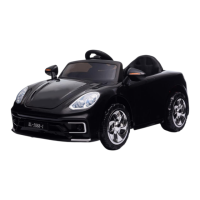

 To Next Page