16
An overloaded carbon ber part will not
bend or deform, so a damaged carbon
part (with reduced strength due to the
damage) may look normal - even after
the same load that bent the metal part.
But when the sum of the forces nally
exceeds the strength limit of the carbon
ber, the carbon ber part breaks, it does
not deform (Fig. 4).
In an accident or impact that does not
break the carbon ber, the carbon ber
could have internal or hidden damage
but appear normal. If that occurs, please
carefully read these instructions and
examine the carbon ber. These tests
are not conclusive: If you are not sure a
part is safe, replace it.
Carbon Fiber Test
To examine for surface problems
1. Clean the part fully with a moist cloth.
2. Look carefully for problems. These
include scratches, gouges, cracks,
discoloration, loose bers, or other
surface imperfections.
To examine for a change of the rigidity
(ex test):
Do not ride, but use the part in the
usual manner while someone carefully
examines the part for movement or
unusual noise.
To examine for delamination (tap test):
1. Clean the part fully with a moist cloth.
2. With a coin, tap near the area you
suspect damage.
3. Listen carefully for variations in
sound. Tap on the part where it is
in good condition (or use a part that
is almost the same). Compare the
sound. Anything unusual, especially
a hollow sound, indicates a problem.
Protect from Extreme
Temperatures
Protect carbon composite components
from extreme temperatures when storing
or transporting your bike.
Allow carbon composite components to
cool o or warm up before you ride. Do not
store a bike with carbon components in
places where the temperature will exceed
66.5°C (150°F). For example, do not
BEFORE EVERY RIDE CONTINUED
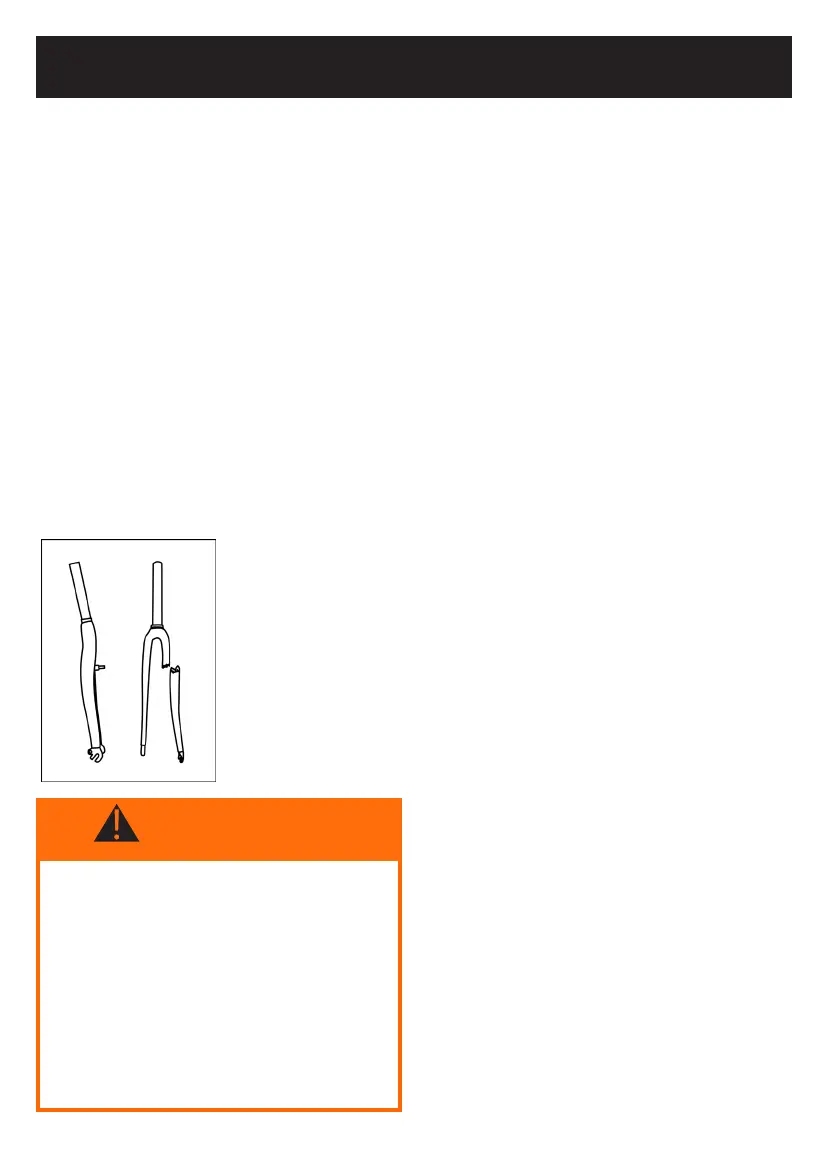
Fig. 4.
Overloaded forks:
• The metal fork
on the left bent
when overloaded
• The carbon ber
fork on the right
failed at a much
higher load, but
separated.
A carbon ber part that has damage
can break suddenly, causing serious
injury or death.
Carbon ber can conceal damage
from an impact or crash. If you
suspect your bicycle has had an
impact or crash, immediately stop
riding the bicycle. Replace the part
before riding, or take to your dealer for
service.
WARNING


 To Next Page