Fun with Envelopes | 9
At first you will hear a whole bunch of
noise as this will cause the sequencers
to run at audio rate. Play around with
the SEQUENCER 1 knobs and the VCO
2 FREQ knob to explore some of the
wild, broadband tones that audio-rate
clock modulation can achieve. Running
sequencers at audio-rate speeds can
be a very powerful method for creating
complex tones.
Once you’re done exploring some of
these tones with the SEQUENCER 1 knobs
and VCO 2 FREQ, rotate the VCO 2 FREQ
knob all the way down as well as VCO 2’s
SUB 1 FREQ knob.
With VCO 2 at a low frequency and
its first sub-oscillator at an even lower
one, you will hear the sequencer is now
driven by VCO 2 SUB 1 instead of the
Subharmonicon internal clock.
The benefit of using one of the oscillators
as a clock is that the VCOs are voltage
controllable—we can change the speed of
the clock with voltages from elsewhere in
Subharmonicon.
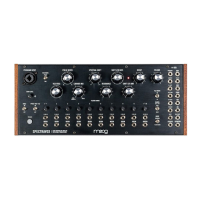
Subharmonicon features two independent
envelopes: one routed to the VCA
controlled by the VCA ATTACK/DECAY
knobs, and one routed to the filter
controlled by the VCF ATTACK/DECAY
knobs. Each has an output on the patch
bay so you can route them to other
Subharmonicon locations.
→ You can use an envelope to modulate
the pulse width for thicker sounds, for
example, or to modulate a rhythm for
more sporadic movement.
MAKE THIS CONNECTION
For this experiment, with VCO 2 SUB 1
driving the sequencers, let’s use the VCF
EG to modulate time. Patch the VCF EG
output to the VCO 2 SUB input.
Adjust the VCF DECAY all the way down
(completely counterclockwise), and begin
to raise the VCF ATTACK until roughly 12
o’clock.


 To Next Page