Need help?
Do you have a question about the Moog SYSTEM 15 and is the answer not in the manual?
Demonstrates basic sound generation using oscillators and noise sources to explore raw audio signals.
Explains how to control the pitch of synthesized sounds using the keyboard controller and associated modules.
Details how to shape the temporal dynamics (envelope) of sounds using the envelope generator and keyboard.
Illustrates combining multiple oscillators, including a VCO, to create complex multi-voice tones.
Covers the application of various filter modules (Fixed, Voltage Controlled Lowpass) for tone color and spectral shaping.
Demonstrates advanced modulation techniques using multiple envelope generators and a reversible attenuator.
Provides a detailed explanation of the 921 Voltage Controlled Oscillator's waveforms, controls, and operation.
Explains the 'clamping' functionality of the 921 VCO, which abruptly sets waveform points via trigger signals.
Describes methods for synchronizing oscillator outputs to create harmonically related or sub-harmonic relationships.
Explores frequency modulation techniques applied to the oscillator bank using control signals for dynamic pitch changes.
Details the functionality of the 995 Attenuators Panel for reducing signal magnitudes and creating multiple attenuation levels.
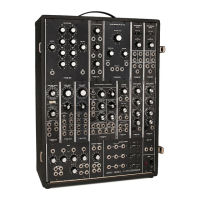
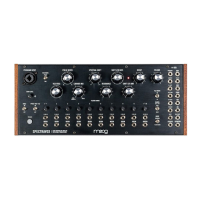
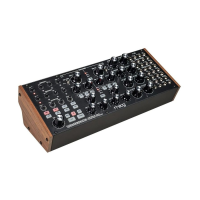
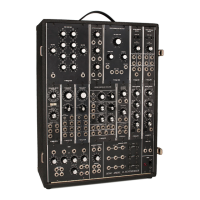
The Moog Synthesizer System 15 is a professional modular electronic music instrument designed for both live performance and studio use. Its compact size and convenient layout make it suitable for various musical applications, offering a wide range of sounds and effects. The system is built with high-quality, precisely-engineered components, ensuring reliability and versatility.
The Synthesizer System 15 comprises several modules, each with specific functions that contribute to sound generation, modification, and control.
921A Oscillator Driver: This module allows a single set of control voltages to determine the pitch and rectangular waveform widths of the 921B Oscillators. It acts as a central control point for multiple oscillators, ensuring consistent pitch relationships.
921B Oscillator: These are the primary sound sources, producing basic waveforms (sine, sawtooth, triangle, and rectangular) for both audio and control purposes. They feature expanded facilities for modulation and synchronization, allowing for complex sound textures and rhythmic interactions.
921 Oscillator: Similar to the 921B, this module also produces basic repetitive waveforms for audio and control. It includes expanded facilities for triggered waveform clamping and waveform level variation, offering additional control over the initial attack and overall dynamics of a sound.
923 Filters / Noise Source: This module combines filtering capabilities with a noise generator.
902 Voltage Controlled Amplifier (VCA): This module shapes the amplitude (loudness) of a signal in response to control signals. It is crucial for articulating sounds, creating dynamic changes, and implementing envelopes.
904A Voltage Controlled Lowpass Filter: This is a more advanced lowpass filter where the cutoff frequency can be controlled by external voltage signals. It also features a "Regeneration" control, which emphasizes frequencies around the cutoff point, leading to resonant effects.
907 Fixed Filter Bank: This module divides the audio spectrum into ten separate bands, each with an individual attenuator. Eight bands cover approximately half-octave frequency ranges, while two additional sections handle the lowest (20-200 Hz) and highest (3,500-20,000 Hz) audible frequencies. This allows for precise spectral shaping and equalization.
911 Envelope Generator: This module produces transient control contours (envelopes) whenever it receives a trigger signal. These envelopes typically control the amplitude of a VCA or the cutoff frequency of a filter, shaping the attack, decay, sustain, and release phases of a sound.
952 Keyboard Controller: This module generates two independent control voltages (for pitch) and two independent trigger signals (for initiating envelopes) in response to depressed keys. It allows for melodic and harmonic playing, with controls for scaling intervals and transposing pitch.
995 Attenuators: This panel allows for the reduction of the amplitude of up to three signals. Its hierarchical input arrangement enables a single signal to be attenuated in multiple ways or routed to different destinations with varying levels.
Mixer Panel: This module combines multiple audio or control signals into two complementary outputs, allowing for the blending of different sound sources or modulation signals.
Reversible Attenuator: This module permits any signal to be reversed in polarity and varied in magnitude, offering creative possibilities for modulation and signal processing.
The Moog Synthesizer System 15 is designed for hands-on exploration and experimentation. Users are encouraged to listen carefully and critically to understand the impact of each control.
 General
| Type | Modular Synthesizer |
|---|---|
| Voltage Control | Yes |
| Amplifier | VCA |
| Envelope Generators | 2 x ADSR |
| LFO | 1 x LFO |
| Patch Points | 1/4" jacks |
| Weight | 30 lbs |
| Oscillators | 3 x 921 Voltage Controlled Oscillators |

 To Next Page