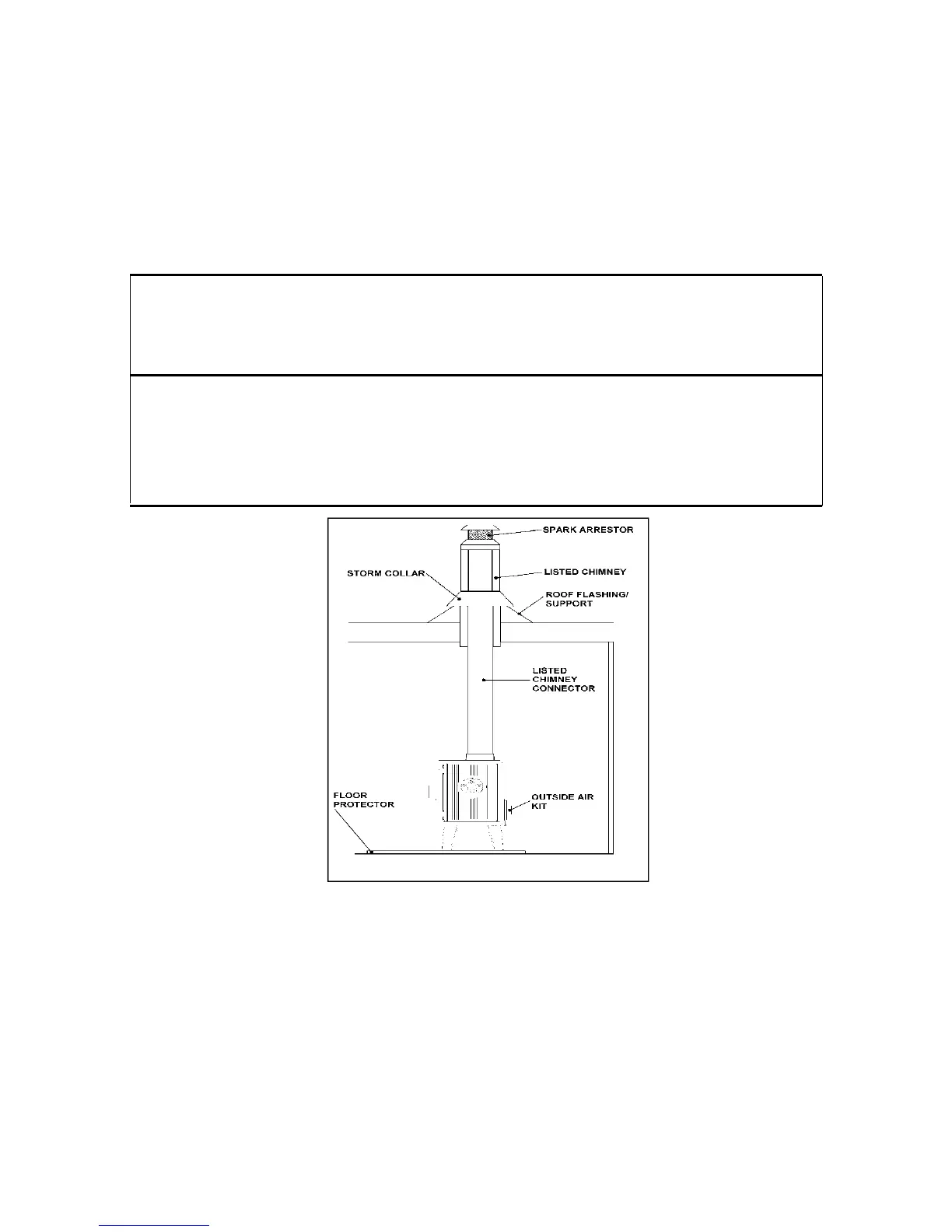
• Follow the chimney and chimney connector manufacturer’s instructions when in-
stalling the flue system for use in a mobile home.
• Outside air kit should be installed according to installation guide in the kit.
• Intake air piping can be installed through the floor into a vented crawl space or
through the wall of the residence to obtain outside air.
• Install in accordance with 24 CFR, Part 3280 (HUD).
• NOTE: Top sections of chimney must be removable to allow maximum clearance of
13.5’ from ground level for transportation purposes.
WARNING:
NEVER DRAW COMBUSTION AIR FROM A WALL, FLOOR OR CEILING CAVITY OR FROM
ANY ENCLOSED SPACE SUCH AS AN ATTIC OR GARAGE.
DO NOT INSTALL IN A SLEEPING ROOM.
CAUTION:
THE STRUCTURAL INTEGRITY OF THE MOBILE HOME FLOOR, WALL, AND CEILING/
ROOF MUST BE MAINTAINED (I.E., DO NOT CUT THROUGH FLOOR JOIST, WALL
STUD, CEILING TRUSS, ETC.) DO NOT USE A GRATE TO ELEVATE FIRE - BUID FIRE
DIRECTLY ON HEARTH.
Note:
Acid Protection
If acid-washing the masonry around the stove, protect the stove surface with an acid-proof
cover
Fresh Air Inlet
Unless there is deemed to be sufficient ambient leakage of air into the room via doorways,
windows and the like, a dedicated fresh air inlet will be needed. This inlet should have 2
square inches (1250 square mm) of free air space. This is particularly importAnt where the
room is well sealed, or where an extractor hood or ventilation system disturbs the natural air
pressure. Such an inlet should not be on a wall that is usually subject to negative pressure
from normal wind pattern. Avoid placing the inlet directly across the room from the stove,
thus causing a cold air draft.




 To Next Page