EasyManua.ls Logo

Motobecane 40 - Variator Description and Operation

Default Icon
90 pages
Print Icon
To Next Page IconTo Next Page
To Previous Page IconTo Previous Page
Loading...
DESCR I
PT I
ON AND
OPERAT I
ON oF THE
"f
IoBYMAT
I
c" vAR
I AToR
DESCRI PTI
ON
:
Like
all
Mobylettes, the
Mobymatic
provides
the
well-known
smoothness
dri
ve.
has a
primary
rubber
belt
drive which
and
flexibility,
and
a
secondary
chain
But the
Mobymatic
primary
drive
is special.
The drive
pulley
locked on
the engine
is
a
special
collaps'ib1e
one,
whose
cheek
spacing
is
varjable
under
the
influence
of centrifuga'riy
moved
balls
pushing
on
the cheek
sjde whjch
is opposjte the
belt.
As the cheeks
spread
apart
or close
inn
the winding
diameter of the
V-belt varies,
and
this
in turn
modjfies the
reduction
ratio
from
18.7:1
to
ll.B:.|.
The
engine
tilts around
its upper
attachment
axjs.
A
spring"tends to
push
the
engine
forward,
thus
ensur-
ing
belt tension.
OPERATION:
-
0n
starting,
the engine
revolves
slowly as
soon
as
it engages.
The
springs
which
push
the
engine
forward compel
the
belt to
rest on
the smallest
drive-
pulley
djameter.
The reduction
ratjo
is
at
jts
highest,
we are
jn
low
$ear.
As soon as
engine
speed'increases,
the
balls
push
the
movable
cheek,
thus
de-
creasing
the
reduction ratio,
which
means
that
for
a
qjven
engine
FPIn,
the
speed
oi the
machine
is increased.
If the
Mobylette
js
on a
flat road,
the
belt
goes
on-increas'ing
to
larger and
larqer
drive
pulley
djameters until
top
speed
is reached.
If
the
Mobylette
engages
an up-grade,
the
speed
of
both
mach-ine and
engine
tend to decrease.
The balls
exert
less
push
on the
mov-
able
cheek
which
then tends
to
move
away
from the
fixed one,
thereby
decreas-
ing the
belt winding
diameter.
As this change
of
speed
js
continuous,
the
modification
in reduction
ratio,
although
fast, occurs
gradually
and
smoothly.
The Mobymatic
responds
to all
road
conditions.
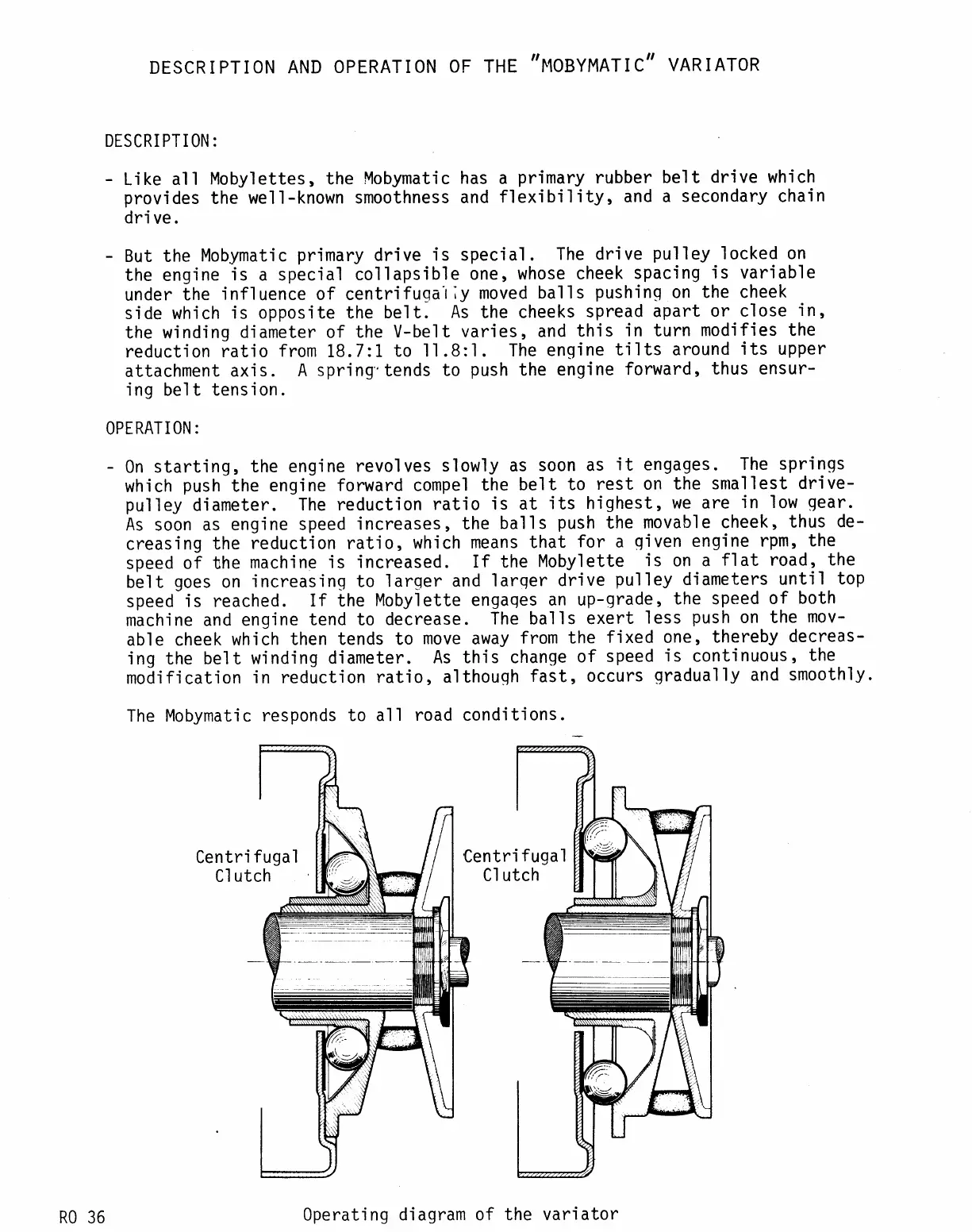
Centri
f
uga'l
Cl utch
Centri
fugal
Cl utch
R0
36
Operating
diagram of the variator