The Motorola GTR8000 is a high-performance base station/repeater designed for conventional simulcast radio systems. It serves as a critical component in radio communication networks, facilitating the transmission and reception of radio signals, and supporting features like externally injected PL (Private Line) tones for enhanced system control and operation. The device is typically rack-mounted and features a robust design suitable for continuous operation in demanding environments.
Function Description:
The primary function of the Motorola GTR8000 is to act as a base station or repeater in a conventional simulcast system. In this configuration, multiple GTR8000 units transmit on the same frequency simultaneously, providing wide-area coverage without the need for users to change channels as they move between coverage areas. The device processes incoming radio signals (RX Audio) and transmits outgoing radio signals (TX Audio). It also handles control signals such as PTT (Push-To-Talk) and CTCSS/PL (Continuous Tone-Coded Squelch System/Private Line) tones, which are essential for managing access to the radio channel and ensuring privacy within a talkgroup.
A key feature highlighted in the manual is its capability for "Externally Injected PL." This implies that the GTR8000 can receive PL tones from an external source, such as a Spectracom 1118 unit, rather than generating them internally. This external injection allows for greater flexibility and integration with advanced simulcast control systems, where precise timing and synchronization of PL tones across multiple sites are crucial for seamless operation.
The GTR8000 integrates with several external components to form a complete simulcast system:
- MUX - Audio/PTT Dist - Voter - 1118: This refers to a multiplexer, audio/PTT distribution unit, and voter, often incorporating a Spectracom 1118 unit. The 1118 unit is a critical component for simulcast synchronization, providing precise timing signals (like 10 MHz reference and 18 KHz clock) and generating CTCSS/PL tones and PTT signals that are injected into the GTR8000.
- Conventional Analog Simulcast Cable: This specialized cable connects the GTR8000 to the external simulcast control equipment, carrying audio, PTT, PL, and ground signals.
- RF Infrastructure: This includes antennas, duplexers, and combiners, which are necessary for transmitting and receiving radio frequency signals and allowing the GTR8000 to operate on a single antenna for both transmit and receive functions.
- Harris Mux Punchblock: This likely serves as an interface or distribution point for various signals within the simulcast system, facilitating connections to other equipment.
- Spectracom SecureSync: This is a high-precision timing and synchronization system that provides the necessary reference signals (e.g., 10 MHz Ref, 18 KHz Clock) to the Spectracom 1118, which then distributes synchronized signals to the GTR8000 units.
Important Technical Specifications (Derived from wiring diagrams and labels):
- System Connector: The GTR8000 utilizes a T57 50-Pin Telco connector for its system connections, labeled "SYS CONN." This type of connector is common in telecommunications and radio equipment for carrying multiple signal lines.
- Power Input: The device operates on a 12 VDC power supply, with specific pins (J4 Pin 2 for negative, J4 Pin 3 for positive) on the 1118 unit providing this power. The GTR8000 itself has a "POWER" input.
- RX Audio Output: Line 2 RX Audio is output from the GTR8000 via Pair 2 (Pin 27 for negative, Pin 2 for positive) of the 50-pin connector. This audio is routed to the MUX/Voter for processing.
- TX Audio Input: General TX Data (TX Audio) is input to the GTR8000 via Pair 9 (Pin 34 for positive, Pin 9 for negative) of the 50-pin connector, originating from the MUX.
- Radio Chassis Ground: Pin 7 of the 50-pin connector serves as the radio chassis ground, connecting to J4 Pin 1 on the Spectracom 1118 for system ground synchronization.
- CTCSS/PL Signal Input: CTCSS (PL) signals are input to the GTR8000 via Pair 10 (Pin 35 for positive, Pin 10 for negative) of the 50-pin connector, originating from the Spectracom 1118.
- External PTT Input: An external PTT (Push-To-Talk) signal, specifically "External PTT Low Active," is input to the GTR8000 via Pair 15 (Pin 15) of the 50-pin connector. This PTT signal is a "Delayed PTT Output" from the Spectracom 1118.
- E Lead (PTT) from MUX: The J4 Pin 5 on the 1118 unit is designated for the "E Lead (PTT) From MUX," indicating another PTT control path.
- Simulcast Synchronization: The Spectracom 1118 provides CTCSS signals and an 18 KHz clock input via its J1 DB-15 connector, which are crucial for maintaining synchronization across simulcast sites. A 10 MHz reference signal is also used for timing.
Usage Features:
- Conventional Simulcast Operation: Designed specifically for conventional analog simulcast systems, allowing for seamless wide-area coverage.
- External PL Injection: Supports receiving PL tones from external sources, offering flexibility in system design and integration with advanced simulcast controllers like the Spectracom 1118. This is crucial for precise control over channel access and squelch operation in a simulcast environment.
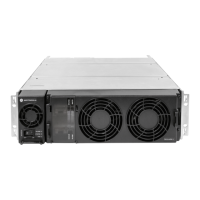
- Modular Design: The image of the GTR8000 shows a modular construction with fan units and internal boards, suggesting ease of maintenance and component replacement.
- Front Panel Indicators: The front panel includes LED indicators for ALARM, STATUS, and FAN, providing immediate visual feedback on the device's operational state. A FAN ALARM indicator is also present on the fan unit itself.
- Front Panel Controls: An ON/OFF switch for the fan is visible on the front panel, allowing for manual control or troubleshooting of the cooling system.
- Rack Mountable: The physical design indicates it is intended for rack mounting, which is standard for base station equipment in communication shelters or data centers.
- Comprehensive Connectivity: The rear panel features various connectors for MIC, SPKR, WIRELINE, V.24, EXT FREQ REF, PPS, and the SYS CONN, indicating its versatility for different operational setups and diagnostic purposes.
Maintenance Features:
- Diagnostic Indicators: The ALARM, STATUS, and FAN LEDs on the front panel, along with the FAN ALARM indicator, provide quick diagnostic information, allowing technicians to identify issues such as fan failures or general system alarms without extensive testing.
- Accessible Fan Units: The fan units appear to be easily accessible from the front, suggesting that they can be serviced or replaced without disassembling the entire unit. This is important for maintaining optimal operating temperatures and preventing overheating.
- Modular Component Access: The internal view of the GTR8000 (with the top cover removed) shows various circuit boards and modules, implying that individual components can be accessed for repair or replacement, potentially reducing downtime.
- Standardized Connections: The use of a T57 50-Pin Telco connector for system connections simplifies wiring and troubleshooting, as this is a widely recognized standard.
- Detailed Wiring Diagrams: The provided wiring diagrams (GTR8000 Analog Simulcast Cable Assembly Signal/Pin Assignments and GTR8000 Analog Conventional Simulcast Wiring Detail) are invaluable for installation, configuration, and troubleshooting, clearly mapping signals to specific pins and external components. This level of detail is critical for maintaining complex simulcast systems.
- Grounding Point: A clear grounding point is visible near the SYS CONN, emphasizing the importance of proper grounding for safety and signal integrity.

 Need help?
 General




 To Next Page