Detailed Features/Benefits Description 2-21
3.4.7 Repeater Talkaround
You may have customers who need to extend their communications coverage. This may be
necessary to communicate over distances beyond the "back-to-back" range of the P Series radios,
or to eliminate a communications "blind spot" created by a hill or large building. The communication
requirements of such a customer can be fulÞlled by employing a repeater.
To better understand the requirement for Repeater Talkaround, consider the following typical
customer scenario :
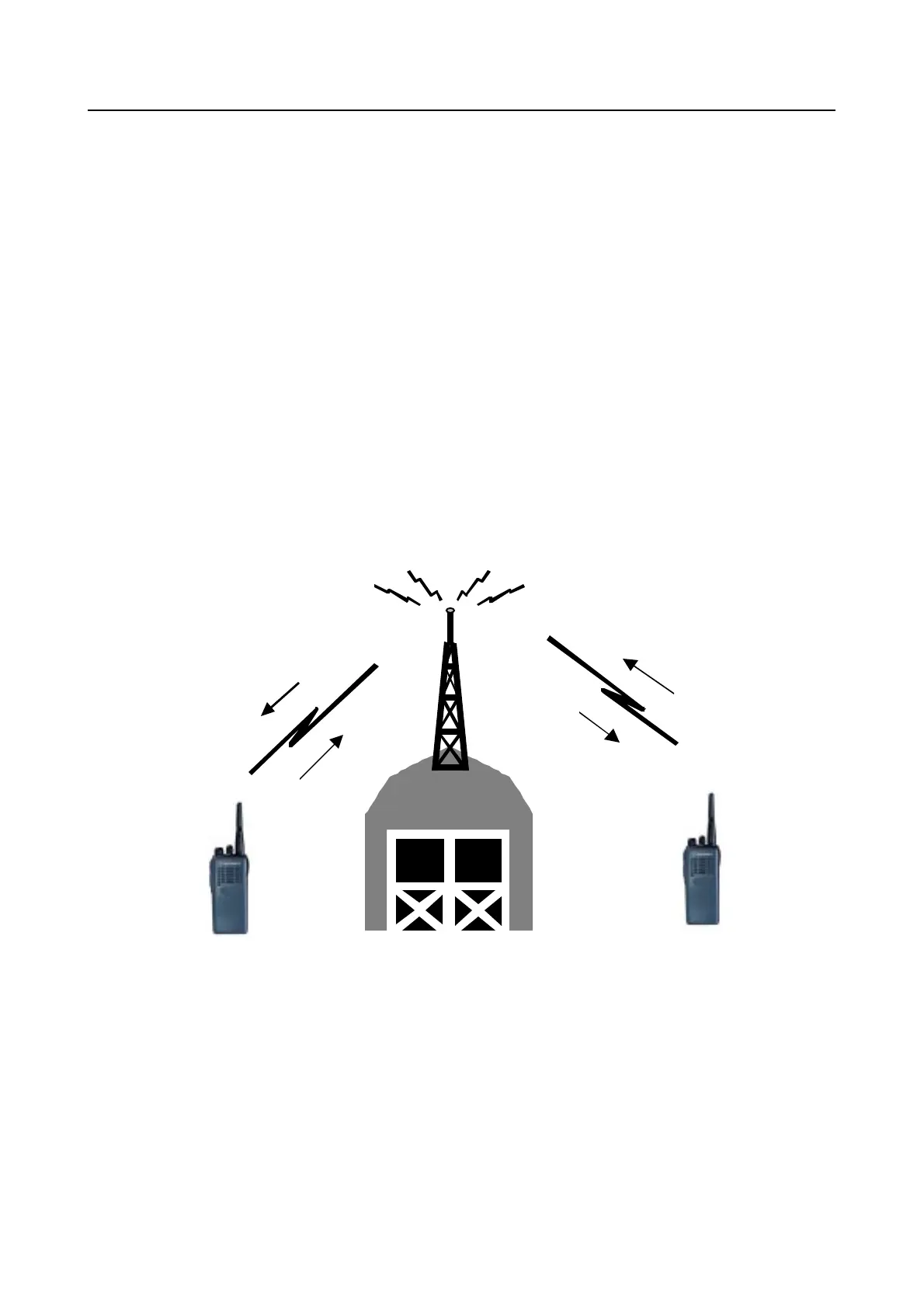
Consider a dockyard where Worker A needs to communicate with Worker B. A repeater is
necessary to overcome the blind spot created by a large warehouse. This situation is described
below in Figure 2-1.
When Worker A presses the PTT, the radio transmits on frequency F1. The repeater receives
Worker A's communication on frequency F1 and re-transmits it on frequency F2. The radio being
used by Worker B receives the call on frequency F2. Similarly, when Worker B replies on F1, the
repeater re-transmits on F2 for Worker A to receive.
In summary, all radios using the repeater transmit on frequency F1 and receive on frequency F2.
This mode of communication is often called "semi-duplex".
Figure 2-1 Repeater Operation
However, if the repeater is taken ofßine for maintenance or a group of workers moves outside the
repeater coverage area, communications can no longer continue using different transmit and receive
frequencies (ie. if Worker A transmits on F1, the call will be missed because Worker B is listening on
F2). Repeater Talkaround provides a simple solution to this problem.
F1
F2
F2
F1
Worker B
Worker A


 To Next Page
 Loading...