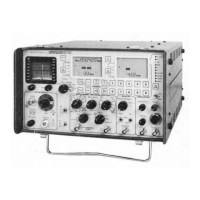
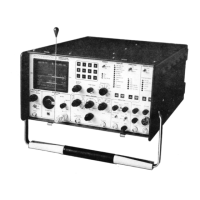
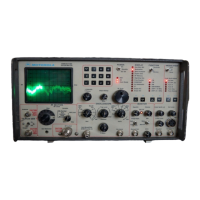
6. To check the transmitter's distortion, connect the
service monitor's
"Demod Out" to the
"Vert/
SINAD/Dist" input jack. Set left LCD to "Dist''
and read
OJo
distortion
on
the display.
If
using an R-2400, the "Pwr
Mon/
Anlzr On" function
may be used alternatively, to observe both the modula-
tion, recovered demod and frequency spectrum signals.
0
Ywt/SII.N>/
Rf
In/Out
1>151/DIIM
Ext Horiz
Domocl
Out
Mod
Out
Ext
Mod
In
0 0 0 0 0
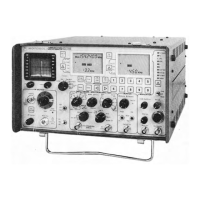
FIGURE
5.11-DUPLEXER
PASSBAND
ADJUSTMENT
SETUP
5.14.0 CAVITY AND
DUPLEXER
TUNING
BANDPASS ADJUSTMENT
A. Passband Adjustment
1.
Connect the service monitor's
"RF
In/Out"
to the
in-service duplexer antenna port as shown in
figure 5 .11.
2.
Set left LCD to "Dev", "Function" switch to
"Gen", "FM", and modulation switch to
"Off'
position.
3. Enter the receiver frequency.
4.
Set the RF Step attenuator to
-30
dB and the
"RF
Vernier" to mid-range, to allow adequate signal
to get through a mistuned duplexer and quiet the
receiver. Reduce the signal generator output, as
necessary, to keep the receiver limiter meter read-
ing below saturation.
Use "Hi Gen" and the "An-
tenna"
port
if
the duplexer
is
badly mis-tuned, to
start.
5-8
5.
Tune the pass-band knobs
of
the cavities in the
duplexer receive leg, for a peak reading
on
there-
ceiver limiter meter. Reduce the signal generator
output, as necessary, to keep the receiver limiter
meter reading below saturation. This completes
the pass-band adjustment for the receiver leg.
6.
Set the "Function" switch to
"Pow
Mon" (or
"Pwr
Mon/
Anlzr On") and the attenuator to
-30 dB.
For
low-power transmitters, it may be
necessary to reduce the attenuator setting to un-
squelch the monitor. Too high an attenuator set-
ting
or
too tight a squelch setting will inhibit the
display
of
frequency and deviation information.
7.
Enter the transmitter frequency. Key the trans-
mitter and tune the pass-band knobs
of
the
cavities in the duplexer transmit leg for maxi-
mum power output. This completes pass-band
adjustments.
D
~~~
O.v~Pwr~
-
0
Rf
In/Out
~'='
Ext
Horir
Oomod
011
0 0 0
:10
1111
PO\IER
LOAD
Mod
011
Ext
Mod
In
0 0
FIGURE
5.12-DUPLEXER
ADJUSTMENT SETUP;
REJECT
NOTCH ON RECEIVE LEG
5.15.0 CAVITY AND
DUPLEXER
TUNING
BANDPASS
WITH
REJECT
NOTCH
B.
Adjustment
of
Reject notch on the Receive leg.
1.
Connect the service monitor's
"RF
In/Out"
to the
in-service duplexer as shown in figure 5.12.
Disconnect the cable at the duplexer receiver port
that comes from the receiver. Move the monitor's
"RF
In/Out"
cable from the duplexer antenna
port to the duplexer receiver port. Connect a
power-rated dummy load to the duplexer anten-
na
port.


 To Next Page
 Loading...