SERVICE MANUAL
MOYNO
1000 PUMPS
1-1. INTRODUCTION
1-2. GENERAL
The Moyno 1000 pump is the most versatile positive
displacement pump available. Its design parameters
have been proven in thousands of applications over the
past 60 years, and it is backed by this same half
century-plus of experience in application and
manufacturing know-how.
The Moyno 1000 pump is a progressing cavity pump.
The pumping action is created by a single helical rotor
rolling eccentrically in the double-threaded helix of the
stator. In its revolution, the rotor forms, in conjunction
with the stator, a series of sealed cavities 180 degrees
apart. As the rotor turns, the cavities progress from the
suction to the discharge. As one cavity diminishes, the
opposing cavity increases at exactly the same rate.
Thus, the sum of the two discharges is a constant
volume. The result is a pulsationless, positive
displacement flow.
1-3. SCOPE
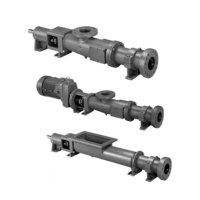
This service manual covers the standard, close-
coupled, and open throat configurations of the Moyno
1000 pump line. Disassembly and assembly procedures
are also covered in this manual.
1-4. NAMEPLATE DATA
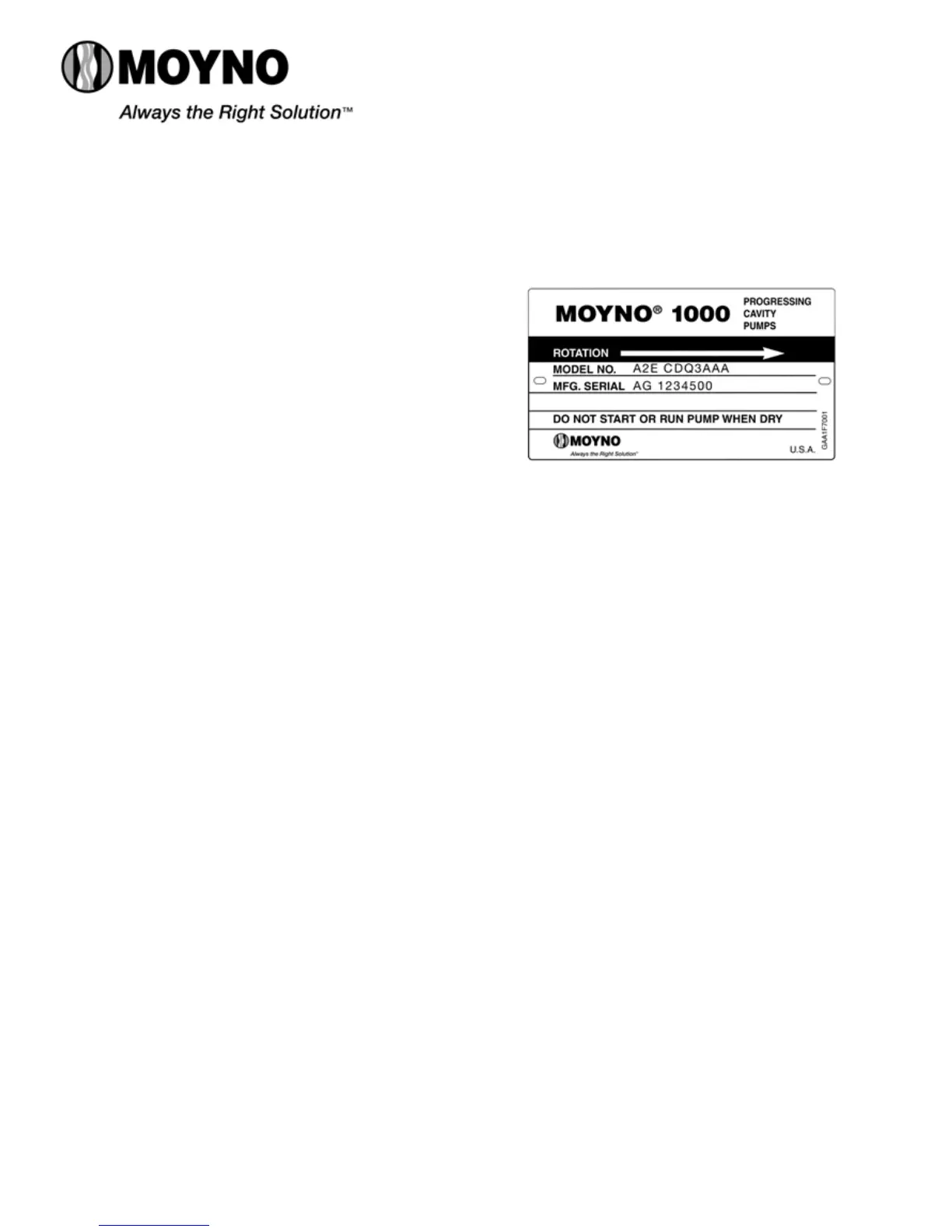
The pump nameplate, located on the bearing housing,
or drive adaptor, contains important information relative
to the operation and servicing of the pump. This
information includes the direction of rotation arrow and
the pump model and serial numbers.
The model and serial numbers must be used when
ordering spare parts. To facilitate parts ordering, the
nameplate data for your pump has been recorded
on the nameplate drawing on the front cover of this
manual.
1-5. Pump Rotation. The direction of rotation is
indicated by a rotation arrow on the nameplate.
Standard rotation of Moyno 1000 pumps is clockwise,
when viewed from the driven end of the pump. Close-
coupled models only, are not to be run in reverse.
1-6. Model Number. The pump model number is a
series of letters and numbers which identifies the
pump’s basic design and materials of construction. A
typical model number, for example, might be A2E
CDQ3AAA, as shown on the nameplate in Figure 1-1.
Figure 1-1. Typical nameplate showing rotation arrow, model, and
manufacturing serial numbers.
The first three letters and numbers identify the pump’s
basic design characteristics.
In the first space, a letter designates the pump type.
Letters used and their corresponding design types are as
follows:
A = Standard D = High Abrasion, Standard
B = Close-coupled E = High Abrasion, Close-coupled
C = Open throat
The second position number identifies the number of
stages in the pumping elements. This will generally be a 1,
2, or 4.
The third position is a letter, A through K, which identifies
the pump’s capacity in terms of gallons (gal.) per 100
revolutions. Sometimes the third position is followed by the
letter “E” which denotes the pumping element is our Ultra
Pro 23 geometry.The letters, with their corresponding
capacities, are:
A – .38 gal./100 revs. G – 22.0 gal./100 revs.
B – .75 gal./100 revs. H – 36.0 gal./100 revs.
C – 1.5 gal./100 revs. J – 48.0 gal./100 revs.
D – 3.0 gal./100 revs. K – 62.0 gal./100 revs.
E – 6.0 gal./100 revs. L – 115.0 gal./100 revs.
F – 12.0 gal./100 revs.
The next 3 positions, always letters, describe the
pump’s “Materials of Construction” in component
groups of parts.
The first letter in this group identifies the material of the
suction chamber casting.
The second letter indicates the material used in the
rotating parts, i.e., the drive shaft, connecting rod, rotor,
Section:
MOYNO
1000 PUMPS
Page: 1
Date: April 2002


 To Next Page