GENERAL DESCRIPTION
DESCRIPTION
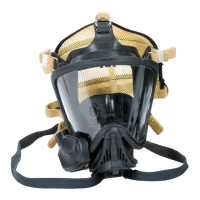
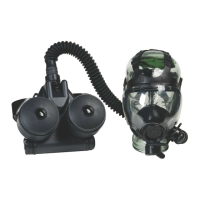
The C420 Respirator is a blower-assisted, air-purifying
r
espirator referred to as a Powered Air-Purifying
Respirator or a PAPR.
The filtering system consists of a waist-mounted battery-
driven blower assembly device and two (2) cartridge-type
f
ilter media. The blower assembly contains an electric
motor driving an air blower. A compartment for a non-
rechargeable 6 volt (nominal) lithium-sulfur dioxide (LI-
SO2) battery pack or a rechargeable 4.8 volt (nominal)
nickel-metal hydride (NiMH) battery pack is located on the
bottom of the blower assembly. There are two (2) thread-
ed inlets on the front of the blower assembly for the
attachment of the cartridges (sold separately). The user of
the respirator breathes ambient air after the air has
passed through the cartridges. The cartridges include a
mechanical filter to trap airborne particles and may also
include a sorbent bed of impregnated activated carbon to
trap and/or neutralize various gases/vapors.
The blower assembly assists breathing by drawing air
through the cartridges and delivering the purified air
through a breathing tube to the facepiece. An airflow indi-
cator (P/N S-30020) used to check for minimum airflow is
provided with the C420 PAPR filtering system. To maintain
respiratory protection:
• The user must be properly fit tested to the respirator
facepiece before use (refer to the appropriate
Facepiece User Instructions Manual)
• The blower, with cartridges installed, must be tested
with the airflow indicator both prior to use and at pre-
scribed intervals during use to monitor battery life and
cartridge efficiency.
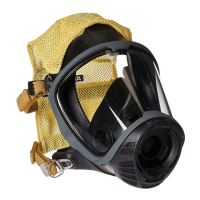
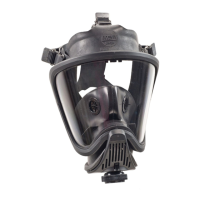
The C420 PAPR can be used with MSA Millennium
®
Facepiece and Ultra Elite
®
Facepiece. Refer to the sepa-
rate NIOSH Approval Labels (P/N 10071373 and
10080165) for a complete list of approved part numbers
and limitations.
RESPIRATOR USE LIMITATIONS
The respirator must not be worn in atmospheres which
exceed any of the following limitations:
1. Maximum use concentrations
a. Full facepiece and hood PAPRs: 1000 times the
exposure limit for the contaminants present.
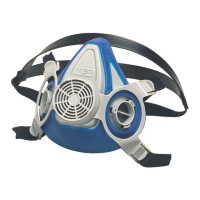
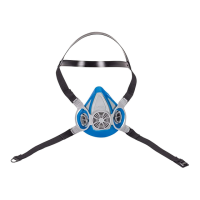
b.Half-facepiece PAPRs: 50 times the exposure limit
for the contaminants present.
c. 1000 parts per million organic vapors (for organic
vapor respirators).
2. The limitations outlined in the applicable NIOSH
approval.
3. Any applicable limitation contained in a standard
established by a regulatory agency (such as OSHA)
with jurisdiction over the wearer.
4. This respirator can be used for protection against a
m
ixture of contaminants that are present simultane-
ously or alternately against one contaminant then
a
nother (using the same cartridges or filters) if the
mixture meets the following conditions:
a. The cartridge/canister/filter must be approved for all
contaminants present.
b.Particulates (dusts, mists, fumes, asbestos,
r
adionuclides) can be mixed with any other particu-
late or any gas or vapor for which the cartridge/can-
ister is approved.
c. Contaminants present simultaneously must be below
IDLH levels for the specific contaminants. If any one
contaminant in the mixture exceeds the IDLH con-
centration then the entire mixture must be treated as
IDLH and the respirator cannot be used (except for
escape from particulates with appropriate filter).”
EXPOSURE LIMITS
A listing of acceptable exposure limits from the following
sources is provided in MSA’s Response® Respirator
Selector:
- American Conference of Governmental Industrial
Hygienists (ACGIH)
- Occupational Safety and Health Administration
(OSHA)
- National Institute for Occupational Safety and Health
(NIOSH)
- American Industrial Hygiene Association (AIHA)
Contact MSA at 1-800-MSA-2222 for information.
Exposure Limits for Mixtures
The American Conference of Governmental Industrial
Hygienists (ACGIH) publishes the following information to
determine the TLV of a mixture.
First determine the total concentration of the chemical
mixture (C
Mixture
) from the individual contaminant con-
centrations (C
1
, C
2
, C
3
, . . . ) using the following formula:
C
Mixture
=C
1
+C
2
+ C
3
+ . . .
The TLV of the mixture is found by using the following for-
mula where T
1
, T
2
, T
3
, . . . are the individual contaminant
TLVs and C
1
, C
2
, C
3
, . . . are the individual contaminant
concentrations:
Only use these equations if the contaminants present are
actually mixed. Some substances do not mix and may be
present separately, for example, in pockets or at different
levels. In that case, the lowest TLV of the substances pre-
sent must be used to determine the appropriate respirator
category for protection against all contaminants present.
7
TAL 706 (L) Rev. 2 - 10072074
T
Mixture
=
C
Mixture
+ + + . . .
T
1
T
2
T
3
C
1
C
2
C
3


 To Next Page