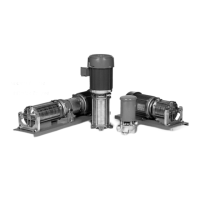
To disassemble the pedestal:
Refer to Figure 4-28 for reference to
the numbered parts in the procedures
1. Remove Bearing Frame Mounting
Brackets (#31) by unscrewing
Shoulder Screws (#33C) with a
2. Remove the four (4) Hex
Capscrews (#33B) that hold the
Bearing Frame Housing (#3) to
the End Bell (#101), using a 7/16”
3. Position assembly horizontally
on workbench. Holding bearing
frame housing fi rmly, tap on the
coupling end of shaft with rubber
mallet until the assembly comes
4. Remove guide rod nuts and guide
5. Remove Outboard Bearing (#24A)
6. With a spanner wrench, unscrew
the Outboard Bearing Adjusting
Nut (#110A) from the end bell.
7. Support end bell, with motor
mounting face up, and press out
shaft / bearing assembly with
arbor press. Remove Inboard
Bearing Adjusting Nut (#110).
8. Disengage bearing lockwasher
tang from slot in Bearing
Locknut (#38), using a thin blade
screwdriver. Locknut and Bearing
Lockwasher (#39) may now be
removed from shaft. Grip shaft in
the area between the two bearing
9. Place shaft / bearing assembly
in arbor press and remove the
4D Inspection of Components
Thoroughly clean all parts. All
components should be examined for
wear and corrosion. Replace any parts
Check to be certain that a press fi t
still exists between the shaft and the
cleaned and regreased bearings, are
Check the shaft for galling, pitting,
and corrosion. Surface corrosion on
the pump portion of the shaft must be
removed so the seals will slide freely
during assembly. The shaft diameter
should be no smaller than .002” below
the nominal fractional seal sizes.
Remove any nicks or burrs which may
have occurred during disassembly.
Reclean parts as necessary.
All parts should be visually inspected
and cleaned or replaced as outlined
in 4D above. It is recommended that
the bearings be replaced any time the
bearing pedestal is disassembled for
The following tools and equipment are
needed for reassembly of P3 units:
2. Rubber or plastic mallet
3. Internal snap ring pliers
4. 3/4” X 6” piece of water pipe
To reassemble the bearing frame:
Refer to Figure 4-24 for reference to
the numbered parts in the reassembly
1. Using an arbor press, install
the bearings on the shaft prior
to installing the shaft into the
pedestal. A steel “donut” with
the proper inside diameter and
outside diameter, refer to Chart 1,
should be used between the
Proceed to section 4E Inspection of
4C Disassembly Multistage on C3
Motors / P3 Bearing Frames
The following tools and equipment are
needed for disassembly of C3 / P3
1. Soft plastic or wooden mallet.
2. Two 9/16” wrenches or sockets.
4. Side cutters (for removing keys).
5. 1” wood dowel (Approx. 6” long).
6. Thin blade screwdriver.
7. Two large blade screwdrivers.
Refer to Figure 4-11 for reference to
the numbered parts in the procedures
1. Remove all liquid from the pump.
Air blown through the pump will
remove the fl uid quickly.
2. Lay the pump on the workbench
3. Remove the four (4) Nuts (#20)
from the Guide Rods (#18).
4. Remove the eight (8) Nuts (#20)
from the Thru-Bolts (#19) located
on the inlet cover (#1 or 1IN). Pull
5. Using a soft mallet, loosen the
Outlet Cover (#2) by tapping lightly
around the outside edge. Slip the
cover off the Guide Rods (#18),
being careful not to bend them.
6. Do not remove the Plain Bearing
(#87) from the outlet cover unless
it is worn. This bearing is a press
fi t and cannot be removed without
7. Remove the four (4) Guide Rod
8. Mark on the outside surface of the
Channel Rings (#9 & #10) such
that the top to bottom relationship
as well as the order is maintained.
Number stamps are preferable
to less permanent markings that
tend to be lost during cleaning.
9. Separate the fi rst Channel Ring
(#9) by gently tapping the ring
around the outside edge with
a soft mallet and slide it off the
guide rods, exercising care to
prevent damage. Should prying
be necessary, it should be done
evenly and with great care.
10. Remove the Interstage Bushing
(#16) from the Channel Ring (#9)
11. Remove the next Channel Ring
(#10) using the same care as with
the fi rst. The Impeller (#11) will
come off along with the channel
ring. Do not attempt to pry the
impeller off fi rst, as prying will
damage the impeller vanes. Hold


 To Next Page
 Loading...