!Caution
5. DC Voltage and AC Voltage Characteristics
1. The capacitance value of a high dielectric constant type
capacitor changes depending on the DC voltage applied.
Please consider the DC voltage characteristics when a
capacitor is selected for use in a DC circuit.
1-1. The capacitance of ceramic capacitors may change
sharply depending on the applied voltage (see figure).
Please confirm the following in order to secure the
capacitance.
(1) Determine whether the capacitance change
caused by the applied voltage is within the
allowed range.
(2) In the DC voltage characteristics, the rate of
capacitance change becomes larger as voltage
increases, even if the applied voltage is below the
rated voltage. When a high dielectric constant
type capacitor is used in a circuit that requires a
tight (narrow) capacitance tolerance (e.g., a time
constant circuit), please carefully consider the
voltage characteristics, and confirm the various
characteristics in the actual operating conditions
of the system.
2. The capacitance values of high dielectric constant type
capacitors changes depending on the AC voltage applied.
Please consider the AC voltage characteristics when
selecting a capacitor to be used in an AC circuit.
-60
-50
-40
-30
-20
-10
0
10
20
30
0 0.5 1 1.5 2
AC Voltage (Vr.m.s.)
-100
-80
-60
-40
-20
0
20
0 1020304050
DC Voltage (V)
[Example of DC Voltage Characteristics]
Sample: X7R (R7) Characteristics 0.1μF,
Rated Voltage 50VDC
[Example of AC Voltage Characteristics]
Sample: X7R (R7) Characteristics 10μF,
Rated Voltage 6.3VDC
Capacitance Change (%)Capacitance Change (%)
6. Capacitance Aging
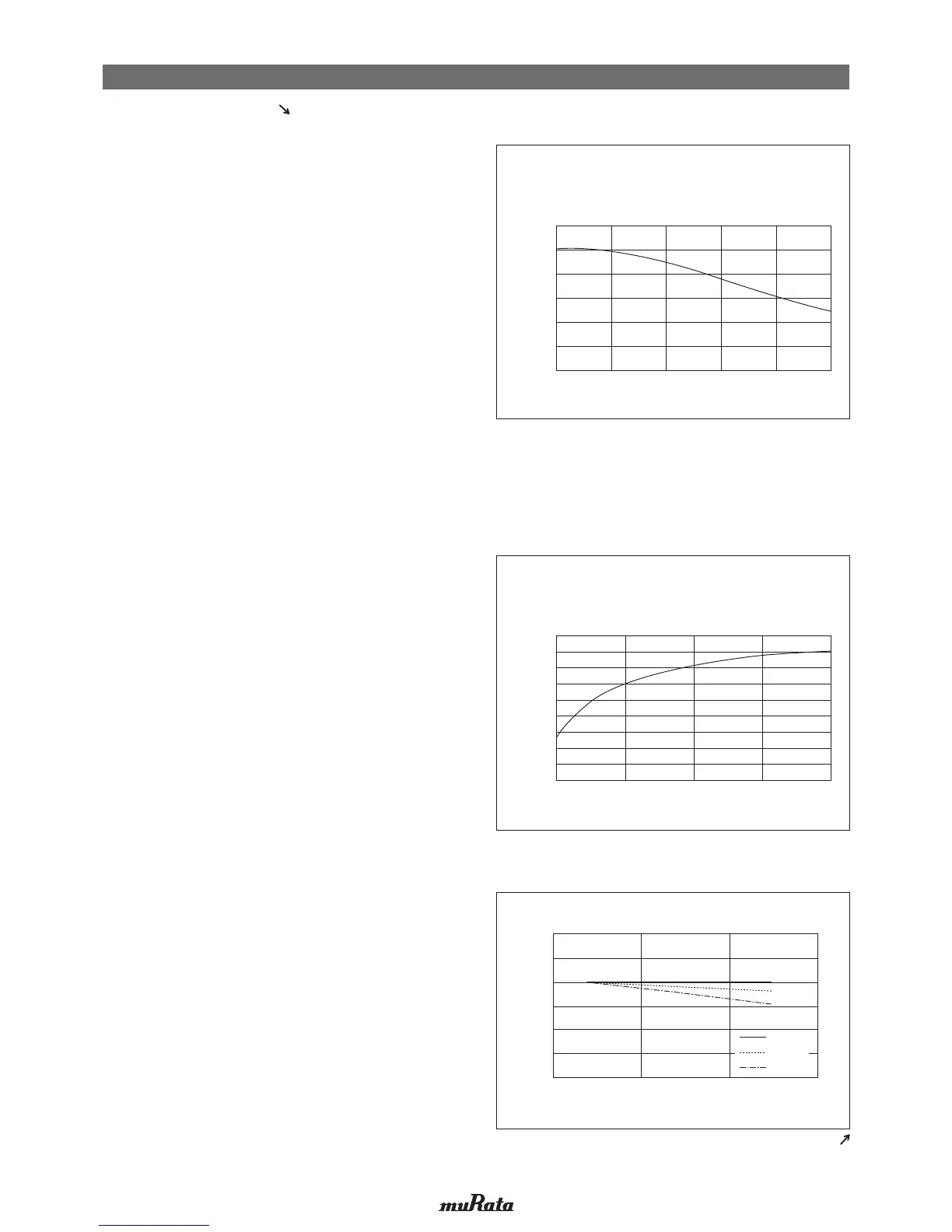
1. The high dielectric constant type capacitors have an
Aging characteristic in which the capacitance value
decreases with the passage of time.
When you use high dielectric constant type capacitors in
a circuit that needs a tight (narrow) capacitance
tolerance (e.g., a time-constant circuit), please carefully
consider the characteristics of these capacitors, such as
their aging, voltage, and temperature characteristics. In
addition, check capacitors using your actual appliances at
the intended environment and operating conditions.
-40
-30
-20
-10
0
10
20
10 100 1000 10000
Time (h)
Capacitance Change (%)
[Example of Change Over Time (Aging Characteristics)]
C0G (5C)
X7R (R7)
X5R (R6)
Continued from the preceding page.
Continued on the following page.
!
Note
• Please read rating and
!
CAUTION (for storage, operating, rating, soldering, mounting and handling) in this catalog to prevent smoking and/or burning, etc.
• This catalog has only typical specifications. Therefore, please approve our product specifications or transact the approval sheet for product specifications before ordering.



 To Next Page
 Loading...