EasyManua.ls Logo

MURO FDVL41 - Maintenance and Inspection

Default Icon
8 pages
Print Icon
To Next Page IconTo Next Page
To Previous Page IconTo Previous Page
Loading...
SS
AEM
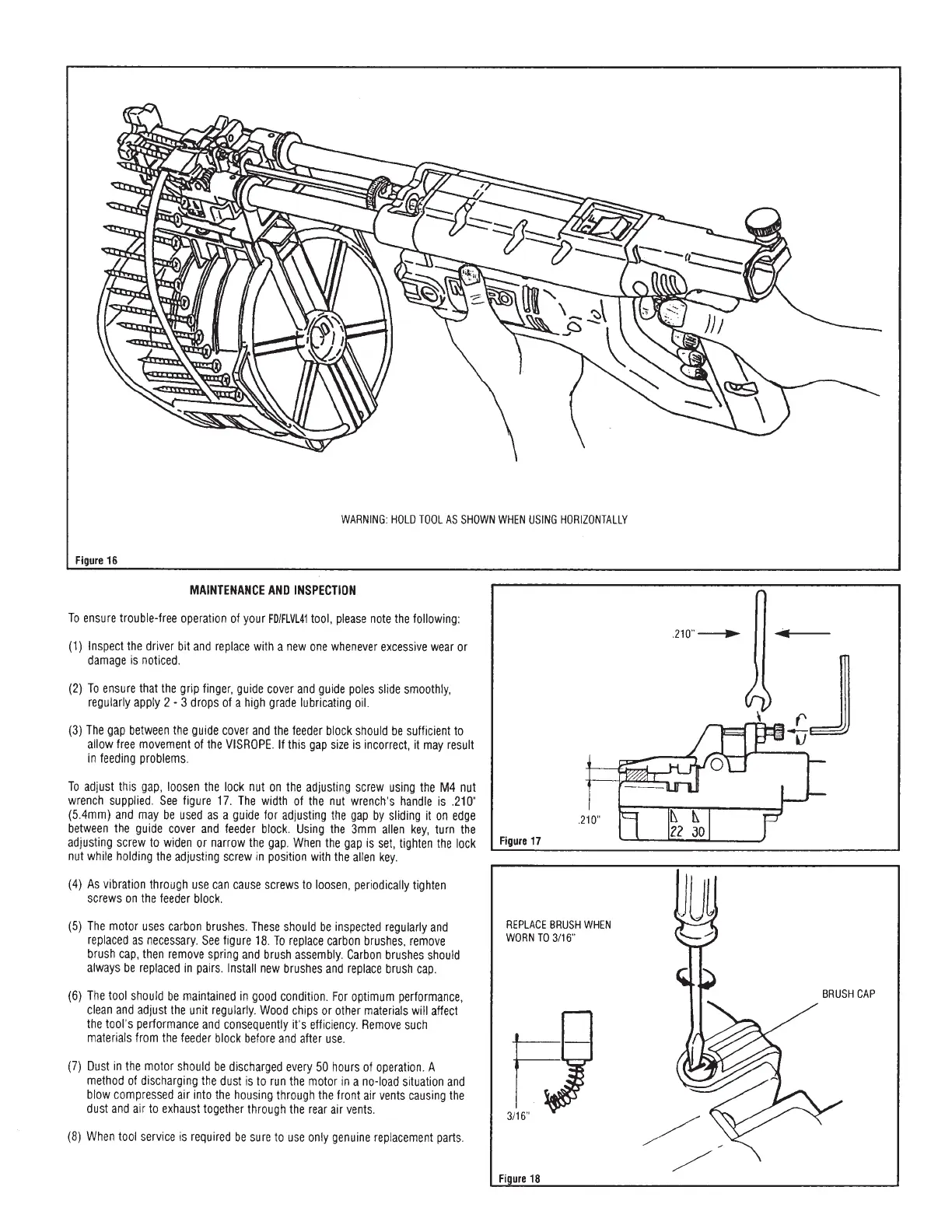
WARNING:
HOLD
TOOL
AS
SHOWN
WHEN
USING
HORIZONTALLY
Figure
16
MAINTENANCE
AND
INSPECTION
To
ensure
trouble-free
operation
of
your
FD/FLVL4/
tool,
please
note
the
following:
(1)
Inspect
the
driver
bit
and
replace
with
a
new
one
whenever
excessive
wear
or
damage
is
noticed.
(2)
To
ensure
that
the
grip
finger,
guide
cover
and
guide
poles
slide
smoothly,
reguiarly
apply
2
-
3
drops
of
a
high
grade
lubricating
oil.
(3)
The
gap
between
the
guide
cover
and
the
feeder
block
should
be
sufficient
to
allow
free
movement
of
the
VISROPE.
If
this
gap
size
is
incorrect,
it
may
result
in
feeding
problems.
To
adjust
this
gap,
loosen
the
lock
nut
on
the
adjusting
screw
using
the
M4
nut
wrench
supplied.
See
figure
17.
The
width
of
the
nut
wrench's
handle
is
.210"
(5.4mm)
and
may
be
used
as
a
guide
for
adjusting
the
gap
by
sliding
it
on
edge
between
the
guide
cover
and
feeder
block.
Using
the
3mm
allen
key,
turn
the
adjusting
screw
to
widen
or
narrow
the
gap.
When
the
gap
is
set,
tighten
the
lock
|
Figure
17
nut
while
holding
the
adjusting
screw
in
position
with
the
allen
key.
(4)
As
vibration
through
use can
cause
screws
to
loosen,
periodically
tighten
screws
on
the
feeder
block.
(5)
The
motor
uses
carbon
brushes.
These
should
be
inspected
regularly
and
REPLACE
BRUSH
WHEN
replaced
as
necessary.
See
figure
18.
To
replace
carbon
brushes,
remove
WORN
TO
3/16"
brush
cap,
then
remove
spring
and
brush
assembly.
Carbon
brushes
should
always
be
replaced
in
pairs.
Install
new
brushes
and
replace
brush
cap.
(6)
The
tool
should
be
maintained
in
good
condition.
For
optimum
performance,
Clean
and
adjust
the
unit
regularly.
Wood
chips
or
other
materials
will
affect
the
tool's
performance
and
consequently
it's
efficiency.
Remove
such
materials
from
the
feeder
block
before
and
after
use.
(7)
Dust
in
the
motor
should
be
discharged
every
50
hours
of
operation.
A
method
of
discharging
the
dust
is
to
run
the
motor
in
a
no-load
situation
and
blow
compressed
air
into
the
housing
through
the
front
air
vents
causing
the
dust
and
air
to
exhaust
together
through
the
rear
air
vents.
(8)
When
tool
service
is
required
be
sure
to
use
only
genuine
replacement
parts.
Figure
18
BRUSH
CAP