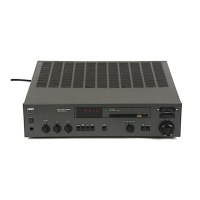
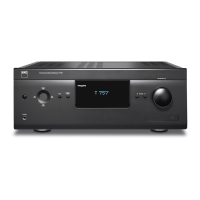
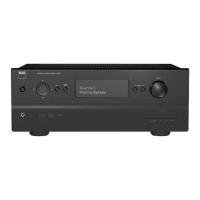
The NAD 7250PE is an AM/FM receiver, designed to provide high-fidelity audio reproduction and versatile connectivity for a home audio system. This service manual covers all versions of the unit, including those for the U.S.A. (A), Canada (A1), U.K. (B), Australia (B1), Europe and others (C), and W-Germany (C1).
Function Description:
The NAD 7250PE integrates a power amplifier, preamplifier, and AM/FM tuner into a single unit. It is designed to receive radio broadcasts and amplify audio signals from various sources, delivering them to loudspeakers. The unit features multiple input options for external devices, including a phono input for turntables, CD input, auxiliary input, and tape input/output for recording and playback. It also includes a preamplifier output and main amplifier input, allowing for flexible system configurations, such as using the preamplifier section with a separate power amplifier or vice versa. The receiver is equipped with speaker outputs for two pairs of loudspeakers (A and B), which can be selected independently or simultaneously.
Important Technical Specifications:
Power Amplifier Section:
- Continuous Average Power Output into 8 Ohms: 50 W (17 dBW) per channel, 20 Hz - 20 kHz, both channels driven, with no more than the rated distortion.
- Rated Distortion (THD), 20 Hz - 20 kHz: 0.03%.
- Clipping Power (max. continuous power per channel): 55 W into 8 ohms.
- IHF Dynamic Headroom at 8 Ohms: +6 dB.
- IHF Dynamic Power (max. short-term power per channel):
- 8 ohms: 200 W
- 4 ohms: 250 W
- 2 ohms: 300 W
- Peak Output Current: >30 A.
- Slew Factor: >50.
- Slew Rate: 30 V/µsec.
- Damping Factor (ref. 8 Ω, at 50 Hz): >50.
- Input Impedance: 30 kΩ.
- Input Sensitivity for 1 W/Rated Power: 140 mV/1 V.
- Power Amplifier Gain: 26 dB (20X).
- THD (Total Harmonic Distortion, 20 Hz - 20 kHz, from 250 mW to rated output): <0.03%.
- SMPTE I.M. (Intermodulation Distortion, 60 Hz + 7 kHz, 4:1, from 250 mW to rated output): <0.03%.
- IHF I.M. (CCIF IM Distortion, 19 + 20 kHz at rated output): <0.03%.
Preamplifier Section:
- Phono Input Impedance: R = 47 kΩ; C = 100 pF.
- Phono Input Sensitivity (ref. 1 watt): 0.4 mV.
- Phono Input Overload at 20 Hz/1 kHz/20 kHz: 18 mV/170 mV/1.5 V.
- Phono THD (20 Hz - 20 kHz) and IM Dist. at +30 dB level: <0.04%.
- RIAA Response Accuracy: ±0.5 dB.
- Phono S/N Ratio, IHF A-weighted, with cartridge connected: 76 dB re 5 mV.
- Line Level Input (Aux, Tape) Impedance: R = 10 kΩ; C = 220 pF.
- Line Level Input Sensitivity: 25 mV for 1 W out, 150 mV for 50 W out.
- Maximum Input Signal: >10 V.
- Signal to Noise Ratio, A-weighted: 85 dB re 1W, >100 dB ref. rated power.
- Frequency Response, 20 Hz - 20 kHz: ±0.5 dB.
- Preamp Out Impedance: 800 ohms.
- Maximum Output Level: 10 V.
- Tape Output Impedance: 1,000 ohms (buffered).
- Tape Output Infrasonic Filter: -3 dB at 15 Hz, 12 dB/octave.
FM Tuner Section:
- Input Sensitivity (Mono, -30 dB THD + N): 10.3 dBf (1.8 µV/300Ω).
- Input Sensitivity (Mono, 50 dB S/N): 29 dBf (15 µV).
- Input Sensitivity (Stereo, 50 dB S/N): 40 dBf (55 µV).
- Capture Ratio (at 45 and 65 dBf): <1.5 dB.
- AM Rejection (at 65 and 85 dBf): >65 dB.
- Selectivity (Alternate channel): 70 dB.
- Selectivity (Adjacent channel): 8 dB.
- Image Rejection: 75 dB.
- R.F. Intermodulation: 65 dB.
- I.F. Rejection: 75 dB.
- SCA Rejection: 70 dB.
- Subcarrier Suppression (19 & 38 kHz): 60 dB.
- THD at 100% Modulation:
- Mono (1 kHz): 0.08%
- Stereo (1 kHz): 0.2%
- Mono (100 Hz - 6 kHz): 0.08%
- Stereo (100 Hz - 6 kHz): 0.3%
- Signal-to-Noise Ratio A-weighted, 65 dBf:
- Mono: 82 dB
- Stereo: 76 dB (typ, 80 dB at 75 dBf)
- Frequency Response, 30 - 15 kHz: ±0.5 dB.
- Stereo Separation (FM NR off):
- 1 kHz: 50 dB
- 30 Hz - 10 kHz: 40 dB
AM Tuner Section:
- Usable Sensitivity: 300 µV/meter.
- THD: 0.5%.
- Selectivity: 35 dB.
- Image Rejection: 50 dB.
- I.F. Rejection: 50 dB.
- S/N Ratio (30% mod., 50 mV input): 45 dB.
Physical Specifications:
- Dimensions (width x height x depth): 42 x 10.8 x 38 cm (16.5 x 4.25 x 15 in).
- Net Weight: 9.2 kg/20 lb. 6 oz.
- Shipping Weight: 10.6 kg/23 lb. 6 oz.
- Power Consumption (50/60 Hz at 110, 120, 220 or 240 VAC): 290 W.
Usage Features:
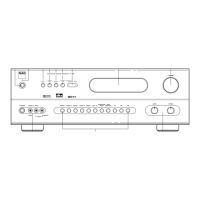
The NAD 7250PE offers a comprehensive set of controls on its front panel for user interaction. These include:
- Power: Main power switch.
- Phones: Headphone jack for private listening.
- Speaker Selector: Allows selection of speaker pair A, B, or both, or to turn speakers off.
- Tone Controls: Bass and Treble adjustments for sound customization.
- Bass EQ: A switch to engage bass equalization for enhanced low-frequency response.
- Infrasonic Filter Off: Disables the infrasonic filter, which normally removes very low-frequency noise.
- Mono: Switches between stereo and mono reception.
- FM NR Off: Disables FM noise reduction.
- Tape Monitor: For monitoring audio during recording or listening to a tape deck.
- Input Selector: To choose between various audio sources (Tuner, Phono, CD, Aux, Video).
- Low Level: Audio muting switch.
- Loudness Compensation: Adjusts frequency response to compensate for the ear's reduced sensitivity to bass and treble at low listening levels.
- Volume/Balance: Controls overall output volume and channel balance.
- Tuning Display: Digital display showing the tuned frequency.
- Status Indicators: LEDs for various operational statuses, including FM Stereo and Soft Clipping.
- Station Pre-sets: Buttons for storing and recalling favorite radio stations.
- Memory Enter: To save a tuned frequency to a pre-set.
- AM/FM: Selects between AM and FM bands.
- Up/Down Tuning: For manual frequency adjustment.
- Search: Initiates automatic station searching.
The rear panel provides all necessary connections:
- AC Line Cord and AC Outlets: For power and connecting other components.
- Speakers A and B: Binding posts for connecting loudspeakers.
- Antenna Terminals and AM Rod Antenna: For radio reception.
- Phono Input and Phono Ground: For connecting a turntable.
- Video, CD, Aux Inputs: For connecting various audio/video sources.
- Tape Input/Output: For connecting a tape recorder.
- Preamp Out, Main In: For connecting external amplifiers or processors.
- Soft Clipping: A switch to engage NAD's Soft Clipping feature, which gently limits waveform peaks to prevent harsh distortion when the amplifier is overdriven.
- Speaker Impedance: A selector switch to match the amplifier's output to the impedance of the connected speakers (8 ohm or 4 ohm).
Maintenance Features (Service Manual Specific):
The service manual provides detailed instructions for alignment and troubleshooting, crucial for maintaining the device's performance.
- FM Alignments: Includes procedures for tuning voltage adjustment (oscillator), RF adjustment (tracking), IF adjustment, detector coarse adjustment, detector alignment (final), autosearch level, stereo decoder/MPX filters, FM NR circuit, and synthesizer frequency. These steps involve using specialized equipment like FM generators, oscilloscopes, VTVMs, THD analyzers, and frequency counters to ensure optimal tuner performance.
- AM Alignments: Covers oscillator and antenna/IF adjustments, as well as signal meter and auto stop calibration. These procedures involve adjusting components like capacitors and coils to maximize signal strength and accuracy.
- Amplifier Alignments: Details procedures for idle (quiescent) current adjustment, offset (centering) voltage adjustment, and minimum distortion adjustment. These ensure the amplifier operates efficiently, without DC offset at the speaker terminals, and with minimal harmonic distortion.
- Layout Diagrams: The manual includes comprehensive PCB layout diagrams for the amplifier, tuner, input/output, LED display, power switch, antenna terminal, frontend, and up/down PCBs, aiding in component identification and repair.
- Schematic Diagrams: Detailed schematic diagrams are provided for both the amplifier and tuner sections, essential for understanding circuit operation and diagnosing faults.
- Wiring Diagram: A complete wiring diagram illustrates the interconnections between different PCBs and external components, facilitating assembly and troubleshooting.
- Exploded View Parts List: An exploded view diagram with a corresponding parts list helps in identifying and ordering replacement parts for mechanical components.
- Electrical Parts List: A detailed list of electrical components, including their symbol numbers, parts numbers, and descriptions, is provided for all major PCBs, making it easier to source and replace faulty electronic components.
The NAD 7250PE is designed for longevity and serviceability, with comprehensive documentation supporting its maintenance and repair. The inclusion of detailed alignment procedures and component lists underscores its professional-grade construction and the manufacturer's commitment to long-term performance.

 Need help?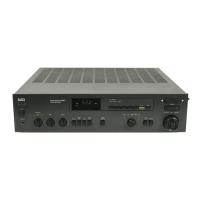

 To Next Page
 General