Need help?
Do you have a question about the Nagman ETC 600 and is the answer not in the manual?
Guidelines for safe storage and transport to maintain working order.
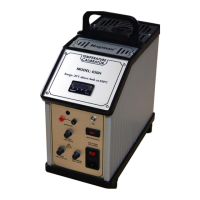
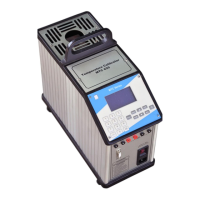
The Nagman ETC 600 is a medium temperature dry block calibrator designed for the precise calibration of various temperature sensors and instruments. Its primary function is to provide a stable and accurate temperature source for calibrating RTDs (Resistance Temperature Detectors), thermocouples, temperature switches, and indicators. The instrument is built for interior use and is intended for calibration work, not for any other applications.
The ETC 600 operates as a dry block calibrator, meaning it uses a metal block with wells into which temperature sensors are inserted for calibration. This method ensures good thermal contact and stability. The calibrator features a PID (Proportional-Integral-Derivative) controller that allows users to set and maintain a desired temperature within its operational range. The heating element within the block raises the temperature, while a cooling fan helps to bring the temperature down when needed.
A key feature of the ETC 600 is its switch test facility, which provides a nominal 7 VDC supply. This allows for the testing of thermostat switches, indicating their state (normally closed or normally open) through an LED indication. When a "Normally Closed" thermostat switch is connected, the LED will initially glow and then stop glowing when the switch changes its state. Conversely, for a "Normally Open" thermostat switch, the LED will not glow initially but will illuminate when the switch changes its state.
The calibrator also includes an analog output, providing 10 mV per °C, which can be useful for external monitoring or recording of the block's temperature.
Operating the ETC 600 involves a straightforward process. First, the power cable is connected, and the instrument is switched on using the main switch. The desired temperature is then set using the PID controller. The controller features dedicated keys for increasing (F1), decreasing (F2), and selecting the range (F3) of the set temperature.
Once the temperature is set, the sensors (Units Under Test, UUT) to be calibrated are inserted into the appropriate holes of the thermowells. It is crucial to allow the bath to stabilize at the set temperature before proceeding. After stabilization, the test probe (UUT) is connected to an indicator, and its readings are noted. This process is repeated for other calibration points as needed.
After the calibration is complete, the bath temperature should be set to ambient and allowed to cool down. Once the instrument reaches ambient temperature, the power supply can be switched off.
Safety is paramount during operation. Users are advised to read the manual before use and to inspect the instrument for damage. It should not be used if it appears damaged or operates abnormally. The calibrator should not be placed under cabinets or other structures, ensuring sufficient clearance for probe insertion and removal. Probes should not be dropped into the well to avoid shocking the sensor. The instrument should not be operated near flammable materials, or in excessively wet, oily, dusty, or dirty environments, or explosive zones. Calibration equipment should only be used by trained personnel, and completely unattended operation is not recommended.
The instrument and thermometer probes are sensitive and should be handled with care. Inserts should not be left in the instrument for prolonged periods at high operating temperatures, as this can cause damage.
Crucially, the well access surface, the well itself, and the insert can become very hot during heating. The tip of the sensor and the portion immersed in the well will also be very hot when removed. Users should avoid touching these hot surfaces and the calibrator's handle during use.
Proper earthing is essential, and the power cord should be plugged into a properly grounded three-pin socket. Extension cords or adapter plugs are not recommended. The instrument should be operated at room temperatures between 15°C and 40°C, with at least 20 cm of clearance around it for air circulation. The instrument should not be turned off when the temperature is higher than 50°C; instead, the set-point should be returned to room temperature, and the instrument allowed to cool before switching off. The cooling fan at the bottom of the instrument must be in working order, and its grill should have a free supply of air.
Regular maintenance ensures the longevity and performance of the ETC 600. Cleaning the instrument is a key aspect of maintenance. Before cleaning, the calibrator must be switched off, allowed to cool down to ambient temperature, and the power cord removed.
The exterior of the instrument can be cleaned using water and a soft cloth. The cloth should be wrung out hard to prevent water from penetrating the calibrator and causing damage.
The inserts must always be clean and should be regularly wiped using a soft, lint-free, dry cloth. It is critical to ensure that no textile fibers remain on the insert when it is placed in the well, as these fibers can adhere to the well and cause damage.
The manual also provides instructions for troubleshooting and replacing fuses. If the main fuse needs replacement, the user should identify it in the fuse box within the power socket, open the lid with a screwdriver, and replace it with a fuse of the correct rating (6.3A for 230V AC or 12A for 115V AC). Similarly, for replacing the heater fuse, the user should identify the fuse holder in the equipment's enclosure, open it in an anti-clockwise direction, and replace the fuse with the correct rating (6.3A for 230V AC or 12A for 115V AC). If a fuse blows immediately after replacement, the calibrator should be returned to the manufacturer for service.
In case of main power fluctuations, the instrument should be turned off immediately to prevent damage from power bumps or brown-outs, and turned back on once the power has stabilized.
For storage and transport, specific guidelines must be followed. When storing the calibrator in its packing box after use, it must have cooled to a temperature very close to ambient (maximum 10°C / 50°F above ambient). For long-distance transport, the inserts must be removed from the instrument to prevent damage.
For optimal performance and accuracy, it is advised to return the calibrator to Nagman, Chennai - INDIA, or an accredited laboratory at least once a year for calibration. When returning the calibrator for service, complete information about any problems faced should be provided for clear analysis. The calibrator should be returned in its original packing. Nagman's liability ceases if parts are replaced or repaired using spare parts not identical to those recommended by the manufacturer, or if errors originate from the factory.
 General
| Type | Dry Block Temperature Calibrator |
|---|---|
| Well Diameter | 25 mm |
| Well Depth | 150 mm |
| Power Supply | 230 VAC, 50/60 Hz, 600 W |
| Display | LCD |
| Weight | 8 kg |
| Stability | ±0.1°C (±0.18°F) |
| Resolution | 0.1°C |


 To Next Page