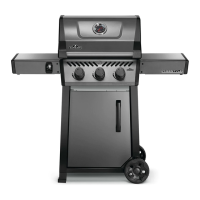
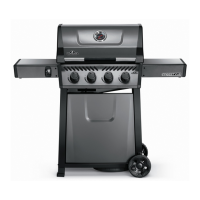
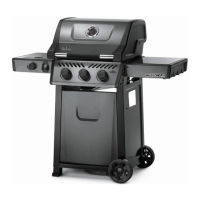
This document is an owner's manual for the Napoleon Freestyle Series gas grills, specifically models F365 and F425. It provides comprehensive information on the safe operation, assembly, maintenance, and features of these outdoor cooking appliances.
The Napoleon Freestyle Series grills are designed for outdoor use in well-ventilated spaces, such as patios or yards, and are not intended for operation in enclosed areas like buildings or garages. They are fueled by propane gas and require a 9 kg propane cylinder with an LCC27 connection. The grills are equipped with a gas pressure regulator and hose assembly, which must be the one supplied by Napoleon or a recommended replacement part, ensuring a gas supply pressure of 2.75 kPa (0.39 psi). The recommended hose length is 0.9 m, with a maximum length of 1.5 m.
Function Description:
The Napoleon Freestyle Series grills are outdoor gas grills designed for various cooking methods, including direct grilling, indirect grilling, and rotisserie cooking (if a rotisserie kit is acquired). They aim to provide a memorable and safe grilling experience through their robust design and user-friendly features.
Important Technical Specifications:
- Models: F365 and F425.
- Fuel Type: Propane gas.
- Gas Supply Pressure: 2.75 kPa (0.39 psi).
- Propane Cylinder: Requires a 9 kg propane cylinder with an LCC27 connection, a safety relief device, a collar to protect the valve, and a listed Overfill Protection Device.
- Hose Length: Recommended 0.9 m, maximum 1.5 m.
- Clearances to Combustibles: 20" (508mm) to the rear, 7" (178mm) to the sides, and 47" (1200mm) from above. An additional 24" (610mm) clearance is recommended near vinyl siding or glass panes.
- Main Tube Burner Orifice Sizes (Propane):
- Freestyle 425: #64
- Freestyle 365: #62
- Main Tube Burner Air Shutter (Propane): 0.500" for both models.
- Main Tube Burner Heat Input:
- Freestyle 425: 10.8 MJ/h
- Freestyle 365: 12.4 MJ/h
- Warranty: 10-year "Bumper to Bumper" warranty covering defects in material and workmanship for components like the hood, porcelain enamel lid, aluminum castings, stainless steel tube burners, porcelain enamel sear plates, porcelain enamel cast iron grids, infrared side burner, and all other parts.
Usage Features:
- ACCU-PROBE™ Temperature Gauge: Allows for easy reading of internal grill temperature for precise cooking results.
- Large Porcelain Enamel Warming Rack: Provides an increased cooking area for keeping food warm or indirect cooking.
- Porcelain Coated WAVE™ Cooking Grids: Designed to create distinctive sear marks and ensure even cooking.
- Porcelain Enamel Sear Plates: Contribute to consistent even heating and vaporize drippings for enhanced food flavor.
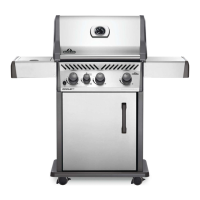
- Powder Coated Folding Side Shelves: Offer convenient workspace and include integrated tool hooks for utensils.
- Integrated Bottle Opener: Located close to the grilling action for user convenience.
- Instant JETFIRE™ Ignition: Enables quick and easy start-up of the burners.
- Heavy Gauge Stainless Steel Burners: Designed for long-lasting quality and durability.
- Large 7" Wheels: Facilitate easy navigation across various terrains.
- Propane Tank Ring: Provides stable storage for the propane tank (on propane models only).
- Direct Grilling: Ideal for searing and cooking foods quickly, such as hamburgers, steaks, chicken, or vegetables.
- Indirect Grilling: Suitable for larger cuts of meat or foods prone to flare-ups, using lower temperatures and circulating heat for slow, even cooking.
- Rotisserie Cooking (Optional): Allows for roasting meats on a rotating spit, ensuring even cooking and browning.
- Lighting Instructions: Detailed steps for lighting main burners using the integrated ignition system or a match.
- Seasoning Cast Iron Cooking Grids: A procedure to be performed prior to first use and repeated every 3-4 uses to maintain the grids and prevent rust. This involves washing, drying, applying fat/oil, and heating the grids.
Maintenance Features:
- Easy Access Drip Pan: Designed for efficient maintenance and cleaning of grease and drippings.
- Regular Cleaning: Emphasized for the grease tray, drip pan, and sear plates to prevent build-up and grease fires.
- Cooking Grid Cleaning: Stainless steel grids can be cleaned by preheating and using a wire brush. Cast iron grids require seasoning and cleaning with warm soapy water.
- Inside Grill Cleaning: Involves removing cooking grids, using a brass wire brush for loose debris, scraping sear plates with a putty knife, and brushing debris from burners.
- Porcelain Enamel Care: Advised to avoid chipping or scratching the porcelain coat on sear plates and drip pan, using plastic putty knives or scrapers for cleaning.
- Control Panel Cleaning: Use warm soapy water only; abrasive cleaners or stainless steel cleaners can rub off the printed text.
- Aluminum Castings Cleaning: Clean with warm soapy water to prevent oxidation.
- Outside Grill Surface Cleaning: Use a non-abrasive cleaner and wipe in the direction of the grain.
- Insect Screen and Burner Ports Maintenance: Instructions for cleaning burner tubes, ports, and insect screens to prevent blockages and ensure proper flame. This involves removing the burner, using a venturi tube brush, and a paper clip or port maintenance bit for ports.
- Combustion in Air Adjustment: Instructions for adjusting the air shutter to achieve optimal flame characteristics (dark blue, tipped with light blue, and occasionally yellow). This should be done by a qualified gas installer.
- Leak Test: A critical safety procedure to be performed before each use, annually, and when any gas components are replaced. It involves applying a soap and water solution to all joints and connections to check for bubbles, indicating a gas leak.
- Hose Inspection: Regular checks for rips, melting, or wear, with replacement if needed.
- Cylinder Inspection: Check for dents or rust and have it inspected by a propane supplier.
- Professional Servicing: Recommended for thorough inspection and servicing annually by a qualified service person.
- Storage and Disuse: Instructions to turn off gas, disconnect the hose, remove the propane cylinder, and store it outdoors in a well-ventilated space away from children. Propane cylinders should not be stored in buildings, garages, or sheds.

 Need help?



 To Next Page
 General