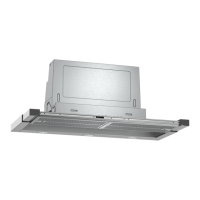
Need help?
Do you have a question about the NEFF D46PU64X0 and is the answer not in the manual?
This document provides comprehensive instructions for the installation, operation, and maintenance of a Neff extractor hood. It covers various aspects from safety information to troubleshooting and accessory details, ensuring users can effectively and safely utilize their appliance.
The extractor hood is designed for domestic use, primarily in kitchen environments, to remove cooking fumes and odors. It operates in two main modes: exhaust air mode and air recirculation mode.
In exhaust air mode, the air drawn in by the hood is cleaned by grease filters and then conveyed to the exterior through a pipe system. This mode requires proper ventilation setup, ensuring the exhaust air is not directed into non-functioning smoke or exhaust gas flues, or shafts used for heat-producing appliances, without the consent of a heating engineer. A telescopic wall box is recommended if exhaust air is conveyed through an outer wall.
In air recirculation mode, the drawn-in air is cleaned by both grease filters and an activated carbon filter before being returned to the kitchen. This mode is particularly useful when external venting is not feasible. An activated carbon filter is essential for odor binding in this mode. The document mentions that different options for operating in air recirculation mode are available, and accessories like activated carbon filters can be obtained from specialist retailers, customer service, or the online shop.
The appliance features a control panel with various symbols for different functions:
The extractor hood is designed for user-friendly operation with several intelligent features:
To switch on the fan, pull out the filter pull-out and touch the ① symbol. The fan starts at setting 2, and the speed can be adjusted using the + or - symbols. When the filter pull-out is pushed in, only fan settings 1, 2, and 3 are available. To switch off, touch the ① symbol and slide in the filter pull-out.
This setting (P) is for large build-ups of odors and fumes. Touching P activates the intensive setting (P2, with P1 also available). It automatically reduces to a lower setting after approximately six minutes. The intensive setting can be manually ended by touching P again.
By pressing - until the O symbol appears, or by sliding in the filter pull-out, the fan can be set to run on for approximately 10 minutes before automatically switching off.
Activated by touching the A symbol, this mode uses a sensor to detect cooking and roasting odors, automatically adjusting the fan speed (A1, A2, or A3) for optimum performance. It runs for a maximum of four hours or switches off when no further change in air quality is detected. The sensor sensitivity can be adjusted from 0 (lowest) to 9 (highest) by pressing and holding A for four seconds, adjusting with + or -, and confirming by holding A again.
Touching the fresh symbol activates the AirFresh function, running the fan for about five minutes per hour to maintain air freshness. It can be ended by touching the fresh symbol again.
This function (vol symbol) reduces fan noise and is available at all fan settings except the intensive setting. It remains active even after the fan is switched off and can be deactivated by touching the vol symbol again.
The lighting can be switched on and off independently using the light symbol. Pressing and holding the light symbol allows for brightness adjustment.
The appliance indicates when the metal grease filters or activated charcoal filter are saturated. An audible signal sounds for about four seconds after the fan is switched off, accompanied by symbols on the display: F== for metal grease filter and = for charcoal filter. The saturation indicator can be reset by touching the - symbol while it is flashing.
For circulating-air mode, the electronic control needs to be switched over. By touching and holding the ⓘ and A symbols simultaneously, the COL indicator lights up for the "Starter Set" circulating-air mode. Repeatedly pressing and holding this combination causes the CLA indicator to light up for the "CleanAir" circulating-air module. To switch back to ducted operation, repeat the button combination until the FIL indicator appears.
An audible signal can be switched on or off by touching and holding the ⓘ and + symbols simultaneously for approximately three seconds when the fan is switched on.
Regular cleaning and maintenance are crucial for the appliance's efficiency and longevity, as well as for safety.
The document provides a detailed table for cleaning different surfaces of the appliance:
Grease filters should be cleaned at least every two months to prevent fire risk and maintain ventilation effectiveness. Never operate the appliance without the grease filter.
To remove, open the lock, fold down the filter while supporting it with the other hand, and then take it out of the holder. Grease may accumulate, so hold the filter level to prevent dripping. To install, insert the filter, support it with the other hand, and fold it upwards to lock it in place.
For some appliance versions, the limit stop for the filter pull-out can be adjusted. Spacers are provided to align the handle strip flush with the fitted unit. Pull out the filter pull-out, shorten the spacer to the required dimension, and insert it into the specified slot.
Defective LED lights must only be replaced by the manufacturer, customer service, or a qualified technician. Avoid looking directly into switched-on LED lights for more than 100 seconds due to dazzling light (risk group 1).
 General
| Type | Chimney |
|---|---|
| Width | 60 cm |
| Number of Speeds | 3 |
| Noise Level | 62 dB |
| Lighting | LED |
| Colour | Stainless steel |
| Energy efficiency class | A |
| Filter Type | Grease filter |


 To Next Page