Need help?
Do you have a question about the NEFF D49ED22N0B and is the answer not in the manual?
Details the intended domestic use of the appliance and its limitations.
Covers crucial safety warnings and precautions for operating the appliance.
Offers solutions for common malfunctions and issues.
Safety precautions specific to the installation process of the appliance.
Risk of poisoning from back-drawn flue gases; ensure adequate fresh air.
Precautions regarding grease filter fires and flammable materials.
Precautions for defective appliances and electrical connections.
Warnings regarding burns, electric shock, injury, and cleaning agents.
Warning about flue gas poisoning when installing near heating appliances.
Ensuring sufficient air for combustion with heat-producing appliances.
Requirement for a safety switch for ventilation systems with heat-producing appliances.
Precautions for fire risks and maintaining safety distances from heat sources.
Warnings about sharp edges, secure fastening, and electrical connections.
Safety warnings for exhaust air mode, especially regarding flue gases.
Instructions and warnings for connecting the appliance to the power supply.
This document provides comprehensive instructions for the installation, operation, and maintenance of a Neff extractor hood, designed for domestic use within a household environment.
The Neff extractor hood is primarily designed to remove cooking fumes, odors, and vapors from the kitchen. It operates in two main modes: exhaust air mode and air recirculation mode.
In exhaust air mode, the air drawn into the appliance is cleaned by grease filters and then conveyed to the exterior of the building through a pipe system. This mode requires proper external venting and adherence to local building regulations, especially concerning the discharge of exhaust air. It is crucial that the exhaust air is not conveyed into a functioning smoke or exhaust gas flue, or into a shaft used to ventilate rooms with heat-producing appliances, without the consent of a heating engineer. For external wall discharge, a telescopic wall box is recommended. The appliance's optimal performance in this mode is achieved with a short, straight exhaust air pipe and the largest possible pipe diameter, ideally 150 mm, but at least 120 mm. Long, rough pipes, many bends, or smaller diameters can reduce extraction performance and increase fan noise. All pipes and hoses for the exhaust air line must be made of non-combustible material.
In air recirculation mode, the drawn-in air is cleaned by both grease filters and an activated carbon filter before being returned to the kitchen. This mode is particularly useful when external venting is not feasible. An activated carbon filter is essential for binding odors in this mode. The document suggests consulting a dealer or the Online Shop for information on required accessories, such as activated carbon filters. Unrestricted operation is possible in this mode, making it a safe option when room air-dependent heat-producing appliances are also in use.
The extractor hood features a fan with multiple speed settings, including an intensive setting for heavy fumes. The lighting can be operated independently of the ventilation system.
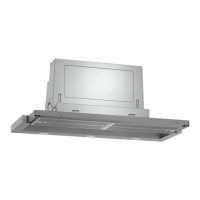
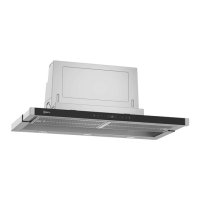
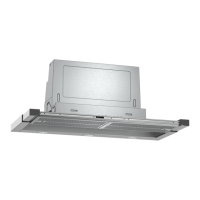
The extractor hood is designed for user-friendly operation with either a pull-out filter mechanism or a control panel with buttons.
For Control Panel Models 1 and 2, the fan is activated by pulling out the filter pull-out. The fan starts at a selected level, and fan strength can be adjusted by pressing buttons 1, 2, or 3. To switch off, the filter pull-out is slid in as far as the limit stop. When the filter pull-out is extended again, the fan resumes at the last selected speed. The lighting is controlled by a separate button.
For Control Panel Model 3, pulling out the filter pull-out and pressing the fan on/off button activates the fan at setting 2. The fan strength can then be adjusted using the '+' or '-' buttons. Pressing the fan on/off button again and sliding in the filter pull-out switches off the fan. This model also includes an intensive setting for significant odor and fume build-up. It is activated by pressing the '+' button until all LEDs light up. After approximately six minutes, the fan automatically reduces to a lower setting, though it can be manually adjusted sooner. A fan run-on time is activated when the filter pull-out is slid in while the hood is operating, with the fan automatically switching off after about 10 minutes. The lighting is controlled by a dedicated button.
To maximize effectiveness, it is recommended to switch on the extractor hood at the start of cooking and switch it off several minutes after cooking is finished. Adjusting the fan speed to the intensity of cooking fumes, using intensive mode only when necessary, and switching off the hood and lighting when not needed contribute to energy saving. Ensuring adequate air supply during cooking also helps the hood work efficiently and quietly.
Regular cleaning and maintenance are crucial for the safe and efficient operation of the extractor hood.
Cleaning the appliance surfaces: Different surfaces require specific cleaning agents and methods.
Cleaning the metal mesh grease filters: These filters are critical for trapping grease and preventing fire hazards.
Removing and installing metal mesh grease filters:
Replacing bulbs:
Troubleshooting: The manual provides a troubleshooting table for common issues like the appliance not working (due to unplugged power, power cut, or faulty fuse) or lighting not working (due to faulty bulbs). It emphasizes that incorrect repairs are dangerous and should only be carried out by trained after-sales technicians.
The document also highlights important safety information regarding suffocation risk from packaging material, fire risk from grease deposits and naked flames, burn risk from hot parts, and electric shock risk from defective appliances or improper cleaning methods. It stresses the importance of adequate fresh air supply when operating the extractor hood in exhaust air mode simultaneously with room air-dependent heat-producing appliances to prevent the backflow of toxic flue gases.
 General
| Brand | NEFF |
|---|---|
| Model | D49ED22N0B |
| Type | Chimney |
| Installation Type | Wall-mounted |
| Typology | Chimney hood |
| Extraction Rate | 650 m³/h |
| Number of Fan Speeds | 3 |
| Noise Level | 66 dB |
| Lighting | LED |
| Color | Stainless Steel |
| Voltage | 220-240 V |
| Frequency | 50/60 Hz |
| Total power of the lamps | 6 W |
| Material body | Stainless Steel |
| Energy efficiency class | A |
| Lighting efficiency class | A |
| Grease filtering efficiency class | B |
| Minimum distance from electric hob | 50 cm |
| Minimum distance from gas hob | 65 cm |
| Diameter of air outlet | 150 mm |
| No-return airflow flap | Yes |
| Type of control | Electronic |
| Maximum air output extraction | 650 m³/h |
| Sound power at max. speed (2010/30/EC) | 66 dB |
| Type of lamps used | LED |
| Number of lights | 2 |
| Color Temperature | 3000 K |
| Width | 900 mm |
| Depth | 500 mm |
| Filter Type | Grease filter |
| Product series | D Series |
| Approval certificates | CE |
| Length electrical supply cord | 130 cm |
| Grease filter material | Aluminium |
| Boost position air recirculation | Yes |
| Increase of air extraction | 650 m³/h |
| Included accessories | Grease filter |
| Optional accessories | Charcoal filter |
| Motor location | Integrated |

 To Next Page