Need help?
Do you have a question about the NEFF D76B21N1 and is the answer not in the manual?
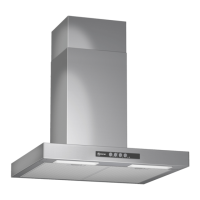
This document provides comprehensive instructions for the installation, operation, and maintenance of a Neff extractor hood, designed for domestic use in kitchen environments. The manual emphasizes safety precautions throughout, ensuring users can operate the appliance correctly and safely.
The extractor hood is primarily designed to remove cooking fumes, steam, and odors from the kitchen. It can operate in two main modes: exhaust air mode and circulating-air mode.
In exhaust air mode, the air drawn in from the kitchen is cleaned by grease filters and then conveyed to the exterior of the building through a pipe system. This mode is highly effective for completely removing cooking byproducts from the living space. For optimal performance in this mode, a short, straight exhaust air pipe with the largest possible diameter (recommended 150 mm, minimum 120 mm inner diameter for round pipes) is advised. Flat ducts should have an inner cross-section corresponding to the round pipe diameter and no sharp deflections. Proper sealing strips should be used for varying pipe diameters. It is crucial to ensure adequate fresh air in the room when operating in exhaust air mode, especially if a room air-dependent heat-producing appliance (such as a gas, oil, wood, or coal-operated heater) is also in operation. This prevents the risk of poisoning from flue gases being drawn back into the room due to a partial vacuum. The manual specifies that safe operation is only possible when the partial vacuum does not exceed 4 Pa (0.04 mbar), which can be achieved by ensuring sufficient combustion air enters through unsealable openings like doors, windows, or dedicated wall boxes. Consulting a Master Chimney Sweep is recommended to assess the house's ventilation setup and suggest appropriate measures. If the exhaust air is conveyed through an outer wall, a telescopic wall box should be used.
In circulating-air mode, the drawn-in air is cleaned by both grease filters and an activated carbon filter before being conveyed back into the kitchen. This mode is suitable for situations where external venting is not feasible. To effectively bind odors in this mode, an activated carbon filter must be installed. The manual refers to a brochure for different options for operating in circulating-air mode and notes that required accessories are available from specialist outlets, customer service, or the Online Shop. Unrestricted operation of the extractor hood is possible when it is operated exclusively in circulating-air mode, eliminating concerns about partial vacuum effects with heat-producing appliances.
The appliance features integrated lighting, which can be switched on and off independently of the ventilation system, providing illumination for the cooking area.
The extractor hood is operated via a control panel with simple, intuitive buttons.
Users are advised to switch on the extractor hood when starting to cook and switch it off several minutes after cooking is finished. This practice is highlighted as the most effective way to remove kitchen fumes.
Regular cleaning and maintenance are essential for the safe and efficient operation of the extractor hood.
Grease deposits in the grease filter can catch fire, so it is crucial to clean them at least every two months. The appliance should never be operated without the grease filter.
The manual provides instructions for replacing both halogen and filament bulbs.
Different cleaning agents are recommended for various surfaces of the appliance:
Users are explicitly warned not to use harsh or abrasive cleaning agents, cleaning agents with high alcohol concentration, hard scouring pads or sponges, high-pressure cleaners, or steam cleaners, as these can damage surfaces. New sponge cloths should be thoroughly washed before use.
The manual includes a troubleshooting table for common issues:
For any issues beyond simple troubleshooting, users are advised to contact the after-sales service. Incorrect repairs are dangerous and should only be carried out by trained technicians.
The appliance packaging should be disposed of in an environmentally responsible manner. The appliance itself is labeled in accordance with European Directive 2002/96/EU (WEEE), indicating that it should be returned and recycled appropriately at the end of its lifecycle.
The manual repeatedly stresses critical safety warnings:
Overall, the manual provides a comprehensive guide to ensure the safe, effective, and long-lasting operation of the Neff extractor hood, emphasizing user responsibility in adhering to all instructions and safety precautions.
 General
| Type | Chimney |
|---|---|
| Width | 60 cm |
| Lighting | LED |
| Number of Speeds | 3 |
| Colour | Stainless Steel |
| Lighting type | LED |
| Energy Efficiency Class | A |
| Number of Fan Speeds | 3 |
| Filter Type | Grease filter |
| Product Type | Ventilation Hood |

 To Next Page