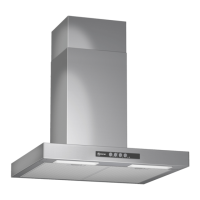
Need help?
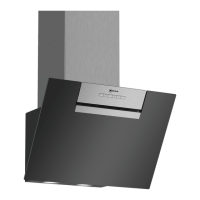
Do you have a question about the NEFF D72MT64N1 and is the answer not in the manual?
This document serves as an instruction manual for an extractor hood, providing comprehensive guidance on its operation, maintenance, and safety.
The extractor hood is designed to remove cooking fumes, odours, and steam from the kitchen environment. It can operate in two primary modes: exhaust air mode and circulating-air mode.
In exhaust air mode, the air drawn in by the hood is cleaned by grease filters and then expelled to the exterior through a pipe system. This mode requires proper ventilation to ensure adequate fresh air supply, especially when room air-dependent heat-producing appliances (e.g., gas heaters) are also in operation, to prevent the risk of poisoning from flue gases. The manual emphasizes consulting a Master Chimney Sweep to assess the house's ventilation setup for safe operation in this mode.
In circulating-air mode, the air is drawn in, cleaned by both grease filters and an activated carbon filter, and then recirculated back into the kitchen. This mode is suitable when external venting is not possible or desired. For effective odour binding in this mode, an activated carbon filter is essential.
The appliance features a fan with multiple settings, allowing users to adjust the extraction intensity based on the amount of cooking fumes. It also includes an intensive setting for periods of heavy fumes or odours, which automatically reverts to a lower setting after a set time. A fan run-on time feature allows the fan to continue operating for a short period after cooking to ensure complete removal of residual fumes before automatically switching off.
An AirFresh function is available, which activates the fan for a short duration each hour to maintain air freshness. Additionally, a noise reduction function can be engaged to minimise fan noise during operation.
The hood is equipped with lighting, which can be switched on and off independently of the ventilation system, and its brightness can be adjusted to suit user preference.
The control panel includes indicators for saturation display of both metal grease filters and activated charcoal filters, alerting users when cleaning or replacement is due. An audible signal can also be activated or deactivated for various functions.
Operating the extractor hood involves a straightforward control panel. Users are advised to switch on the hood at the start of cooking and keep it running for several minutes after finishing to maximise effectiveness in removing kitchen fumes.
To set the fan, users press the fan on/off button, and then use '+' and '-' buttons to adjust the fan speed. The fan starts at a default setting and can be increased or decreased as needed. The manual recommends adjusting the fan strength to match current conditions, using higher settings for heavy steam or fumes.
The intensive setting is activated by pressing the 'P' button, which cycles between P1 and P2 settings. This mode runs for approximately six minutes before automatically returning to a lower fan setting.
The fan run-on time is activated by pressing a dedicated button, causing the fan to run on fan level 1 for 10 minutes before switching off. The lighting, if on, remains active during this period.
The AirFresh function is engaged by pressing and holding the 'fresh' button until "fresh" appears on the display. This initiates a five-minute fan operation per hour.
The noise reduction function is activated by pressing its dedicated button and is available in all fan settings except the highest.
The lighting is controlled by a separate button, and its brightness can be adjusted by pressing and holding the button until the desired level is reached.
The manual also details how to switch over the display for circulating-air mode, including specific steps for the "Starter set for circulating-air mode" and the "CleanAir recirculation module," as well as how to switch back to exhaust air mode display.
Regular maintenance is crucial for the efficient and safe operation of the extractor hood.
The most critical maintenance task is cleaning the metal mesh grease filters. The manual strongly advises cleaning these filters at least every two months, or when the saturation indicator (FEE) flashes, to prevent grease deposits from catching fire. Cleaning can be done either in a dishwasher or by hand using a hot soapy solution and a brush. When cleaning by hand, a special grease solvent can be used for stubborn dirt. The manual provides instructions on how to remove and reinstall these filters, emphasising holding them level to prevent grease from dripping.
For circulating-air mode, the activated charcoal filter needs to be replaced when its saturation indicator (EΞΞ) flashes. The manual refers to a separate "CleanAir air recirculation module" supplement for detailed instructions on filter replacement.
The saturation displays for both grease and charcoal filters need to be reset after cleaning or replacement. This is done by pressing and holding the reset button until the indicator stops flashing.
General cleaning of the appliance surfaces is also covered, with specific recommendations for different materials:
The manual provides a list of cleaning agents to avoid, including harsh, abrasive, or high-alcohol concentration cleaners, as well as hard scouring pads, sponges, high-pressure cleaners, and steam cleaners.
LED lights are designed to be replaced only by the manufacturer, customer service, or a licensed technician.
The document also includes a troubleshooting section with a fault table, offering solutions for common issues like the appliance not working, faulty lighting, or saturated filters, before advising users to contact after-sales service for more complex problems.
 General
| Width | 600 mm |
|---|---|
| Lighting | LED |
| Type | Wall-mounted |
| Energy efficiency class | A |
| Grease filter type | Metal |
| Number of speeds | 3 |
| Filter type | Metal grease filter |


 To Next Page