Need help?
Do you have a question about the NEFF KI7863DD0G and is the answer not in the manual?
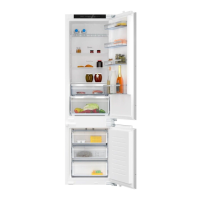
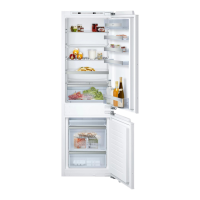
This document provides comprehensive information for the use and maintenance of a Neff fridge-freezer, model K1786...
The appliance is designed for chilling and freezing food, as well as for making ice cubes. It is intended for full integration into a kitchen, suitable for private households and domestic environments, and can operate at altitudes up to 2000 m above sea level.
The fridge-freezer features a refrigerator compartment and a freezer compartment. The refrigerator compartment allows for the storage of various foods such as meat, sausage, fish, dairy products, eggs, prepared meals, and pastries. Its temperature can be set between 2 °C and 8 °C, with lower temperatures extending food freshness. The coldest zone in the refrigerator is located between an arrow stamped on the side and the shelf underneath, ideal for highly perishable items like fish, sausages, and meat. The warmest zone is at the very top of the door, suitable for foods that do not spoil easily, such as hard cheese and butter, allowing cheese to release its aroma and butter to remain spreadable. An "OK" sticker (not included with all models) helps verify if the refrigerator compartment has reached the recommended safe temperature range of +4 °C or colder.
The freezer compartment is designed for storing frozen food, freezing fresh food, and making ice cubes. Its temperature can be set from -16 °C to -24 °C, with -18 °C or lower recommended for long-term storage. The freezer compartment utilizes a fully automatic NoFrost system, eliminating the need for manual defrosting. The freezing capacity, which indicates the quantity of food that can be frozen within a specific period, is detailed on the rating plate. To maximize the freezer compartment volume, most fittings can be removed, allowing food to be stacked efficiently.
The appliance includes basic operation functions such as switching on/off and temperature setting for both compartments. Additional functions include "Super cooling" for the refrigerator compartment, which rapidly cools it to the coldest possible temperature, and "Super freezing" for the freezer compartment, which cools it to the coldest possible temperature for freezing large quantities of fresh food. The appliance also features alarm functions: a "Door alarm" activates if a door is left open for too long, and a "Temperature alarm" warns if the freezer compartment becomes too warm.
The fridge-freezer offers several features to enhance food storage and organization:
For optimal energy saving, users are advised to keep the appliance out of direct sunlight, away from heat sources, and ensure external ventilation openings are clear. Opening the appliance briefly, avoiding obstruction of internal/external ventilation, transporting purchased food in a cool bag, allowing warm food to cool before storage, thawing frozen food in the refrigerator, and leaving space between food and the back panel are also recommended.
Regular cleaning and servicing are crucial for the appliance's long-term efficiency.
In case of a power failure, users should minimize opening the appliance, check food quality immediately, and dispose of defrosted food hotter than 5 °C. Slightly thawed food can be cooked, consumed, or refrozen after cooking. The appliance also features a self-test function to identify faults that may require customer service.
 General
| Energy Efficiency Class | A++ |
|---|---|
| Number of Shelves | 5 |
| Category | Refrigerator |
| Installation Type | Built-in |
| Freezing Capacity | 4 kg/24h |
| Climate Class | SN-T |
| Number of Door Bins | 4 |
| Defrost System | Automatic |
| Total Net Capacity | 366 liters |
| Refrigerator Net Capacity | 190 L |
| Refrigerator Capacity | 190 L |


 To Next Page