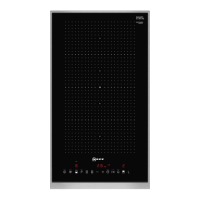
This document is a user manual for a built-in gas hob, providing comprehensive information on its safe and efficient operation, maintenance, and disposal.
Function Description
The gas hob is designed for cooking purposes in private households and domestic environments. It features gas burners that allow for precise flame height adjustment across different power levels, from 1 (lowest) to 9 (highest), and an "Off" position. Some models include a dual-wok multi-crown burner, which offers independent regulation of inner and outer flames, providing greater flexibility for various cooking needs. The appliance incorporates a safety system (thermocouple) that automatically interrupts the gas flow if a burner accidentally goes out, enhancing user safety. Ignition of the burners is automatic, requiring the user to press and turn the control knob to the highest level, which generates sparks to light the flame. In the event of a power cut, burners can be lit manually using a lighter or match.
Usage Features
The hob's control knobs are used to set the flame height, allowing users to adjust the heat intensity for different cooking tasks. For the dual-wok multi-crown burner, specific power levels (9, 4, 3, 1) correspond to different combinations of inner and outer flame settings, from full power on both to minimum power on the inner flame only.
Safety Precautions:
- Gas Safety: Users are warned about the risk of explosion from escaping gas. Instructions are provided for immediate action if a gas smell is detected, including shutting off the gas supply, extinguishing flames, avoiding electrical switches, and ventilating the room. Liquefied gas bottles must always be used in an upright position to prevent intense darting flames.
- Ventilation: Operating the gas hob generates heat, moisture, and combustion products. Adequate kitchen ventilation is crucial, especially during intensive or prolonged use, to ensure combustion products are safely fed outside.
- Fire Risk: Leaving fat or oil unattended on the hob is dangerous and can lead to fires. Users are advised never to leave hot oil or fat unattended and to extinguish fires by covering them, not with water. Flammable objects should be kept away from the cooktop.
- Burns: Accessible parts of the appliance become hot during operation, posing a burn risk. Small children should be kept away, and users should avoid heating empty cookware.
- Electric Shock: Incorrect repairs or damaged power cords are dangerous. Repairs should only be carried out by trained specialists using genuine spare parts. Users are warned not to operate a damaged appliance or use steam/high-pressure cleaners.
- Injury: Faults or damage to the appliance, or improper repairs, can cause injury. Users should not switch on a faulty appliance and should contact customer service if a control knob is too stiff or loose.
- Suffocation: Packaging materials should be kept away from children to prevent suffocation.
Cookware Usage:
- Selection: Only cookware with a suitable diameter should be used, ensuring it does not protrude over the hob's edge and flames do not touch the sides. Minimum and maximum base diameters are specified for multi-crown, high-output, and standard-output burners.
- Positioning: Cookware should be placed centrally on the burner and correctly on the pan supports. Deformed cookware is unstable and should not be used. An additional wok grid is required for cookware with a rounded base on the multi-crown burner.
- Energy Saving: Tips for saving energy include choosing a burner size appropriate for the pan, covering saucepans with lids, lifting lids infrequently, using glass lids, cooking with minimal water, and turning down power levels early.
Recommended Cooking Settings:
The manual provides a table of recommended power levels (1-9) for various cooking tasks, from bringing water to a boil and high-temperature frying to simmering, defrosting, and keeping food warm. These settings are general guidelines, as actual cooking times and power levels may vary based on food type, weight, gas type, and cookware material.
Maintenance Features
Regular cleaning and servicing are essential to maintain the appliance's efficiency and longevity.
Cleaning Products:
- Users are advised to obtain suitable cleaning products from after-sales service or online shops.
- Warnings: Harsh or abrasive detergents, steel wool, knives, or sharp objects should not be used, as they can damage the appliance surfaces or connections. Steam-cleaning appliances are also prohibited.
Cleaning the Appliance:
- The appliance should be allowed to cool down before cleaning.
- It should be cleaned with a sponge and soapy water, then dried with a soft cloth.
- Important: Control knobs should not be removed during cleaning to prevent humidity from damaging the appliance's interior.
- Spilled liquids should be removed immediately to prevent food remnants from sticking.
Cleaning the Burners:
- Burner parts should be cleaned after each use to prevent food from burning on.
- Warning: Burner parts should not be cleaned in a dishwasher, as this can cause damage.
- After cooling, burners should be cleaned with a non-metallic brush and soapy water, then completely dried to prevent enamel damage.
- Burner parts, including caps, must be correctly inserted after cleaning to ensure a correct flame. Ignition plugs should be cleaned regularly with a small, non-metallic brush, taking care to avoid heavy knocks.
Cleaning the Pan Supports:
- Pan supports should be allowed to cool down before cleaning.
- They can be cleaned with a non-metallic brush and soapy water.
- Alternatively, pan supports can be cleaned in a dishwasher using recommended cleaning agents, with pre-cleaning for heavy soiling.
- The area around the rubber pads on the pan supports should be cleaned carefully, as loose pads can scratch the hob.
- Pan supports must be correctly inserted after cleaning.
Troubleshooting:
The manual includes a troubleshooting section to help users identify and rectify minor faults, such as impaired electrical operation, automatic ignition not working, uneven burner flame, or issues with gas flow. It provides causes and corresponding solutions, emphasizing that repairs should only be performed by trained specialists.

 Need help?
 General

 To Next Page