56 Link Layer Discovery Protocol
Link Layer Discovery Protocol
Feature overview The IEEE 802.1AB standard defines the Link Layer Discovery Protocol (LLDP).
LLDP enables stations residing on an 802 LAN to advertise major capabilities
and physical descriptions, and allows a network management system (NMS) to
access and display this information. You can view the information to identify the
system topology and detect bad configurations on the LAN.
The standard is designed to be extensible, providing for the optional exchange of
organizational-specific information and data related to other IEEE standards.
This implementation supports the required basic management set of type-length
values (TLVs). LLDP is a superset of the Physical Topology MIB (PTOPO)
defined in RFC 2922; therefore, support of the basic management set implies
functional support for PTOPO.
As a one-way protocol, LLDP has no request/response sequences. Information is
advertised by stations that implement the transmit function, and is received and
processed by stations that implement the receive function.
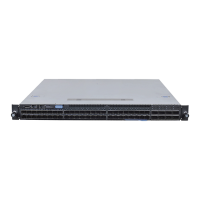
The CN1610 switch supports both the transmit and receive functions to support
device discovery. Devices are not required to implement both functions; you can
enable or disable each function separately on a per-port basis.
Supported TLVs The following TLVs are supported:
◆ Chassis ID
◆ Port ID
◆ Time to live
◆ Port Description
◆ System name
◆ System Description
◆ System Capability
◆ Management Address
LLDP transmit The transmit function is configurable with respect to packet construction and
timing parameters. The required Chassis ID, Port ID, and Time to Live (TTL)
TLVs are always included in the LLDPDU (Link Layer Discovery Protocol Data



 To Next Page