Need help?
Do you have a question about the New Holland 130 and is the answer not in the manual?
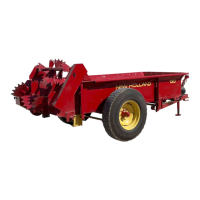
The New Holland Box Spreader is a robust agricultural implement designed for efficient and effective material spreading. It is engineered to handle various types of materials, making it a versatile tool for farm operations. The spreader is available in several models, each tailored to different capacity requirements, ensuring that users can select the appropriate size for their specific needs.
The primary function of the New Holland Box Spreader is to distribute materials evenly across a designated area. This is achieved through a well-designed spreading mechanism that ensures consistent coverage. The spreader is built with durable components to withstand the rigors of agricultural use, providing reliable performance over extended periods. Its construction emphasizes strength and longevity, making it a valuable asset for demanding tasks.
One of the key usage features of this spreader is its adaptability to different terrain conditions. Whether operating on level ground or gently rolling land, the spreader is designed to maintain stability and effective material distribution. For more challenging environments, such as hilly terrain or situations requiring high-speed road travel, specific recommendations are provided to ensure safe and optimal operation. This includes guidelines regarding the tractor's weight relative to the spreader's gross weight, highlighting the importance of proper equipment matching for safety and performance.
The spreader's design incorporates various dimensions that contribute to its functionality and ease of use. These include the inside width and length of the bed, which dictate the volume of material it can hold, and the overall width and length, which are important for maneuverability and transport. The loading height is also a critical dimension, influencing the ease with which materials can be loaded into the spreader. The height to the top of the upper beater is another design consideration that impacts the spreading process.
The PTO (Power Take-Off) speeds are a crucial aspect of the spreader's operation, indicating the rotational speed at which power is transferred from the tractor to the spreader's internal mechanisms. The ability to operate at different PTO speeds allows for flexibility in matching the spreader's performance to the specific material being spread and the desired distribution rate. Some models offer the convenience of easily converting between different PTO speeds, enhancing their versatility.
The apron chain system is integral to the material delivery within the spreader. It moves the material towards the beaters for distribution. The availability of different apron chain types, such as T-Rod and Pintle, provides options for users to select the most suitable system based on the type of material they are handling and their operational preferences. Some models offer standard configurations for these chains, while others provide options for customization.
The number of apron speeds, both mechanical and hydraulic, further contributes to the spreader's operational flexibility. These speeds control the rate at which material is fed to the beaters, allowing operators to adjust the spread pattern and density. For certain models, a slow-speed option is available, which can be beneficial for specific spreading applications requiring a more controlled or finer distribution.
The beater paddles are a core component of the spreading mechanism, responsible for breaking up and distributing the material. The number of beater paddles can vary across models, influencing the effectiveness and consistency of the spread. A higher number of paddles generally contributes to a more thorough and even distribution of materials, especially for denser or more challenging substances.
Maintenance features, while not explicitly detailed in terms of specific tasks, are implicitly supported by the design and the availability of an Operator's Manual. The emphasis on understanding the equipment and reading the manual before use suggests that proper maintenance procedures are outlined to ensure the longevity and safe operation of the spreader. The warning about operating machinery without shields and protective devices underscores the importance of maintaining the equipment in its intended operational state.
The overall design of the New Holland Box Spreader reflects a commitment to user safety and operational efficiency. The inclusion of various models with differing capacities and features allows farmers to choose a spreader that precisely meets their agricultural needs. The attention to detail in dimensions, power requirements, and material handling mechanisms ensures that the spreader performs reliably and effectively in a wide range of farming scenarios. The availability of support resources, such as a website and a toll-free number, further enhances the user experience by providing access to information and assistance.
 General
| Type | Spreader |
|---|---|
| Capacity | 130 cu ft |
| Hopper Capacity | 130 cu ft |
| Power Take Off (PTO) Speed | 540 RPM |
| Drive System | PTO-driven |